
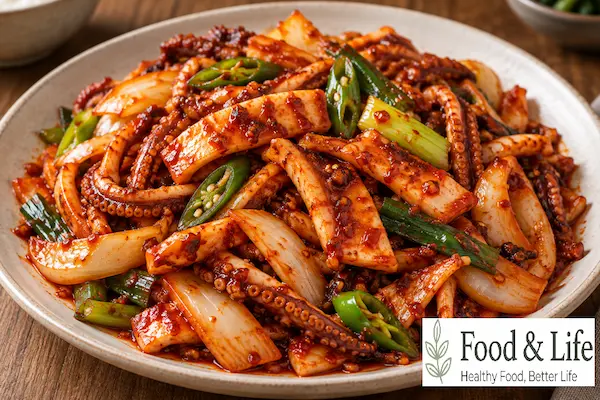
The key to making Ojingeo Bokkeum (Korean spicy stir-fried squid) with a tender, pleasantly chewy texture and without too much liquid is to dry the squid thoroughly, season it for 10 minutes, stir-fry the vegetables first, and finish everything quickly over high heat.
Clean 2 whole squid with sea salt and flour, dry them well, then season with 1 tablespoon anchovy fish sauce and 1 tablespoon maesil syrup for 10 minutes. Prepare the sauce with 6 tablespoons gochugaru, 2 tablespoons gochujang, 2 tablespoons soy sauce, 3 tablespoons corn syrup, and the remaining seasonings, then briefly simmer it over low heat. Stir-fry the onion, green onions, and Cheongyang peppers first in vegetable oil and chili oil. Finally, add the seasoned squid and sauce and stir-fry over high heat for about 5 minutes. This keeps the squid springy and tender while coating it evenly in a spicy-sweet sauce.
⏱️ Cooking Time: About 20 minutes
🍳 Difficulty: ★★☆☆☆
✓ Ingredients
🥣 Main Ingredients
- 2 whole squid
- 1 onion
- 2 green onions
- 3–5 Cheongyang peppers
🧂 Seasonings & Sauce
- 1 tablespoon sea salt (for cleaning the squid)
- 3 tablespoons flour (for cleaning the squid)
- 1 tablespoon anchovy fish sauce (for seasoning the squid)
- 1 tablespoon maesil syrup (Korean green plum syrup, for seasoning the squid)
- 2 tablespoons vegetable oil (1 tablespoon for the sauce + 1 tablespoon for stir-frying the vegetables)
- 6 tablespoons gochugaru (Korean red pepper flakes)
- 2 tablespoons gochujang (Korean red pepper paste)
- 2 tablespoons soy sauce
- 3 tablespoons corn syrup
- 1 tablespoon sugar
- 2 tablespoons minced garlic
- 1 tablespoon ground ginger
- 2 tablespoons cooking wine
- 2 tablespoons chili oil
- 1 tablespoon sesame oil
(Measurement guide: 1 tablespoon = 15 ml, 1 teaspoon = 5 ml, 1 Korean paper cup = 180 ml)
✓ How to Make Ojingeo Bokkeum
- Clean the squid: Use kitchen scissors to cut off the 2 long feeding tentacles from each of the 2 squid. Place the squid in a bowl with 1 tablespoon sea salt and 3 tablespoons flour. Rub thoroughly with both hands to remove debris from the suckers and surface, then rinse well under running water 2–3 times.
- Cut and season the squid: Pat the cleaned squid completely dry with paper towels. Cut the bodies and tentacles into bite-size pieces, place them in a bowl, and add 1 tablespoon anchovy fish sauce and 1 tablespoon maesil syrup. Gently mix and let sit for 10 minutes.
- Prepare the vegetables: Cut 1 onion into large, thick pieces. Slice 2 green onions and 3–5 Cheongyang peppers diagonally into bite-size pieces.
- Cook the sauce: In a separate pan, add 1 tablespoon vegetable oil, 6 tablespoons gochugaru, 2 tablespoons gochujang, 2 tablespoons soy sauce, 3 tablespoons corn syrup, 1 tablespoon sugar, 2 tablespoons minced garlic, 1 tablespoon ground ginger, and 2 tablespoons cooking wine. Heat gently over low heat until the sauce briefly comes to a simmer.
- Stir-fry the vegetables first: Heat 1 tablespoon vegetable oil and 2 tablespoons chili oil in a large skillet or wok. Add the onion, green onions, and Cheongyang peppers. Stir-fry until the vegetables are about halfway softened.
- Add the squid and sauce and cook over high heat: Once the vegetables are partially cooked, add the seasoned squid and all of the prepared sauce. Stir-fry quickly over high heat for about 5 minutes, stirring continuously with a spatula. Turn off the heat, drizzle with 1 tablespoon sesame oil, and toss well to finish.
✓ Tips for Success
- Dry and season the squid before cooking: If the squid is still wet after washing or is stir-fried immediately without being seasoned first, it can release a large amount of liquid during cooking. Pat the squid thoroughly dry, then season it with anchovy fish sauce and maesil syrup for 10 minutes before stir-frying to help keep the texture firm and reduce excess liquid in the pan.
- Cook the vegetables first and finish quickly over high heat: If the squid and vegetables are cooked together from the beginning for too long, the squid can become tough and the vegetables can release a lot of water. Stir-fry the vegetables first in vegetable oil and chili oil, then add the squid and prepared sauce and cook quickly over high heat for about 5 minutes to keep the vegetables crisp and the squid tender and springy.
✓ Serving Tips
- Spoon freshly cooked Ojingeo Bokkeum generously over warm rice and top with a fried egg with a soft yolk for an easy spicy squid rice bowl.
- Cook somyeon (thin Korean wheat noodles) or udon noodles, rinse them under cold water, and toss them with the remaining sauce. The spicy-sweet sauce coats the noodles well.
- Place a piece of spicy squid and some crisp onion on a kkaennip (Korean perilla leaf) or ssammu (thin pickled radish wrap). Add a small amount of mayonnaise before wrapping it up to mellow the heat.
✓ How to Choose Fresh Squid
- Skin color: Choose squid with a vivid reddish-brown or chocolate-colored tone still visible on the body.
- Firmness and shine: The surface should have a clear natural sheen, and the flesh should spring back when gently pressed with a finger.
- Condition of the suckers: Squid with the suckers still firmly attached to the tentacles is a better choice.
✓ Squid Nutrition per 100 g
| Nutrition per 100 g | Amount |
|---|---|
| Calories | 94.00 kcal |
| Carbohydrates | 0.16 g |
| Protein | 18.84 g |
| Fat | 1.44 g |
| Sodium | 199.00 mg |
Values are based on 100 g of raw squid. Actual nutritional values may vary depending on the variety, cut, product, and cooking method.
Source: Korean Ministry of Food and Drug Safety Food Nutrition Database
✓ Frequently Asked Questions (FAQ)
Q1. Why season the squid with anchovy fish sauce and maesil syrup for 10 minutes before stir-frying?
This allows the seasoning to penetrate the squid before cooking and helps the flesh stay firmer. Combined with thoroughly drying the squid first, it also helps reduce the amount of liquid released during stir-frying.
Q2. Why does Ojingeo Bokkeum sometimes become watery?
This usually happens when the squid is not dried thoroughly after washing or when the squid and vegetables are cooked too long over low heat. Pat the squid completely dry, stir-fry the vegetables first, then add the squid and cook it quickly over high heat for about 5 minutes.
Q3. Can I use minced fresh ginger instead of ground ginger in the sauce?
Yes. You can substitute the same amount of minced fresh ginger for the ground ginger. If you do not like the texture of ginger pieces in the sauce, you can use about 1 teaspoon of ginger juice instead.
After thoroughly drying the squid, seasoning it with anchovy fish sauce and maesil syrup, and stir-frying it quickly over high heat, the finished dish does not collect too much liquid on the plate and the squid keeps its springy, pleasantly chewy texture. The sauce made with gochugaru and gochujang, along with ground ginger and chili oil, coats the squid and vegetables with a spicy, slightly sweet flavor.
My family also liked that the squid was not tough and that the seasoning paired well with warm rice. Any remaining sauce is also great with somyeon or udon noodles, or you can serve a generous portion over rice for an easy Ojingeo Bokkeum rice bowl.
If your Ojingeo Bokkeum usually turns watery or the squid becomes tough, try drying the squid thoroughly after cleaning, stir-frying the vegetables first, and then cooking the squid briefly over high heat. This method helps the sauce cling well while keeping the squid tender and chewy.
If you found this recipe helpful, save it to your bookmarks and share it so you can easily find it again later.
I’ll continue sharing easy-to-follow recipes and practical cooking tips. 😊
If there’s a dish you’d like to see featured in a future recipe, feel free to leave a comment. 😊
※ This recipe was prepared with reference to a recipe introduced on the YouTube channel “요리왕비룡 셰프TV,” then written based on the cooking process and the results after making it.