
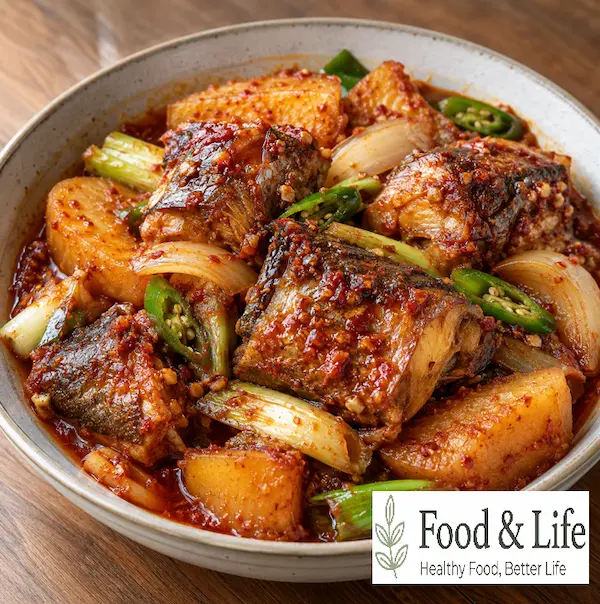
The key to making Kodari Jorim (Korean braised semi-dried pollock) without the fish falling apart is to thoroughly dry the cleaned pollock, then lightly pan-sear both sides in oil to firm up the surface before braising.
Clean 4 semi-dried pollock with water mixed with 1 tbsp vinegar and 1 tbsp coarse salt, then remove the black membrane and any blood clots from inside the cavity to reduce fishy odors and bitterness. Simmer Korean radish with kombu to make a flavorful broth, then season it with 2 tbsp soy sauce and 2 tbsp gochugaru before braising the radish first.
The fish is then simmered with a spicy-sweet sauce made with 6 tbsp gochugaru, 4 tbsp soy sauce, 4 tbsp corn syrup, maesil extract, cooking wine, and other seasonings until the liquid reduces. This method helps the sauce penetrate deeply while keeping the fish intact, giving you pleasantly chewy pollock with tender, well-seasoned radish.
⏱️ Cooking Time: About 40 minutes
🍳 Difficulty: ★★★☆☆
✓ Ingredients (For 4 Semi-Dried Pollock)
🥣 Main Ingredients
- 4 semi-dried pollock (kodari)
- 1 piece Korean radish, white portion (6–7 cm / 2.4–2.8 in)
- 1/2 onion
- 1 green onion
- 5 chili peppers
🧂 Sauce & Seasonings
- 1 tbsp vinegar, for cleaning the pollock
- 1 tbsp coarse salt, for cleaning the pollock
- 1 sheet kombu, for simmering the radish
- 2 tbsp soy sauce, for simmering the radish
- 2 tbsp gochugaru (Korean red pepper flakes), for simmering the radish
- 1 tbsp minced garlic
- 2 tbsp maesil extract (Korean green plum extract)
- 2 tbsp cooking wine
- 4 tbsp corn syrup
- 6 tbsp gochugaru (Korean red pepper flakes)
- 1/2 tbsp minced ginger
- 4 tbsp soy sauce
- 1 tbsp sesame oil
- A little black pepper
- 5 tbsp cooking oil (Measurement guide: 1 tbsp = 15 ml, 1 tsp = 5 ml, 1 Korean paper cup = 180 ml / 6.1 fl oz)
✓ How to Make Kodari Jorim
- Clean and prepare the pollock: Trim the fins and tails from 4 semi-dried pollock with kitchen scissors. Scrape away the black membrane inside the cavity, then wash the fish in water mixed with 1 tbsp vinegar and 1 tbsp coarse salt. Rinse once more under running water, place in a colander, and drain thoroughly.
- Simmer the radish and make the broth: Cut a 6–7 cm (2.4–2.8 in) piece of the white portion of Korean radish into 4 thick pieces and place them in a pot. Add 1 L (33.8 fl oz) water and 1 sheet kombu. Bring to a boil, then simmer for 5 minutes from the point it begins boiling. Remove the kombu, add 2 tbsp soy sauce and 2 tbsp gochugaru, and gently simmer over low heat until the radish is partially tender but still slightly firm.
- Make the braising sauce: In a bowl, combine 1 tbsp minced garlic, 2 tbsp maesil extract, 2 tbsp cooking wine, 4 tbsp corn syrup, 6 tbsp gochugaru, 1/2 tbsp minced ginger, 4 tbsp soy sauce, 1 tbsp sesame oil, and a little black pepper. Mix well.
- Lightly sear the pollock: Add 5 tbsp cooking oil to a pot. Place the drained semi-dried pollock in the pot and lightly sear both sides to firm up the surface so the flesh is less likely to fall apart during braising.
- Add the sauce and radish, then braise: Pour the prepared sauce over the seared pollock. Add the cooked radish and 1 Korean paper cup (180 ml / 6.1 fl oz) of the reserved broth. Bring to a boil over high heat, then reduce to medium heat and simmer until the liquid reduces to a shallow layer.
- Add the vegetables and finish: When the braising liquid has reduced by about half, add 1/2 onion cut into thick strips, 1 green onion sliced diagonally, and 5 chili peppers sliced diagonally. Continue simmering until the vegetables are cooked and the sauce has soaked evenly into the fish.
✓ Key Tips for Success
- Drain well and sear the pollock first: If excess water remains on the fish after washing, the oil can splatter and the flesh may break apart more easily. Drain the pollock thoroughly, then lightly sear both sides in oil. Firming the exterior first helps the fish hold its shape while simmering in the sauce.
- Remove the black membrane completely: The dark membrane inside the belly and any coagulated blood around the bones can contribute to bitterness and fishy odors after cooking. Scrape them away thoroughly during preparation, then rinse the fish in vinegar-and-salt water before draining well.
✓ Serving Tips
- Place a large piece of chewy, tender kodari and a piece of radish soaked with sauce over freshly cooked rice. Spoon a little braising liquid over the top and mix it with the rice for a deeply savory meal.
- Wrap rice, a piece of pollock, and one of the braised chili peppers in crisp, unseasoned roasted gim (Korean dried seaweed). The spicy-sweet sauce pairs especially well with the savory flavor of the seaweed.
- If you have plenty of braising sauce left, serve it with briefly blanched soybean sprouts and lightly toss them in the sauce for another flavorful Korean side dish.
✓ How to Choose Good Kodari
- Firm texture and drying level: Choose fish that is not completely dried out or hard on the surface. The flesh should feel thick and slightly firm with the characteristic dense, semi-dried texture.
- Color and appearance: Look for skin with a natural sheen and a clear yellowish-brown or silvery-white color. Avoid fish with dark discoloration or visible signs of mold on the flesh.
- Aroma: Avoid kodari with a rancid, musty, or overly strong fishy smell. Good semi-dried pollock should have a mild, savory dried-fish aroma.
✓ Kodari Nutrition per 100 g (3.5 oz)
| Nutrient | Amount per 100 g (3.5 oz) |
|---|---|
| Calories | 290.00 kcal |
| Carbohydrates | 0.00 g |
| Protein | 61.70 g |
| Fat | 3.10 g |
| Sodium | – |
Values are based on 100 g (3.5 oz) of semi-dried pollock (kodari). Actual nutrition may vary depending on the variety, cut, product, and preparation method.
Source: Ministry of Food and Drug Safety Food Nutrition Database
✓ Frequently Asked Questions (FAQ)
Q1. Why should I lightly sear kodari before braising it?
Lightly searing the surface helps prevent the pollock flesh from falling apart during the long braising process. Firming the exterior first allows the fish to hold its shape even after the sauce and broth are added.
Q2. Why does braised kodari sometimes taste bitter or smell fishy?
One common cause is leaving the black membrane or coagulated blood inside the fish cavity. Scrape away the membrane thoroughly, rinse the fish in water mixed with vinegar and salt, and drain it well before cooking to reduce unwanted odors and bitterness.
Q3. Can I replace the maesil extract with sugar or oligosaccharide syrup?
Yes, you can substitute it, but maesil extract adds a mild acidity and savory depth while helping balance the fishy aroma. If using sugar or oligosaccharide syrup instead, adjust the amount slightly so the sauce does not become overly sweet.
Lightly searing the kodari in cooking oil before braising helps the flesh stay intact while giving the outside a pleasantly chewy texture and keeping the inside moist. The spicy-sweet sauce made with maesil extract, cooking wine, ginger, and gochugaru blends with the kombu-and-radish broth, allowing both the fish and radish to absorb plenty of savory flavor.
The clean flavor of the fish pairs especially well with warm rice, and the soft radish soaks up the spicy sauce as it cooks. Enjoying the tender radish together with the pollock gives you both the chewy texture of the fish and the soft texture of the braised radish in every bite.
If your Kodari Jorim tends to fall apart or retain a fishy smell, thoroughly remove the black membrane from inside the fish, drain it well, and lightly sear it before adding the braising sauce. This simple sequence helps preserve the shape of the fish while allowing the seasoning to penetrate deeply.
Save or bookmark this Kodari Jorim recipe so you can easily find it later, and share it with someone who enjoys Korean food.
I’ll continue sharing approachable recipes and practical cooking tips that are easy to follow at home. 😊
If there’s a dish you’re curious about or a recipe you’d like to see next, feel free to leave a comment. 😊
※ This recipe was inspired by a recipe featured on the YouTube channel ‘요리왕비룡 셰프TV’. I prepared the dish myself and wrote this post based on the cooking process and results.