
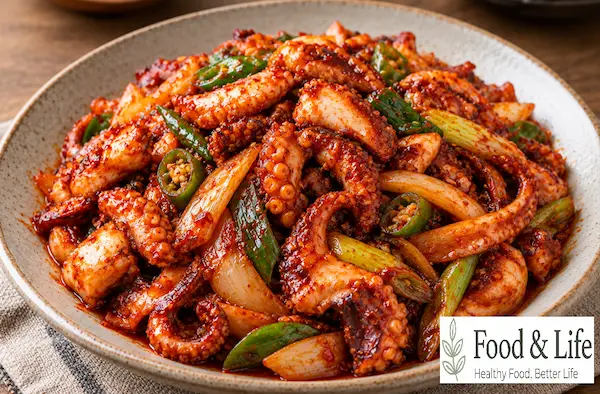
The key to making Nakji Bokkeum (Korean spicy stir-fried octopus) without excess liquid while keeping the octopus tender and chewy is to pre-cook it for 1 minute with 1 tbsp water and 1 tbsp Mirim, then quickly stir-fry it over high heat with a sauce that has been cooked separately.
Start by thoroughly cleaning 4 frozen small octopuses, then pre-cook them for just 1 minute to release excess moisture. The spicy-sweet sauce is made with 6 tbsp gochugaru, 2 tbsp gochujang, 2 tbsp soy sauce, 3 tbsp starch syrup, and other seasonings, then brought to a boil separately before stir-frying.
First stir-fry the onion, green onion, and Cheongyang chili peppers in chili oil. Add the octopus and prepared sauce, then cook quickly over high heat for 3 minutes. This helps prevent the sauce from becoming watery while keeping the octopus pleasantly firm and chewy. In about 20 minutes, you can make a bold, spicy-sweet Nakji Bokkeum that works well as a main side dish or served over rice.
⏱️ Cooking Time: About 20 minutes
🍳 Difficulty: ★★☆☆☆
✓ Ingredients
🥣 Main Ingredients
- 4 frozen small octopuses (nakji)
- 1 onion
- 1 large green onion
- 3–5 Cheongyang chili peppers
🧂 Sauce & Seasonings
- 5 tbsp all-purpose flour, for cleaning the octopus
- 1 tbsp coarse salt, for cleaning the octopus
- 1 tbsp water, for pre-cooking the octopus
- 1 tbsp Mirim (Korean cooking wine), for pre-cooking the octopus
- 1 tbsp cooking oil
- 6 tbsp gochugaru (Korean red pepper flakes)
- 2 tbsp gochujang (Korean red chili paste)
- 2 tbsp soy sauce
- 1 tbsp maesil extract (Korean green plum syrup)
- 3 tbsp starch syrup
- 1 tbsp sugar
- 2 tbsp minced garlic
- 1 tbsp ground ginger
- 2 tbsp cooking wine
- 2 tbsp chili oil, for stir-frying the vegetables
- 1 tbsp cooking oil, for stir-frying the vegetables
- 1 tbsp sesame oil
(Measurement guide: 1 tbsp = 15 ml (0.5 fl oz), 1 tsp = 5 ml, 1 Korean paper cup = 180 ml (6.1 fl oz))
✓ How to Make Nakji Bokkeum
- Thaw and clean the octopus: Place 4 frozen small octopuses in cold water and thaw completely. Add 5 tbsp flour and 1 tbsp coarse salt, then rub the octopus firmly by hand, paying particular attention to the suction cups, to remove debris and the slippery coating. Rinse thoroughly, then remove the internal organs, eyes, and beak.
- Pre-cook the octopus: Place the cleaned octopus in a pot with 1 tbsp water and 1 tbsp Mirim. Cover with a lid and, once the liquid begins to boil, cook for only 1 minute.
- Cut the octopus and vegetables: Transfer the lightly cooked octopus to a colander and let it cool briefly. Cut it into large, bite-size pieces. Slice 1 onion into thick strips, then slice 1 large green onion and 3–5 Cheongyang chili peppers diagonally.
- Cook the spicy sauce: Add 1 tbsp cooking oil, 6 tbsp gochugaru, 2 tbsp gochujang, 2 tbsp soy sauce, 1 tbsp maesil extract, 3 tbsp starch syrup, 1 tbsp sugar, 2 tbsp minced garlic, 1 tbsp ground ginger, and 2 tbsp cooking wine to a skillet. Turn on the heat and stir continuously until the sauce is evenly combined and bubbling.
- Stir-fry the vegetables: Heat 2 tbsp chili oil and 1 tbsp cooking oil in a separate skillet or wok. Add the sliced onion, green onion, and Cheongyang chili peppers, then stir-fry quickly over high heat until the vegetables are about halfway softened.
- Add the octopus and sauce: Once the vegetables are partially cooked, add the prepared sauce and sliced octopus at the same time. Keep the heat high and stir-fry quickly for 3 minutes. Turn off the heat, drizzle with 1 tbsp sesame oil, and toss well to finish.
✓ Key Tips for Success
- Pre-cook the octopus for just 1 minute: If raw octopus is stir-fried directly with the vegetables, a large amount of moisture can be released, leaving the pan watery and diluting the sauce. Covering the octopus with just 1 tbsp water and 1 tbsp Mirim and steaming it briefly for 1 minute helps release excess moisture before stir-frying, allowing the sauce to cling more closely to the octopus while preserving its texture.
- Cook the sauce first, then stir-fry over high heat for 3 minutes: Cooking a gochugaru-based sauce together with the octopus for too long can cause the seasoning to burn or retain a raw chili flavor. Bringing the sauce to a boil separately first helps cook and hydrate the gochugaru. Once the octopus and sauce are added, stir-fry them over high heat for no more than 3 minutes to keep the octopus tender, springy, and chewy.
✓ Serving Tips
- Cook somyeon (thin Korean wheat noodles) in boiling water until pleasantly chewy, rinse them under cold water, and serve alongside the Nakji Bokkeum. Toss the noodles with the remaining spicy sauce for a flavorful combination.
- For a rice bowl, top warm rice with blanched bean sprouts and crushed roasted seaweed, then add the Nakji Bokkeum and a little sesame oil. Mix everything together before eating.
- Serve a small dish of mayonnaise on the side if you want to soften the heat while adding a richer, creamier flavor.
✓ How to Choose Good Octopus
- Color and natural sheen: Choose octopus with an even, clear dark brown or grayish color across the body and tentacles, with a naturally moist sheen on the surface.
- Suction cups: Fresh octopus should have round, well-defined suction cups along the underside of the tentacles. They should not appear damaged or mushy and should feel firm.
- Firmness of the flesh: When gently held, the body and tentacles should feel firm and springy rather than limp or overly soft.
✓ Octopus Nutrition per 100 g (3.5 oz)
| Nutrient | Amount per 100 g (3.5 oz) |
|---|---|
| Calories | 73.00 kcal |
| Carbohydrates | 0.00 g |
| Protein | 16.30 g |
| Fat | 0.43 g |
| Sodium | 479.00 mg |
Based on 100 g (3.5 oz) of raw octopus. Actual nutrition values may vary depending on the variety, part used, product, and cooking method.
Source: Ministry of Food and Drug Safety Food Nutrition Database – Raw Food Ingredients
✓ Frequently Asked Questions (FAQ)
Q1. Why do you pre-cook the octopus with 1 tbsp water and 1 tbsp Mirim before stir-frying?
Briefly pre-cooking the octopus helps release excess moisture before it goes into the stir-fry, reducing the amount of liquid that collects in the pan. The Mirim also helps reduce the strong seafood aroma.
Q2. Why does Nakji Bokkeum sometimes become watery?
Octopus and vegetables naturally contain a lot of moisture. Stir-frying them slowly over low heat or adding the octopus raw can cause more liquid to be released, which thins out the spicy sauce.
Q3. What is the best way to thaw frozen octopus?
Thaw the frozen octopus gradually in cold water. This method helps preserve its texture and moisture so it stays pleasantly firm and chewy after stir-frying.
Pre-cooking the octopus for 1 minute with water and Mirim before quickly stir-frying it over high heat kept excess liquid from pooling on the plate. The spicy sauce stayed concentrated and coated the octopus well, while the octopus remained springy and chewy instead of becoming tough.
My family also liked how the heat from the gochujang and gochugaru was intensified by the Cheongyang chili peppers and chili oil. It pairs especially well with warm rice, and the remaining sauce is also delicious tossed with somyeon. You can also turn it into a Nakji Bokkeum rice bowl with rice, bean sprouts, and roasted seaweed.
If your Nakji Bokkeum usually turns watery or the octopus becomes tough, try pre-cooking the octopus for 1 minute, cooking the sauce separately, and then stir-frying everything together over high heat for just 3 minutes. This method helps keep the sauce bold and concentrated while preserving the octopus’s chewy texture.
Save or bookmark this recipe for later, and share it with someone who enjoys Korean food.
I’ll continue sharing practical recipes and useful cooking tips that are easy to follow at home. 😊
If there’s a dish you’re curious about or a recipe you’d like to see next, feel free to leave a comment. 😊
※ This recipe was adapted from a recipe featured on the YouTube channel “요리왕비룡 셰프TV.” I prepared the dish myself and wrote this post based on the cooking process and results.