
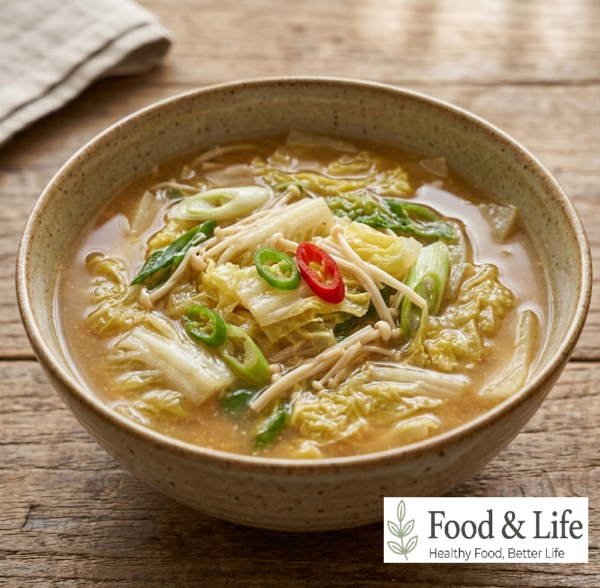
The key to making a flavorful Korean napa cabbage doenjang soup (Baechu Doenjang Guk) is to first build a deep broth with dried anchovies and kelp, then dissolve the doenjang smoothly before adding the cabbage. This gives the soup a clean, savory base while allowing the natural sweetness of the cabbage to come through.
Simmer 40 g (1.4 oz) dried anchovies and 10 g (0.35 oz) kelp in 2.5 L (about 10.6 cups) of water for 15 minutes. Stir in 3 tbsp doenjang, then add 600 g (21.2 oz) baby napa cabbage and cook until tender. Korean soup soy sauce and anchovy fish sauce add seasoning and umami, while enoki mushrooms, green onion, and Cheongyang chili added at the end keep the soup light, savory, and pleasantly spicy.
With tender napa cabbage and a rich anchovy broth, this comforting Korean soup is especially good with steamed rice for breakfast or as part of a warm home-style meal.
⏱️ Cooking Time: About 25 minutes
🍳 Difficulty: ★★☆☆☆
✓ Ingredients
🥣 Main Ingredients
- 1 baby napa cabbage, 600 g (21.2 oz)
- 2.5 L (about 10.6 cups) water
- 1 handful dried anchovies, 40 g (1.4 oz)
- 10 g (0.35 oz) dried kelp
- 150 g (5.3 oz) enoki mushrooms
- 1/2 stalk green onion
- 1 Cheongyang chili pepper
- 1 red chili pepper, optional
🧂 Seasonings & Sauces
- 3 tbsp doenjang (Korean fermented soybean paste)
- 2 tbsp Korean soup soy sauce
- 2 tbsp anchovy fish sauce
- 1 tbsp minced garlic
(Measurement guide: 1 tbsp = 15 ml, 1 tsp = 5 ml, 1 Korean paper cup = 180 ml / 6.1 fl oz)
✓ How to Make Korean Napa Cabbage Doenjang Soup
- Make the broth: Pour 2.5 L (about 10.6 cups) water into a pot and add 1 handful dried anchovies (40 g / 1.4 oz) and 10 g (0.35 oz) dried kelp. Bring to a boil over high heat. As soon as it boils, remove the kelp, reduce to medium heat, and simmer the anchovies for 15 minutes. Strain out all the solids.
- Dissolve the doenjang: Place 3 tbsp doenjang in a fine-mesh strainer over the broth and press it through with a spoon until it is fully dissolved without large soybean pieces.
- Season the broth: Add 2 tbsp Korean soup soy sauce, 2 tbsp anchovy fish sauce, and 1 tbsp minced garlic. Stir well.
- Add the cabbage: Cut the baby napa cabbage in half, then into bite-size pieces. Add all 600 g (21.2 oz) to the broth and increase the heat to high. Once the soup returns to a boil, reduce to medium heat and cook for about 2 minutes, until the cabbage begins to soften.
- Add the remaining ingredients: Trim the base from 150 g (5.3 oz) enoki mushrooms and separate the strands. Add them along with 1/2 stalk diagonally sliced green onion, 1 Cheongyang chili, and 1 optional red chili. Simmer over medium-low heat for another 2–3 minutes, then serve.
✓ Key Tips for Success
- Strain the doenjang: Adding doenjang directly to the broth can leave coarse soybean pieces that make the soup cloudy and heavy. Pressing it through a fine-mesh strainer creates a smoother, cleaner-tasting broth.
- Do not overcook the cabbage: If the napa cabbage is simmered from the very beginning, it can become overly soft. Add it only after the broth has been seasoned with doenjang, and cook until the thicker white stems are just slightly translucent and tender.
✓ Serving Tips
- Serve the soup with freshly cooked white rice and well-fermented kkakdugi or geotjeori (fresh kimchi) for a simple, comforting Korean meal.
- If you prefer a spicier broth, thinly slice an additional Cheongyang chili and simmer it with the soup.
- For a different meal, add cooked somyeon (thin Korean wheat noodles) or kalguksu noodles to the leftover broth and bring it back to a boil for a simple napa cabbage doenjang noodle soup.
✓ How to Choose Baby Napa Cabbage
- Weight and size: Choose a head that feels heavy for its size and is densely packed inside.
- Leaf color and condition: Look for fresh yellow to pale green leaves without dark spots, wilted sections, or visible damage.
- Cut base: The cut surface at the base should look white and fresh rather than dry or brown.
✓ Baby Napa Cabbage Nutrition per 100 g (3.5 oz)
| Nutrient | Amount per 100 g (3.5 oz) |
|---|---|
| Calories | 15.00 kcal |
| Carbohydrates | 2.99 g |
| Protein | 1.46 g |
| Fat | 0.09 g |
| Sodium | 7.00 mg |
Values are based on 100 g (3.5 oz) of raw baby napa cabbage. Actual nutrition may vary depending on the variety, part used, product, and cooking method.
Source: Ministry of Food and Drug Safety Food Nutrition Database
✓ Frequently Asked Questions (FAQ)
Q1. Why should I remove the kelp as soon as the broth starts boiling?
If kelp is boiled too long over high heat, it can release slimy compounds that make the broth cloudy and may add an unpleasant bitter or astringent note. Remove it shortly after the water comes to a boil.
Q2. What should I do if the soup tastes too mild or lacks depth?
Adding more doenjang can make the broth heavy or muddy, so try adding about 1/2 tbsp more anchovy fish sauce instead. This increases both seasoning and umami while keeping the broth relatively clean.
Q3. Can I replace the anchovy fish sauce with another seasoning?
Yes. You can use sand lance fish sauce or Korean tuna extract instead. If you do not have fish sauce, Korean soup soy sauce can also be used to adjust the seasoning.
After simmering the dried anchovies and kelp long enough to build the broth, the doenjang blends naturally with the gentle sweetness of the baby napa cabbage. Korean soup soy sauce and anchovy fish sauce add savory depth, while the Cheongyang chili gives the broth a subtle spicy finish without making it feel heavy.
Because the cabbage is cooked only until tender, it keeps a pleasant texture while absorbing the flavorful doenjang broth. Enoki mushrooms and green onion add even more texture and aroma, making this Korean napa cabbage doenjang soup an easy choice when you want a warm, comforting soup with steamed rice.
For the best balance of flavor and texture, simmer the anchovy-kelp broth for 15 minutes, then cook the napa cabbage for about 5 minutes in total with the remaining ingredients.
Save or bookmark this recipe so you can easily find it again, and share it with someone who enjoys Korean home cooking.
I’ll continue sharing practical recipes and useful cooking tips that are easy to follow at home. 😊
If there’s a Korean dish or recipe you’d like to see next, feel free to leave a comment. 😊