
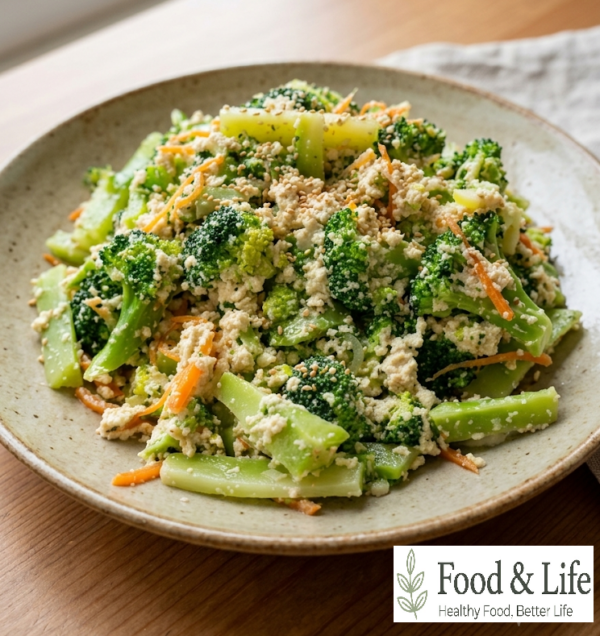
The key to this Korean broccoli tofu salad, or Broccoli Tofu Muchim, is steaming the broccoli and tofu together for just 2 minutes, removing as much moisture as possible, and seasoning them simply with salt and sesame oil.
Steaming 300 g (10.6 oz) broccoli with 150 g (5.3 oz) tofu keeps the broccoli crisp while softening the tofu enough to crumble easily. After steaming, rinse the broccoli under cold water and squeeze it thoroughly, then let the tofu drain well in a strainer. Removing excess moisture keeps the finished dish from becoming watery and helps preserve its clean, nutty flavor.
Seasoned salt, minced garlic, sesame seeds, and sesame oil bring everything together into a simple Korean side dish with crisp broccoli and soft, savory tofu.
⏱️ Cooking Time: About 15 minutes
🍳 Difficulty: ★★☆☆☆
✓ Ingredients
🥣 Main Ingredients
- 1 broccoli head, 300 g (10.6 oz)
- 1/2 block tofu, 150 g (5.3 oz)
- 20 g (0.7 oz) green onion
- 20 g (0.7 oz) carrot
🧂 Seasonings
- 1/4 tbsp seasoned salt
- 1/2 tbsp minced garlic
- 1 tbsp sesame seeds
- 2 tbsp sesame oil
(Measurement guide: 1 tbsp = 15 ml, 1 tsp = 5 ml, 1 Korean paper cup = 180 ml / 6.1 fl oz)
✓ How to Make Korean Broccoli Tofu Salad
- Clean the broccoli: Fill a large bowl with plenty of water. Grip the end of the broccoli stem with kitchen tongs and submerge the entire broccoli head, florets facing down, for 10 minutes so any debris trapped between the buds can loosen.
- Slice the vegetables: Thinly julienne 20 g (0.7 oz) green onion and 20 g (0.7 oz) carrot.
- Prep the broccoli: Cut the cleaned broccoli florets into bite-size pieces. Peel the tough outer layer from the thick stem with a vegetable peeler, cut the stem into bite-size pieces, and rinse everything briefly under running water.
- Steam the broccoli and tofu: Once the water in the steamer is boiling, add the prepared broccoli and 1/2 block tofu, 150 g (5.3 oz). Cover and steam over high heat for 2 minutes.
- Cool and remove excess moisture: After 2 minutes, remove the tofu and let it drain well. Rinse the broccoli under cold water, then firmly squeeze out as much water as possible with your hands.
- Crumble the tofu and mix: Add the drained broccoli and tofu to a bowl. Gently crumble the tofu with your hands, then add the sliced green onion, carrot, 1/4 tbsp seasoned salt, 1/2 tbsp minced garlic, 1 tbsp sesame seeds, and 2 tbsp sesame oil. Toss gently until evenly combined.
✓ Key Tips for Success
- Remove as much moisture as possible: If the tofu and broccoli retain too much water, liquid will collect in the bowl over time, diluting the seasoning and making the dish taste bland. Drain the steamed tofu thoroughly and squeeze the cooled broccoli firmly before mixing.
- Use salt to preserve the clean color: Soy sauce can darken the white tofu and make the finished dish look less vibrant. Seasoning with salt keeps the tofu bright and allows the green broccoli and orange carrot to stand out.
✓ Serving Tips
- Its mild, nutty flavor makes this side dish a good match for spicy Korean main dishes such as Jeyuk Bokkeum (spicy stir-fried pork) or Kimchi Jjigae.
- It can be served as a Korean side dish with rice, but it also works on its own as a light breakfast or simple salad-style meal.
- To reduce excess moisture from the vegetables, store it in an airtight container in the refrigerator and enjoy it within 1–2 days for the best texture.
✓ How to Choose Fresh Broccoli
- Floret shape and density: Choose broccoli with a rounded, slightly domed crown that feels firm. The individual buds should be small, uniform, and tightly packed.
- Color and flowering: Look for broccoli with a deep green color and a natural sheen. Avoid heads with yellow flowers beginning to bloom.
- Stem condition: The cut end of the stem should look fresh and moist rather than dry. Choose a firm stem without holes or hollow spaces inside.
Source: FoodNuri Seasonal Produce – Broccoli
✓ Broccoli Nutrition per 100 g (3.5 oz)
| Nutrient | Amount per 100 g (3.5 oz) |
|---|---|
| Calories | 28.00 kcal |
| Carbohydrates | 4.72 g |
| Protein | 3.56 g |
| Fat | 0.29 g |
| Sodium | 4.00 mg |
Values are based on 100 g (3.5 oz) of raw broccoli. Actual nutrition may vary depending on the variety, part used, product, and cooking method.
Source: Ministry of Food and Drug Safety Food Nutrition Database
✓ Frequently Asked Questions (FAQ)
Q1. Is steaming broccoli better than boiling it for this recipe?
Steaming the broccoli for just 2 minutes helps it absorb less water, so it stays much crisper. It also reduces the amount of water-soluble nutrients that can leach into cooking water.
Q2. Why does my broccoli tofu salad become watery and taste bland after sitting?
This usually happens when the tofu and cooled broccoli still contain too much moisture. Drain the tofu well and firmly squeeze the broccoli before seasoning and mixing.
Q3. Can I season it with regular soy sauce or Korean soup soy sauce instead of seasoned salt?
Soy sauce will darken the white tofu and change the clean appearance of the finished dish. For this recipe, simple salt seasoning works best when you want to keep the colors bright.
Steaming the broccoli and tofu for just 2 minutes and thoroughly removing excess moisture gives this dish its best texture. The broccoli stays pleasantly crisp, while the crumbled tofu becomes soft and savory. Using seasoned salt instead of soy sauce also keeps the tofu bright, while sesame oil and sesame seeds add a naturally nutty aroma.
Because the broccoli and tofu are well drained before mixing, the dish stays relatively dry instead of releasing a lot of liquid as it sits. This makes Korean broccoli tofu salad an easy, mild side dish to serve alongside everyday meals.
When you want a simple vegetable side dish with a clean, savory flavor, steam the broccoli and tofu for 2 minutes, drain them thoroughly, and toss them with the seasonings as written.
Save or bookmark this recipe so you can easily find it again, and share it with someone who enjoys Korean food.
I’ll continue sharing practical recipes and useful cooking tips that are easy to follow at home. 😊
If there’s a Korean dish or recipe you’d like to see next, feel free to leave a comment. 😊