
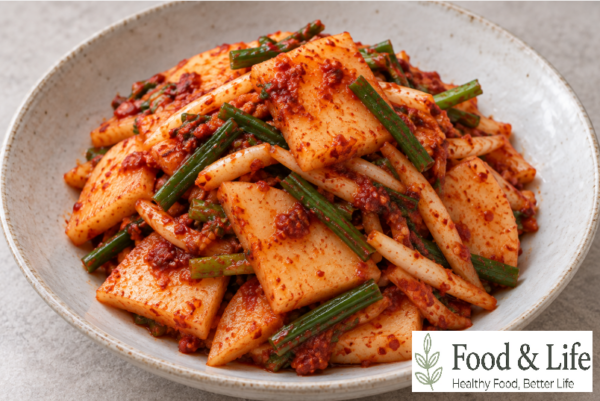
If you want to make crisp, refreshing seokbakji at home to serve with gukbap, seolleongtang, or other Korean soups, getting the radish salting time and seasoning ratio right is especially important.
This seokbakji recipe uses 1 Korean radish, salted with 1 tbsp each of salt and sugar for about 20–30 minutes until the slices bend without breaking. The radish is then tossed directly with a seasoning made from gochugaru, anchovy fish sauce, and saeujeot without rinsing. Keeping the liquid and seasoning from the salting step helps the flavors coat the radish evenly without the need for a separate rice-flour paste.
The crisp radish, spicy-sweet seasoning, and savory depth from the fermented seafood make this Korean radish kimchi especially good with gukbap, gomtang, seolleongtang, and even ramen.
⏱️ Cooking Time: About 40 minutes
🍳 Difficulty: ★★☆☆☆
✓ Ingredients
🥣 Main Ingredients
- 1 Korean radish (mu)
- 1/2 onion
- 10 stalks scallions
🧂 Seasonings
- 1 tbsp salt, for salting
- 1 tbsp sugar, for salting
- 7 tbsp gochugaru (Korean red pepper flakes)
- 2 tbsp anchovy fish sauce
- 2 tbsp saeujeot (Korean salted fermented shrimp)
- 2 tbsp sugar
- 1 tbsp minced ginger
- 2 tbsp minced garlic
- 2 pinches Miwon (MSG)
(Measurement guide: 1 tbsp = 15 ml, 1 tsp = 5 ml, 1 Korean paper cup = 180 ml / 6.1 fl oz)
✓ How to Make Seokbakji
- Cut the radish: Wash 1 Korean radish thoroughly and trim the skin as needed. Cut it into evenly sized, thick fan-shaped slices.
- Salt the radish: Place the sliced radish in a large bowl. Add 1 tbsp salt and 1 tbsp sugar, then toss evenly. Let sit for about 20–30 minutes, until the radish slices become flexible enough to bend without breaking.
- Make the seasoning: In a separate bowl, combine 7 tbsp gochugaru, 2 tbsp anchovy fish sauce, 2 tbsp saeujeot, 2 tbsp sugar, 1 tbsp minced ginger, 2 tbsp minced garlic, and 2 pinches Miwon. Mix until evenly combined.
- Prep the vegetables: Cut 1/2 onion into thick strips and slice 10 scallion stalks into 4–5 cm (1.6–2 in) lengths.
- Add the vegetables: Once the radish has softened enough to bend without snapping, add the prepared onion and scallions to the bowl.
- Toss with the seasoning: Add all of the prepared seasoning mixture. Toss thoroughly by hand until the radish, onion, and scallions are evenly coated with the red seasoning.
✓ Key Tips for Success
- Check the radish texture rather than only the clock: The radish is ready when a slice bends with springy flexibility instead of snapping. Salting it to this stage helps prevent excessive liquid from coming out later and allows the seasoning to cling more evenly.
- Do not rinse the salted radish: In this recipe, the liquid and seasoning created during the salting process are kept and used as part of the final kimchi. Rinsing the radish would wash away some of that seasoning and can make the finished seokbakji taste too mild.
✓ Serving Tips
- Right after mixing, seokbakji has a crisp, fresh flavor similar to freshly made kimchi. It pairs well with hot steamed rice or ramen.
- Let it ferment at room temperature for about half a day to 1 day, then refrigerate. As it ferments, a little more liquid develops, making it especially well suited to gomtang or seolleongtang.
- If you prefer a spicier flavor, replace 1–2 tbsp of the total 7 tbsp gochugaru with a hotter variety of Korean red pepper flakes.
✓ How to Choose a Good Korean Radish
- Surface and shape: Look for a firm, cylindrical radish with smooth white skin and no visible cracks or damage.
- Weight: A radish that feels heavy for its size usually has plenty of moisture and a dense interior.
- Green upper section: A radish with a vivid green section covering about the top third has received plenty of sunlight and tends to have good texture and sweetness.
✓ Korean Radish Nutrition per 100 g (3.5 oz)
| Nutrient | Amount per 100 g (3.5 oz) |
|---|---|
| Calories | 21.00 kcal |
| Carbohydrates | 4.72 g |
| Protein | 0.77 g |
| Fat | 0.15 g |
| Sodium | 13.00 mg |
Values are based on 100 g (3.5 oz) of raw Korean radish. Actual nutritional values may vary depending on variety, portion, product, and preparation.
Source: Ministry of Food and Drug Safety Food Nutrition Database
✓ Frequently Asked Questions (FAQ)
Q1. How long should I salt the radish for seokbakji?
The exact time depends on how thick the radish is cut, but about 20–30 minutes is usually enough. Check by gently bending a slice; it should flex without breaking.
Q2. Why does the seasoning slide off or become watery after making seokbakji?
This can happen if the radish was not salted long enough and releases too much water afterward, or if the salted radish was rinsed and lost its initial seasoning. Let the radish soften until flexible, then toss it directly with the seasoning without rinsing.
Q3. Do I have to add Miwon to the seasoning?
No. Miwon is optional and can be omitted. In the original recipe, about 2 pinches are added to give the seasoning a little more savory depth.
Following the 20–30 minute salting time and the seasoning ratio gives the radish a noticeably crisp bite while allowing the savory flavor of saeujeot and anchovy fish sauce to blend naturally with the spicy seasoning. Because the salted radish is not rinsed before mixing, the seasoning coats each piece well and pairs especially nicely with gukbap or seolleongtang.
If you are looking for a relatively simple seokbakji recipe that does not require making a separate rice-flour paste, try this method. You can enjoy it fresh and crunchy right after mixing or let it ferment for a deeper, more refreshing flavor that works especially well with Korean soups and stews.
Save or bookmark this recipe so you can easily find it later, and share it with someone who enjoys Korean food.
More approachable recipes and practical cooking tips are coming. If there is a dish or recipe you would like to see next, feel free to leave a comment. 😊