
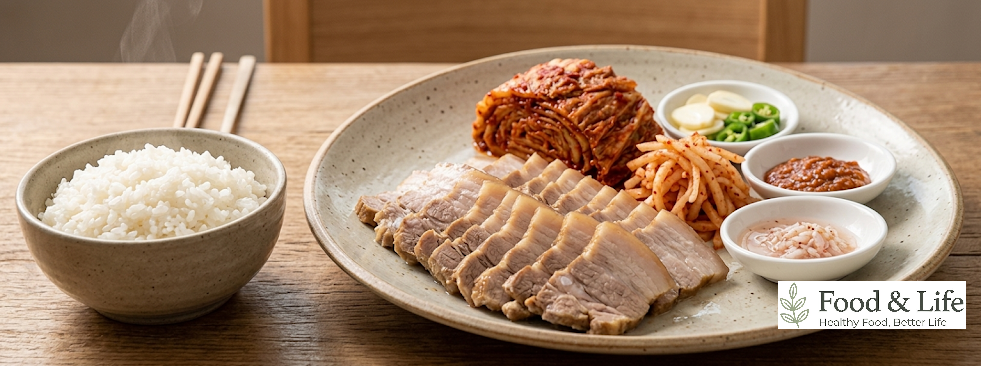
When making Korean boiled pork at home, it’s easy to worry about the meat turning dry or retaining a strong pork smell.
This Pork Belly Suyuk recipe simmers whole pork belly with doenjang, soju, apple, onion, green onions, and whole garlic cloves to reduce unwanted odors and add a subtle savory aroma. Starting over high heat, then gently simmering over medium-low heat and letting the meat rest at the end helps preserve the moist, tender texture that makes pork belly so satisfying.
Serve the warm sliced pork with kimchi or saeujeot (Korean salted shrimp) for a hearty Korean-style meal.
⏱️ Cooking Time: About 60 minutes
🍳 Difficulty: ★★☆☆☆
✓ Ingredients
🥣 Main Ingredients
- 600 g (21.2 oz / about 1.3 lb) whole pork belly
- 1 apple
- 1 onion
- 2 green onions
- 10 whole garlic cloves
- 5 dried chilies
🧂 Broth & Seasonings
- 1.5 L (50.7 fl oz) water
- 3 tbsp doenjang (Korean fermented soybean paste)
- 3 tbsp regular soy sauce
- 1 tbsp whole black peppercorns
- 90 ml (3 fl oz) soju
(Measurement guide: 1 tbsp = 15 ml, 1 tsp = 5 ml, 1 Korean paper cup = 180 ml / 6.1 fl oz)
✓ How to Make Pork Belly Suyuk
- Soak the pork: Place the pork belly in a container and add enough water to fully cover it. Let it soak for 10 minutes to lightly remove blood from the surface.
- Make the aromatic cooking broth: Add 1.5 L (50.7 fl oz) water, 3 tbsp doenjang, 3 tbsp regular soy sauce, 5 dried chilies, 1 apple with the stem and seeds removed, 1 onion, 2 green onions, 10 whole garlic cloves, and 1 tbsp whole black peppercorns to a large pot. Bring to a vigorous boil over high heat.
- Add the pork and soju: Once the broth is boiling, add the pork belly and 90 ml (3 fl oz) soju. Keep the lid off and boil over high heat for 5 minutes to allow the alcohol and strong pork aromas to evaporate.
- Simmer gently: Cover the pot, reduce the heat to medium-low, and simmer gently for 40 minutes.
- Let the pork rest: Turn off the heat and leave the pork covered in the pot for 10 minutes. The residual heat continues cooking the center gently and allows the juices to settle.
- Slice and serve: Remove the pork from the pot and let it cool slightly. Slice into bite-size pieces and serve.
✓ Key Tips for Success
- Add the pork only after the broth reaches a full boil: If the meat goes into the pot too early, more moisture can escape during cooking and the pork may turn dry. Starting with a vigorously boiling broth helps the surface set quickly and keeps the pork juicy.
✓ Serving Tips
- Let the cooked suyuk cool for 2–3 minutes before slicing. Cutting it immediately can cause more juices to run out and make the slices lose their shape.
- To store leftovers, wrap the pork tightly in aluminum foil and refrigerate so it does not dry out. Reheat it briefly in a steamer just before serving to help maintain its moist texture.
✓ How to Choose Good Pork Belly
- Meat and fat color: Choose pork belly with bright, light pink lean meat and clean, firm, milky-white fat.
- Surface and firmness: Fresh pork should not have excessive liquid or blood pooling on the surface. It should feel firm and springy rather than soft or mushy.
- Distribution of fat and lean meat: Look for pork belly with evenly layered fat and lean meat, along with a uniform grain and firm overall structure.
✓ Pork Belly Nutrition per 100 g (3.5 oz)
| Nutrient | Amount per 100 g (3.5 oz) |
|---|---|
| Calories | 372.00 kcal |
| Carbohydrates | 0.00 g |
| Protein | 13.90 g |
| Fat | 33.31 g |
| Sodium | 56.00 mg |
Based on 100 g (3.5 oz) of raw pork belly. Actual nutritional values may vary depending on the breed, cut, product, and preparation method.
Source: Ministry of Food and Drug Safety Food Nutrition Database – Raw Ingredient Foods
✓ Frequently Asked Questions (FAQ)
Q1. Can I keep the lid on from the beginning when cooking suyuk?
After adding the pork belly and soju, keep the lid off for the first 5 minutes. This allows the alcohol and some of the stronger pork aromas to evaporate.
Q2. Why does boiled pork sometimes turn tough or dry?
Cooking over high heat the entire time or removing the pork immediately without letting it rest can cause moisture to evaporate too quickly. Simmer it gently over medium-low heat, then turn off the heat and let it rest covered for 10 minutes.
Q3. Can I use pork shoulder or pork neck instead of pork belly?
Yes. For the same 600 g (21.2 oz) amount, you can use the same cooking time. If using a leaner cut, be sure to keep the 10-minute covered resting step to help prevent the meat from drying out.
By slowly simmering pork belly in a seasoned broth with aromatic vegetables and doenjang, then allowing it to rest after cooking, you can make moist and tender Pork Belly Suyuk at home without a complicated process. Serve the freshly sliced pork warm with well-fermented kimchi or saeujeot for a satisfying Korean-style meal.
Save or bookmark this recipe for later, and share it with someone who enjoys Korean food.
More easy-to-follow recipes and practical cooking tips will be added regularly. 😊
If there’s a Korean dish you’ve been curious about or a recipe you’d like to see next, feel free to leave a comment. 😊