
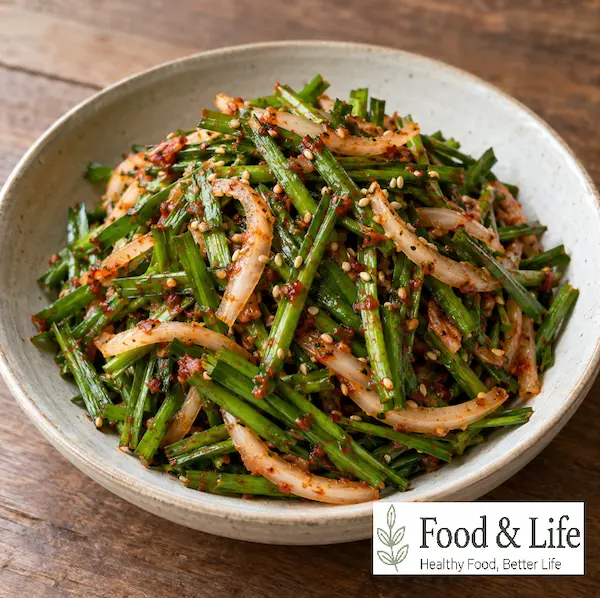
The key to making Korean chive salad (Buchu Geotjeori) is to lightly toss 100 g (3.5 oz) of garlic chives and 1/4 onion with 2 tbsp each of gochugaru, soy sauce, and vinegar.
There is no need to salt or pre-season the chives. Tossing everything together right before serving helps prevent excess moisture while keeping the chives crisp and fresh. Because garlic chives are delicate, squeezing or mixing them too aggressively can bruise the leaves and bring out a harsh grassy aroma, so use your fingertips to toss them gently.
The sweet-and-tangy dressing, combined with nutty sesame oil, makes this Korean chive salad an especially good side dish for rich meats such as grilled pork belly or boiled pork. It comes together in about 10 minutes.
⏱️ Cooking Time: About 10 minutes
🍳 Difficulty: ★☆☆☆☆
✓ Ingredients
🥣 Main Ingredients
- 100 g (3.5 oz) garlic chives
- 1/4 onion
🧂 Seasonings & Sauce
- 2 tbsp gochugaru (Korean red pepper flakes)
- 2 tbsp regular soy sauce
- 2 tbsp vinegar
- 1 tbsp maesil syrup (Korean plum syrup)
- 1 tbsp sugar
- 1 tbsp minced garlic
- 1 tbsp sesame oil
- 1 tbsp sesame seeds
(Measurement guide: 1 tbsp = 15 ml, 1 tsp = 5 ml, 1 Korean paper cup = 180 ml)
✓ How to Make Korean Chive Salad
- Prepare the chives: Rinse 100 g (3.5 oz) of garlic chives thoroughly under running water. Shake off as much water as possible, then cut them into bite-size pieces.
- Slice the onion: Thinly slice 1/4 onion and place it in a large mixing bowl with the prepared chives.
- Add the seasoning and toss: Add 2 tbsp gochugaru, 2 tbsp soy sauce, 2 tbsp vinegar, 1 tbsp maesil syrup, 1 tbsp sugar, 1 tbsp minced garlic, 1 tbsp sesame oil, and 1 tbsp sesame seeds. Using your fingertips, gently toss everything together without crushing or wilting the chives.
✓ Key Tips for Success
- Toss gently to prevent a grassy flavor: Garlic chives have delicate leaves that bruise easily. Squeezing or kneading them can damage the leaves, soften their texture, and bring out a stronger grassy aroma. Toss lightly with your fingertips, almost as if you are fluffing the vegetables.
- Season just before serving: Buchu Geotjeori is a fresh, quick-seasoned vegetable dish that is not salted in advance. Once seasoned, the vegetables gradually release moisture, so toss the salad immediately before serving to keep it crisp.
✓ Serving Tips
- Serve with golden, freshly grilled samgyeopsal (pork belly), grilled pork shoulder, jokbal (Korean braised pig’s trotters), or suyuk (Korean boiled pork). The sweet-and-tangy dressing and slightly pungent chives help balance the richness of the meat.
- Spoon a generous amount of the chive salad over freshly cooked rice and top with a fried egg for a quick and flavorful bibimbap-style meal.
✓ How to Choose Fresh Garlic Chives
- Leaf tips and firmness: Choose chives with straight, firm leaves and tips that are not wilted or dried out.
- Color and shape: Look for vivid, deep-green leaves. Chives with relatively short, thick leaves tend to have a tender texture.
- Aroma and stems: Fresh garlic chives should have their characteristic mild, fresh aroma, with firm stems that are not soft or mushy.
Source: Rural Development Administration – Nongsaro
✓ Garlic Chive Nutrition per 100 g (3.5 oz)
| Nutrient | Amount per 100 g (3.5 oz) |
|---|---|
| Calories | 22.00 kcal |
| Carbohydrates | 4.10 g |
| Protein | 1.80 g |
| Fat | 0.30 g |
| Sodium | 3.00 mg |
Values are based on 100 g of raw traditional-variety garlic chives. Actual nutrition may vary depending on the variety, product, and cooking method.
Source: Ministry of Food and Drug Safety Food Nutrition Database
✓ Frequently Asked Questions (FAQ)
Q1. How do I keep Korean chive salad from tasting too grassy?
Garlic chives are delicate, so avoid squeezing or kneading them. Toss the salad gently with your fingertips to keep the leaves crisp and prevent a strong grassy aroma.
Q2. What can I use instead of maesil syrup?
You can add a little more sugar or use oligosaccharide syrup instead to maintain the sweet-and-tangy balance of the dressing.
Combining equal amounts of gochugaru, soy sauce, and vinegar with maesil syrup and sesame oil creates a sweet, tangy, and nutty dressing that coats the garlic chives and onion naturally. Gently tossing the chives instead of squeezing them keeps their crisp texture and fresh aroma intact. Served alongside grilled meat, the slightly pungent chives and tangy dressing provide a refreshing contrast to the richness.
If you need a quick vegetable side dish for samgyeopsal, grilled pork shoulder, or suyuk, try this Korean chive salad recipe with 100 g (3.5 oz) of garlic chives and 2 tbsp each of gochugaru, soy sauce, and vinegar. Since there is no salting step, the entire dish can be ready in about 10 minutes.
Save or bookmark this recipe so you can easily find it again, and share it with someone who enjoys Korean food.
More easy-to-follow recipes and practical cooking tips are coming soon. 😊
If there’s a dish you’d like to see featured next, feel free to leave a comment. 😊