
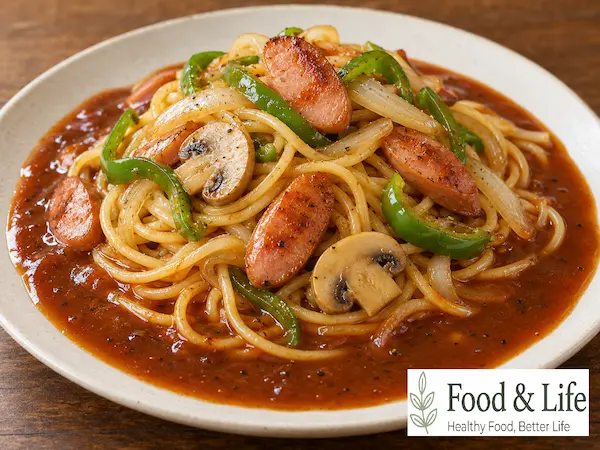
If you’re looking for a Japanese pasta dish with a thick sauce and a bold black pepper kick, Nagoya-style Ankake Spaghetti is a great one to try.
The key to this Ankake Spaghetti recipe is making a thick ankake sauce by simmering ketchup, Worcestershire sauce, beef Dashida seasoning, and water, then thickening it with a starch slurry. The cooked spaghetti is stir-fried once more with sausage, onion, green bell pepper, and button mushrooms for a pleasantly chewy texture. Instead of mixing the sauce into the pasta in the pan, the thick sauce is generously poured around and over the noodles just before serving. The sweet and tangy tomato flavor, sharp black pepper, savory sausage, and sautéed vegetables come together in a distinctly Nagoya-style pasta dish.
⏱️ Cooking Time: About 30 minutes
🍳 Difficulty: ★★☆☆☆
✓ Ingredients (2 Servings)
🥣 Main Ingredients
- 200 g (7 oz) spaghetti
- 1/2 onion
- 1/2 green bell pepper
- 2 button mushrooms
- 4 sausages
🧂 Sauce & Seasonings
- 6 tbsp ketchup
- 2 tbsp Worcestershire sauce
- 1 tbsp sugar
- 1 tbsp beef Dashida seasoning
- 1 tsp black pepper
- 400 ml (13.5 fl oz) water
- 2 tbsp starch, for the slurry
- 2 tbsp water, for the slurry
- Cooking oil, as needed for stir-frying
(Measurement guide: 1 tbsp = 15 ml, 1 tsp = 5 ml, 1 paper cup = 180 ml / 6.1 fl oz)
✓ How to Make Ankake Spaghetti
- Combine the sauce ingredients: Add 6 tbsp ketchup, 2 tbsp Worcestershire sauce, 1 tbsp sugar, 1 tbsp beef Dashida seasoning, 1 tsp black pepper, and 400 ml (13.5 fl oz) water to a saucepan. Mix well.
- Simmer the sauce: Place the saucepan over heat and bring the mixture to a boil while stirring. Once it begins boiling, continue cooking for 3 minutes, then turn off the heat.
- Make the starch slurry: Mix 2 tbsp starch with 2 tbsp water until smooth.
- Thicken the ankake sauce: With the heat turned off, keep stirring the sauce while slowly pouring in the starch slurry. Mix thoroughly so no lumps form. Turn the heat back on and cook until the sauce comes to a boil once more, then remove it from the heat. The sauce should now be thick and glossy.
- Cook the spaghetti: Bring 2 L (about 8.5 cups) water to a boil and add 2 tsp salt. Add 200 g (7 oz) spaghetti and cook for 11 minutes. Follow the cooking time listed on your pasta package if it differs.
- Prepare the vegetables and sausage: Thinly slice 1/2 onion. Remove the seeds from 1/2 green bell pepper and cut it into thin strips. Thinly slice 2 button mushrooms and cut 4 sausages in half lengthwise.
- Brown the sausage: Add an appropriate amount of cooking oil to a skillet. Cook the sausage first over medium heat until lightly browned.
- Sauté the vegetables: Once the sausage is browned, add the onion, green bell pepper, and mushrooms. Continue sautéing over medium heat.
- Stir-fry the cooked spaghetti: Drain the spaghetti after cooking and immediately add it to the skillet. Gently stir-fry so the noodles are evenly coated with the cooking oil and mixed with the sausage and vegetables. This extra step helps give the noodles a chewier texture.
- Reheat the ankake sauce: Just before plating, bring the prepared ankake sauce back to a boil so it is hot when served.
- Plate the pasta: Arrange the stir-fried spaghetti in a mound in the center of each plate. Place the onion, green bell pepper, mushrooms, and sausage over the noodles.
- Finish with the sauce: Generously pour the hot ankake sauce around and over the pasta so you can enjoy the thick sauce with each bite.
✓ Key Tips for Success
- Do not pour the starch slurry directly into vigorously boiling sauce. If the slurry is added all at once while the sauce is bubbling, the starch can cook immediately and form lumps. Turn off the heat first, then slowly add the mixture of 2 tbsp starch and 2 tbsp water while continuously stirring. Once fully incorporated, return the sauce to the heat and bring it to a boil.
- Handle thin spaghetti gently when stir-frying. Thin noodles can break easily when tossed again with the vegetables. Rather than aggressively stirring with tongs, gently toss and turn the noodles to maintain their chewy texture.
✓ Serving Tips
- Instead of mixing the ankake sauce into the noodles in the skillet, plate the stir-fried pasta first and pour the thick sauce over it just before serving. This helps preserve the sauce’s signature thick texture.
- The recipe uses 1 tsp black pepper, giving the sauce a noticeable peppery kick. Eating the sauce together with the noodles, sausage, and sautéed vegetables creates the best flavor balance.
- The sausage can be replaced with ham or bacon, and the button mushrooms can be substituted with another type of mushroom while keeping the remaining sauce proportions unchanged.
✓ How to Choose a Good Onion
- Check the outer skin: Choose onions with dry, papery skins that have a slight sheen and no visible damage, lesions, or mold.
- Check firmness and weight: A good onion should feel firm and relatively heavy for its size, without soft spots when gently pressed.
- Check the stem and sprouts: Choose onions with a thin, dry, tightly closed stem and no visible green sprouts.
Source: Rural Development Administration Nongsaro – Characteristics and Nutritional Value of Onions
✓ Onion Nutrition per 100 g (3.5 oz)
| Nutrient | Amount per 100 g (3.5 oz) |
|---|---|
| Calories | 29.00 kcal |
| Carbohydrates | 6.52 g |
| Protein | 0.96 g |
| Fat | 0.17 g |
| Sodium | 2.00 mg |
Values are based on 100 g (3.5 oz) of raw onion. Actual nutrition may vary depending on the variety, product, and preparation method.
Source: Ministry of Food and Drug Safety Food Nutrition Database – Raw Onion
✓ Frequently Asked Questions (FAQ)
Q1. How do you thicken the sauce for Ankake Spaghetti?
Turn off the heat after the sauce has boiled, then slowly stir in a slurry made with 2 tbsp starch and 2 tbsp water. Return the sauce to the heat and bring it to a boil once more while stirring until it becomes smooth and thick.
Q2. Why does my ankake sauce have starch lumps?
This can happen when the starch slurry is added too quickly while the sauce is still boiling. Turn off the heat first, gradually stir in the slurry until completely incorporated, and then heat the sauce again.
Q3. Can I substitute the sausage or button mushrooms?
Yes. The 4 sausages can be replaced with ham or bacon, and the 2 button mushrooms can be replaced with another type of mushroom. Keep the remaining sauce proportions the same.
Finished Ankake Spaghetti is instantly recognizable by its thick reddish-brown sauce surrounding the pasta, giving it a very different appearance from typical tomato-based spaghetti. Ketchup provides a sweet and tangy tomato base, while Worcestershire sauce and beef Dashida add savory depth. With 1 teaspoon of black pepper, the sauce also has a clear peppery kick, and its thick consistency clings generously to the noodles.
The browned sausage adds savory richness, while the onion contributes gentle sweetness, the green bell pepper brings a fresh aroma, and the mushrooms add a tender texture. Because the cooked spaghetti is briefly stir-fried before serving, the noodles retain a pleasantly chewy texture even after being covered with the thick sauce.
When I made this dish, preparing the ankake sauce first and then chopping the vegetables and sausage while the spaghetti cooked made the process more straightforward than I expected. I especially liked that the thick sauce is poured over the noodles at the end instead of being completely mixed into the pasta beforehand. It gives each bite a slightly different amount of sauce and makes the texture feel distinct from standard spaghetti dishes.
Stir-frying the cooked noodles with the vegetables also creates a chewier texture that feels different from ordinary pasta. The black pepper flavor is noticeably bold, but the sweetness and acidity from the ketchup and Worcestershire sauce keep it from tasting one-dimensionally spicy.
My family also enjoyed the generous amount of sausage, green bell pepper, and mushrooms, which gave each bite a different texture. The thick sauce coats the spaghetti well, making the dish satisfying and hearty. Since it has a noticeably different character from everyday tomato pasta, it is a recipe I would make again whenever I want something a little different from the usual Japanese-style noodles or pasta.
If you want to try a rich, peppery pasta dish that is different from ordinary spaghetti, make this Nagoya-style Ankake Spaghetti. The thick sauce, stir-fried noodles, sausage, and vegetables come together in one filling plate that works well for lunch or dinner.
Save or bookmark this recipe so you can easily find it again, and share it with someone who enjoys Japanese food.
I’ll continue sharing approachable recipes and practical cooking tips that are easy to make at home. 😊
If there is a dish you have been curious about or a recipe you would like to see next, feel free to leave a comment. 😊
※ This recipe was prepared after referring to a recipe introduced by the YouTube channel ‘일식예보’, and this post is based on the cooking process and results.