
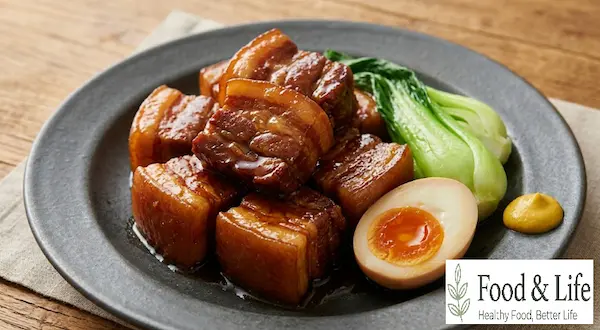
This Buta no Kakuni recipe is a Japanese braised pork belly dish made by simmering thick pieces of pork belly until tender, then slowly cooking them in a sweet and savory soy-based sauce.
The pork belly is first seared until golden to render some of the excess fat, then simmered with ginger and green onion over low heat for 1 hour. After that, it is braised for another 30 minutes in a sauce made with soy sauce, Cheongha, Mirim, sugar, and honey.
Because the pork is thoroughly simmered before being gently braised, the inside becomes moist and tender while the outside takes on a glossy, sweet-savory glaze. Serve it with soft-boiled eggs, blanched bok choy, and a little hot mustard for a well-balanced Japanese-style pork belly dish.
⏱️ Cooking Time: About 1 hour 40 minutes
🍳 Difficulty: ★★★☆☆
✓ Ingredients
🥣 Main Ingredients
- 800 g (28.2 oz / 1.8 lb) slab pork belly
- 3 slices ginger
- Green part of 1 green onion
- Boiled eggs, as desired
- Bok choy, as desired
🧂 Sauce & Seasonings
- 200 ml (6.8 fl oz) water
- 100 ml (3.4 fl oz) Cheongha
- 50 ml (1.7 fl oz) Mirim
- 50 ml (1.7 fl oz) soy sauce
- 3 tbsp sugar
- 1 tbsp honey
- Hot mustard, as desired
(Measurement guide: 1 tbsp = 15 ml, 1 tsp = 5 ml, 1 Korean paper cup = 180 ml / 6.1 fl oz)
✓ How to Make Buta no Kakuni
- Prep the pork belly and aromatics: Cut 800 g (28.2 oz / 1.8 lb) slab pork belly into large 4 cm (about 1.6-inch) cubes. Prepare 3 slices of ginger, then tear the green part of 1 green onion lengthwise so its aroma can infuse the simmering liquid.
- Sear the pork belly: Add cooking oil to a skillet and place the pork belly fat-side down. Sear until the outside is crisp and golden and some of the fat has rendered out. Transfer the pork to a paper towel to remove excess grease.
- Start the first simmer and skim impurities: Place the seared pork belly, ginger, and green onion in a pot. Add enough water to fully cover the pork. Bring to a boil over high heat, then reduce to low heat and carefully skim off any foam or impurities.
- Cover and simmer for 1 hour: Cover the pot and gently simmer over low heat for 1 hour. After 30 minutes, check the water level. If any pork is exposed above the water, add more water so the pieces remain submerged. After 1 hour, remove only the pork from the pot.
- Prepare the garnishes: Add the eggs to boiling water and cook for 8 minutes, then cool them in cold water to make soft-boiled eggs. Add a pinch of salt to boiling water and blanch the bok choy for 1 minute, then transfer it to cold water to preserve its crisp texture.
- Make the braising sauce: In a pot, combine 200 ml (6.8 fl oz) water, 100 ml (3.4 fl oz) Cheongha, 50 ml (1.7 fl oz) Mirim, 50 ml (1.7 fl oz) soy sauce, 3 tbsp sugar, and 1 tbsp honey. Mix well.
- Braise for 30 minutes: Add the simmered pork belly to the braising sauce and bring it to a boil. Once boiling, reduce the heat to low and braise for 30 minutes.
- Add the eggs and let everything cool in the sauce: After 30 minutes, turn off the heat and add the boiled eggs to the braising liquid. Let everything cool gradually so the seasoning can soak further into both the pork and eggs.
- Plate and serve: Arrange the tender braised pork belly, boiled eggs, and blanched bok choy neatly on a serving plate. Serve with hot mustard according to your preference.
✓ Key Tips for Success
- Sear first, then simmer thoroughly: Searing the fat side of the pork belly first helps render excess fat. After that, simmering it with green onion and ginger over low heat for a full hour helps reduce the pork’s strong aroma and richness while creating a softer, more tender texture.
✓ Serving Tips
- Instead of serving the pork immediately after braising, turn off the heat and let it cool for a while in the sauce with the soft-boiled eggs. This gives both the pork and eggs more time to absorb the seasoning for a deeper flavor.
- Add a small amount of hot mustard to each piece of sweet and savory pork. Its sharp flavor helps balance the richness of the pork belly.
- For a different way to serve it, place braised pork belly, thinly sliced green onion, and hot mustard inside a warm steamed flower bun or bun. This creates a Kakuni Man-style dish inspired by the Japanese specialty.
✓ How to Choose Good Pork Belly
- Meat and fat color: Look for pork with a clear pale pink to reddish-pink color. The fat should be milky white, firm, and even in appearance.
- Firmness and surface condition: Fresh pork should feel springy when lightly pressed and quickly return to its original shape. Avoid meat with excessive surface liquid or a sticky texture.
- Balance of fat and lean meat: Choose pork belly with evenly alternating layers of lean meat and fat. Avoid pieces that look excessively coarse or dry.
✓ Pork Belly Nutrition per 100 g (3.5 oz)
| Nutrient | Amount per 100 g (3.5 oz) |
|---|---|
| Calories | 372.00 kcal |
| Carbohydrates | 0.00 g |
| Protein | 13.90 g |
| Fat | 33.31 g |
| Sodium | 56.00 mg |
Based on 100 g of raw pork belly. Actual nutritional values may vary depending on breed, cut, product, and cooking condition.
Source: Ministry of Food and Drug Safety Food Nutrition Database – Raw Ingredients
✓ Frequently Asked Questions (FAQ)
Q1. Why is my Buta no Kakuni tough or dry instead of tender?
This can happen if the pork is not simmered gently for long enough during the first cooking stage, or if it is braised too quickly over high heat and loses moisture. Keep the pork submerged in plenty of water and simmer it over low heat for 1 hour before braising it gently over low heat for a moist, tender texture that can be pulled apart with chopsticks.
Q2. Can I substitute another type of alcohol for Cheongha or use corn syrup instead of honey?
You can replace Cheongha with another clear rice wine or use a little more Mirim. Honey can also be replaced with oligosaccharide syrup or corn syrup, although using honey in the original ratio gives the braising sauce its intended flavor and glossy finish.
After searing the pork belly until golden, simmering it with ginger and green onion for 1 hour, and then slowly braising it in the soy-based sauce, the thick pieces of pork become tender enough to separate easily along the grain. The sweet and savory sauce also coats the pork beautifully.
Letting the finished pork cool slowly in the braising liquid with the soft-boiled eggs gives both the pork and eggs extra time to absorb the sauce. Served with rice, the tender pork belly and savory braising sauce make a satisfying weekend meal.
If you want to make Buta no Kakuni at home, remember the two most important steps: simmer the pork belly long enough to make it tender, then braise it slowly over low heat. Add soft-boiled eggs and bok choy for a complete meal or a special weekend dish.
Save or bookmark this recipe so you can easily find it later, and share it with someone who enjoys Japanese cooking.
I’ll continue sharing approachable recipes and practical cooking tips that are easy to follow at home. 😊
If there’s a dish you’ve been curious about or a recipe you’d like to see next, feel free to leave a comment. 😊
※ This recipe was adapted from a recipe introduced on the YouTube channel “일식예보”. I prepared the dish myself and wrote this post based on the cooking process and results.