
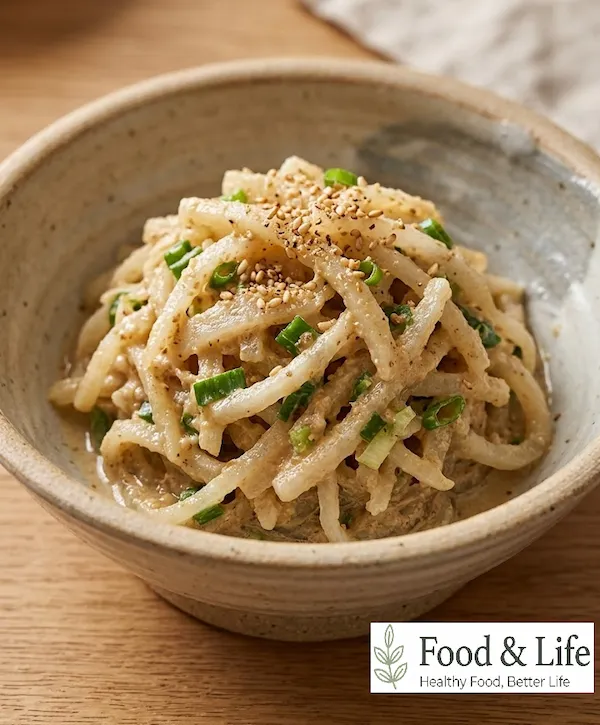
The key to this Korean radish namul with perilla is seasoning the thinly julienned radish with salt and anchovy fish sauce for 10 minutes first, then cooking it covered over medium-low heat for 4 minutes with all the liquid released during seasoning.
Use 1 kg (2.2 lb) of the upper green portion of Korean radish, which has a naturally mild sweetness. Instead of constantly stir-frying the radish with a spatula, cover the pan and let it gently steam so the thin strips stay intact while becoming moist and tender. Finish with 3 tbsp perilla seed powder and 2 tbsp perilla oil for a rich, nutty flavor that complements the natural sweetness of the radish.
With plenty of savory depth but no heavy seasoning, this mild Korean vegetable side dish pairs especially well with warm rice.
⏱️ Cooking Time: About 20 minutes
🍳 Difficulty: ★★☆☆☆
✓ Ingredients
🥣 Main Ingredients
- 1 kg (2.2 lb) Korean radish, upper green portion
- A small amount of green onion, green part only
🧂 Seasonings
- 1/2 tbsp fine salt
- 1 tbsp anchovy fish sauce
- 1/3 tbsp minced garlic
- 60 ml (2 fl oz / 1/4 US cup) water
- 3 tbsp perilla seed powder
- 2 tbsp perilla oil
- 1 tbsp sesame seeds
(Measurement guide: 1 tbsp = 15 ml, 1 tsp = 5 ml, 1 Korean paper cup = 180 ml / 6.1 fl oz)
✓ How to Make Korean Radish Namul with Perilla
- Prepare the ingredients: Peel 1 kg (2.2 lb) of the upper green portion of the Korean radish. Cut it into thin slices, then julienne into evenly sized strips. Thinly slice a small amount of the green part of the green onion.
- Season the radish: Add 1/2 tbsp fine salt and 1 tbsp anchovy fish sauce to the julienned radish. Toss evenly and let it sit for 10 minutes so the radish softens slightly and absorbs the savory seasoning.
- Add moisture and steam for 4 minutes: After 10 minutes, heat a pan over high heat. Add the seasoned radish along with all the liquid it released. Add 1/3 tbsp minced garlic and 60 ml (2 fl oz / 1/4 US cup) water. Once the liquid comes to a boil, cover the pan, reduce the heat to medium-low, and cook for 4 minutes.
- Finish with perilla seasoning: After 4 minutes, remove the lid. Add 3 tbsp perilla seed powder, 2 tbsp perilla oil, 1 tbsp sesame seeds, and the sliced green onion. Gently toss everything together until evenly combined, taking care not to break up the radish strips.
✓ Key Tips for Success
- Do not discard the liquid released from the radish: As the radish sits with salt and anchovy fish sauce, it naturally releases moisture. This liquid contains the radish’s flavor along with the seasoning, so add all of it to the pan to keep the finished dish moist and flavorful.
- Cover and cook for 4 minutes over medium-low heat: Constantly stirring thin radish strips with a spatula can cause them to break or turn mushy. Once the liquid starts boiling, cover the pan and let the radish gently steam for 4 minutes so it cooks through while keeping its shape.
✓ Serving Tips
- Add the perilla oil at the end: Prolonged heating can reduce the distinctive aroma of perilla oil. Add it during the final stage, ideally after turning off the heat or while using only the residual heat, to preserve its rich, nutty fragrance.
- Spoon a generous amount of the radish namul over warm rice and top with a fried egg for a mild, comforting, and filling rice bowl.
- Let the finished namul cool slightly, then store it in an airtight container in the refrigerator. As it chills, the nutty seasoning settles further into the radish strips, making it a refreshing side dish.
✓ How to Choose a Good Korean Radish
- Look at the green upper portion: A radish with a vivid green section covering about one-third of its length near the leafy top tends to have a pleasantly mild sweetness.
- Check the surface and shape: Choose a radish with few fine roots and a smooth, pale surface without cracks or visible damage.
- Check the firmness and weight: It should feel heavy for its size and firm when pressed. This indicates that the inside is still dense and full of moisture.
✓ Korean Radish Nutrition per 100 g (3.5 oz)
| Nutrient | Amount per 100 g (3.5 oz) |
|---|---|
| Calories | 21.00 kcal |
| Carbohydrates | 4.72 g |
| Protein | 0.77 g |
| Fat | 0.15 g |
| Sodium | 13.00 mg |
Based on raw Korean radish (Joseon radish) per 100 g. Actual nutritional values may vary depending on variety, part of the radish, product, and cooking method.
Source: Ministry of Food and Drug Safety Food Nutrition Database
✓ Frequently Asked Questions (FAQ)
Q1. Why is the radish covered and steamed instead of stir-fried?
Constantly stirring thin radish strips in a pan can make them break apart or turn mushy. Covering the pan and cooking them with steam for 4 minutes allows the radish to become tender while keeping the strips neatly intact.
Q2. Why does Korean radish namul sometimes taste bitter or spicy?
The lower white portion of Korean radish tends to have a stronger peppery flavor. Bitterness can also develop if there is not enough moisture and the radish begins to scorch. Use the mildly sweet upper green portion and cook it with all the liquid released during seasoning.
Q3. Can I use broth instead of plain water?
Yes. You can replace the water with the same amount, 60 ml (2 fl oz / 1/4 US cup), of anchovy-kelp broth. It pairs naturally with the anchovy fish sauce and gives the dish a deeper savory flavor.
Following this method, seasoning the julienned radish for 10 minutes and then cooking it covered over medium-low heat for 4 minutes keeps the strips moist, tender, and largely intact. Adding the perilla seed powder and perilla oil at the end brings a rich, nutty aroma that blends naturally with the radish’s mild sweetness.
Because the radish is not constantly tossed around in the pan, the thin strips keep their shape and develop a soft, moist texture that goes especially well with warm rice. As long as you let the radish sit for 10 minutes and cook it covered for 4 minutes over medium-low heat, you can easily make tender Korean radish namul with perilla without the strips falling apart.
If you are looking for a mild, nutty Korean vegetable side dish for an everyday meal, this simple radish recipe is an easy one to try.
Save or bookmark this recipe so you can find it again later, and share it with someone who enjoys Korean food.
More easy-to-follow recipes and practical cooking tips will be added regularly. If there is a dish you would like to see next, feel free to leave a comment. 😊