
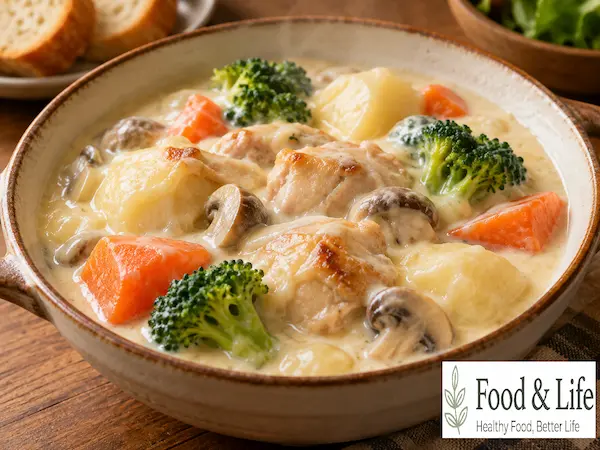
If you want to make a rich and creamy milk-based stew at home, you can skip store-bought roux and make the cream sauce from scratch with butter and flour.
This Japanese cream stew recipe starts by browning chicken thigh in butter, then sautéing it with potato, carrot, and button mushrooms. Cheongha and chicken stock are added, and everything is simmered over low heat for about 10 minutes. In a separate pan, butter and onion are cooked with cake flour, then milk is gradually stirred in before cream cheese is added to create a thick, smooth cream sauce.
The homemade cream sauce and broccoli are added during the final stage and cooked for another 3 minutes while stirring. The result is a smooth, savory stew with tender chicken and vegetables coated in a rich, creamy sauce.
⏱️ Cooking Time: About 30 minutes
🍳 Difficulty: ★★☆☆☆
✓ Ingredients
🥣 Main Ingredients
- 200 g (7 oz) chicken thigh, or another tender cut such as chicken tenderloin
- 1 potato
- 1/2 carrot
- 1/4 broccoli
- 2 button mushrooms
- 1/2 onion
🧂 Seasonings & Sauce
- 1 pinch salt, for seasoning the chicken
- 40 g (1.4 oz) butter, divided into 10 g + 30 g
- 50 ml (1.7 fl oz) Cheongha, or white wine
- 150 ml (5.1 fl oz) water
- 1/2 tsp chicken stock
- 2 tbsp cake flour, for the cream sauce
- 300 ml (10.1 fl oz) milk, for the cream sauce
- 40 g (1.4 oz) cream cheese, for the cream sauce
(Measurement guide: 1 tbsp = 15 ml, 1 tsp = 5 ml, 1 Korean paper cup = 180 ml / 6.1 fl oz)
✓ How to Make Japanese Cream Stew
- Prepare the vegetables: Slice 1/2 onion about 5 mm thick. Peel 1 potato and 1/2 carrot and cut them into bite-size pieces. Cut 1/4 broccoli into bite-size florets and cut 2 button mushrooms into bite-size pieces.
- Season the chicken: Cut 200 g (7 oz) chicken thigh into bite-size pieces. Sprinkle with 1 pinch salt and gently massage it into the chicken.
- Brown the chicken: Melt 10 g (0.4 oz) butter in a pot over medium heat. Place the chicken skin-side down first and cook until golden. Flip and brown the other side evenly.
- Sauté the vegetables and add Cheongha: Add the prepared potato, carrot, and button mushrooms and sauté over medium heat for about 3 minutes. When the vegetables begin to turn slightly translucent, add 50 ml (1.7 fl oz) Cheongha. Increase the heat to high and stir while allowing the alcohol to cook off.
- Simmer over low heat: Add 150 ml (5.1 fl oz) water and 1/2 tsp chicken stock. Once the mixture comes to a boil, reduce the heat to low. Cover and simmer for about 10 minutes while preparing the cream sauce.
- Make the homemade cream sauce: Heat a separate pan over medium heat and melt 30 g (1.1 oz) butter. Add 1/2 onion and sauté until lightly golden. Reduce the heat to low and add 2 tbsp cake flour, stirring until evenly combined. Gradually add 300 ml (10.1 fl oz) milk in small additions while stirring continuously to prevent lumps. Once the sauce becomes smooth, add 40 g (1.4 oz) cream cheese and mix well until thick and creamy.
- Finish the cream stew: After the stew has simmered for 10 minutes, remove the lid and add the prepared cream sauce and broccoli. Mix until evenly combined, season with salt to taste, and cook for another 3 minutes while stirring continuously.
✓ Key Tips for Success
- Do not add all the milk at once: Pouring in all 300 ml (10.1 fl oz) of milk at once can cause the cake flour to form lumps. Add the milk gradually while stirring continuously to make a smooth cream sauce.
- Cook the chicken skin-side down first: Brown the chicken thigh skin-side down in the melted butter before flipping it. This helps reduce moisture loss and keeps the chicken tender while developing a golden surface.
✓ Serving Tips
- Cheongha substitute: If you do not have 50 ml (1.7 fl oz) Cheongha, you can use white wine instead.
- Chicken substitute: Chicken thigh can be replaced with another tender cut, such as chicken tenderloin.
- Using the cream sauce: This homemade cream sauce method can also be adapted for pasta, risotto, or gratin.
✓ How to Choose Good Chicken Thigh
- Skin and meat color: Look for chicken with pale apricot-colored skin and a natural sheen. The meat should have a clear pink color rather than looking noticeably pale.
- Firm texture: Good chicken should feel springy and return to its original shape when lightly pressed rather than feeling soft or mushy.
- Surface and packaging: Choose chicken without obvious bruising or discoloration on the skin, and avoid packages with excessive liquid collected inside.
Source: Rural Development Administration, Nongsaro – How to Choose and Store Livestock Products
✓ Chicken Thigh Nutrition per 100 g (3.5 oz)
| Nutrient | Amount per 100 g (3.5 oz) |
|---|---|
| Calories | 144.00 kcal |
| Carbohydrates | 0.00 g |
| Protein | 19.41 g |
| Fat | 7.67 g |
| Sodium | 84.00 mg |
Based on 100 g of raw chicken thigh. Actual nutrition values may vary depending on the breed, cut, product, and cooking method.
Source: Food Safety Korea Food Nutrition Information – Chicken, Thigh, Raw
✓ Frequently Asked Questions (FAQ)
Q1. Should I add the broccoli at the beginning when making cream stew?
No. Add the 1/4 broccoli after the chicken, potato, and other ingredients have simmered for 10 minutes. Add it together with the cream sauce, then cook for another 3 minutes while stirring.
Q2. Why does my cream sauce turn lumpy?
If you pour in all 300 ml (10.1 fl oz) of milk at once, the cake flour may not blend evenly and can form lumps. Add the milk gradually while stirring continuously to keep the sauce smooth.
Q3. Do I have to use Cheongha when making cream stew?
No. If you do not have Cheongha, you can substitute white wine.
The cream sauce made with butter, milk, and cream cheese gently coats the potato and chicken thigh, creating a smooth, rich stew with a savory, creamy flavor. When I made this recipe as written, the browned chicken paired especially well with the thick cream sauce, and the larger pieces of potato and carrot made each spoonful especially satisfying.
If you want to make Japanese cream stew without store-bought roux, or you are craving a warm and creamy stew, this is an approachable recipe to try. As long as you add the milk gradually while making the cream sauce, the rest of the cooking process is straightforward and easy to follow.
Save or bookmark this recipe so you can easily find it later, and share it if you found it helpful.
I’ll continue sharing approachable recipes and practical cooking tips that are easy to make at home. 😊
If there is a dish you are curious about or a recipe you would like to see next, feel free to leave a comment. 😊
※ This recipe was prepared and written after referring to a recipe introduced on the YouTube channel ‘일식예보’, then cooking it and documenting the process and results.