
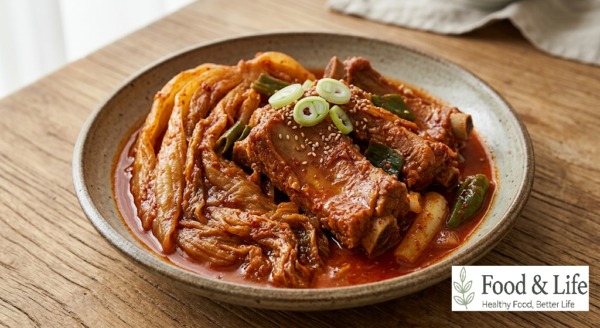
When you’re craving a hearty Korean main dish with deeply seasoned kimchi and tender pork, Dwaeji Deunggalbi Kimchi Jjim (Korean Braised Pork Ribs with Kimchi) is a satisfying choice.
The key to this recipe is soaking 1.2 kg (42.3 oz) of pork back ribs in sugar water for 30 minutes, then parboiling them for 3 minutes with bay leaves and soju to remove residual blood and unwanted odors. The ribs and kimchi are then simmered with a bold seasoning mixture made with gochujang, doenjang, gochugaru, and curry powder for 40 minutes over medium-low heat. This slow braise makes the pork tender enough to pull away easily from the bones while allowing the kimchi to absorb the rich, spicy seasoning.
The result is a deeply savory and pleasantly spicy broth filled with tender pork ribs and soft, flavorful kimchi—perfect with a bowl of hot steamed rice.
⏱️ Cooking Time: About 80 minutes
🍳 Difficulty: ★★☆☆☆
✓ Ingredients
🥣 Main Ingredients
- 1.2 kg (42.3 oz) pork back ribs
- 1/2 head well-fermented kimchi
- 1 onion
- 4 Cheongyang chili peppers
- 2 stalks green onion
- Water, as needed
🧂 Seasonings
- 45 ml (3 tbsp) sugar, for soaking the ribs
- 5 bay leaves, for parboiling
- 60 ml (4 tbsp / 2 fl oz) soju, for parboiling
- 45 ml (3 tbsp) sugar, for parboiling
- 22.5 ml (1 1/2 tbsp) gochujang
- 15 ml (1 tbsp) doenjang
- 30 ml (2 tbsp) regular soy sauce
- 30 ml (2 tbsp) minced garlic
- 45 ml (3 tbsp) sugar
- 30 ml (2 tbsp) Mirim
- 60 ml (4 tbsp) gochugaru
- 15 ml (1 tbsp) curry powder
- 15 ml (1 tbsp) tuna extract seasoning
- 15 ml (1 tbsp) neutral cooking oil
(Measurement guide: 1 tbsp = 15 ml, 1 tsp = 5 ml, 1 Korean paper cup = 180 ml / 6.1 fl oz)
✓ How to Make Korean Braised Pork Ribs with Kimchi
- Soak the ribs: Place 1.2 kg (42.3 oz) pork back ribs in enough water to fully submerge them. Add 45 ml (3 tbsp) sugar and soak for 30 minutes to draw out excess blood.
- Parboil the ribs: Transfer the drained ribs to a pot and add enough water to cover, 5 bay leaves, 60 ml (4 tbsp / 2 fl oz) soju, and 45 ml (3 tbsp) sugar. Once the water comes to a boil, cook over high heat for 3 minutes.
- Rinse the ribs: Rinse the parboiled ribs thoroughly under cold water, paying particular attention to any coagulated blood or residue around the cut bones. Discard all of the parboiling liquid.
- Make the seasoning sauce: In a bowl, combine 22.5 ml (1 1/2 tbsp) gochujang, 15 ml (1 tbsp) doenjang, 30 ml (2 tbsp) regular soy sauce, 30 ml (2 tbsp) minced garlic, 45 ml (3 tbsp) sugar, 30 ml (2 tbsp) Mirim, 60 ml (4 tbsp) gochugaru, 15 ml (1 tbsp) curry powder, and 15 ml (1 tbsp) tuna extract seasoning. Mix thoroughly.
- Prepare the vegetables: Cut 1 onion into thick strips. Slice 2 green onions and 4 Cheongyang chili peppers diagonally into large pieces.
- Layer the ingredients and bring to a boil: Spread 15 ml (1 tbsp) neutral cooking oil evenly over the bottom of a pot. Lay the 1/2 head of kimchi over the bottom, then arrange the pork ribs on top and spoon over the prepared seasoning sauce. Add enough water to cover about two-thirds of the ingredients, then bring to a boil over high heat.
- Add the vegetables and braise: Once the liquid is boiling vigorously, add the onion, green onions, and Cheongyang chili peppers. Cover the pot, reduce the heat to medium-low, and simmer gently for 40 minutes until the ribs are tender and the kimchi is deeply seasoned.
✓ Key Tips for Success
- Control the heat and cooking time: Once the broth comes to a boil, cover the pot and reduce the heat to medium-low. Boiling too aggressively can evaporate the liquid too quickly and leave the meat tough. A gentle 40-minute braise helps the pork become tender and moist.
- Rinse thoroughly after parboiling: After the initial 3-minute boil, rinse away any coagulated blood and residue around the bones under cold running water. This step helps keep the finished broth clean-tasting without unwanted odors or heaviness.
✓ Serving Tips
- Wrap pieces of tender pork rib meat in the fully braised kimchi and enjoy them together with hot steamed rice.
- If you prefer an extra-spicy broth, add a little coarse gochugaru or additional sliced Cheongyang chili pepper just before serving.
✓ How to Choose Good Pork Back Ribs
- Color and firmness: Choose ribs with bright reddish-pink meat that springs back when lightly pressed with a finger.
- Fat quality: The fat around the meat and bones should be firm, white, and closely attached rather than soft or loose.
✓ Pork Back Rib Nutrition per 100 g (3.5 oz)
| Nutrient | Amount per 100 g (3.5 oz) |
|---|---|
| Calories | 237.00 kcal |
| Carbohydrates | 0.00 g |
| Protein | 17.88 g |
| Fat | 17.19 g |
| Sodium | 52.00 mg |
Based on raw pork belly/back rib meat per 100 g (3.5 oz). Actual nutrition values may vary depending on breed, cut, product, and cooking method.
Source: Ministry of Food and Drug Safety Food Nutrition Database – Raw Ingredients
✓ Frequently Asked Questions (FAQ)
Q1. What should I do if too much liquid evaporates while the ribs are simmering?
Even with the lid on, the amount of evaporation can vary depending on the heat level. Check the pot occasionally, and if the bottom starts to look dry, add about 1/2 cup of water to prevent scorching.
Q2. Why are my pork ribs tough instead of tender?
Cooking the ribs too quickly over high heat can cause the meat to contract while the liquid evaporates too fast. Cover the pot and simmer gently over medium-low heat for at least 40 minutes so the meat has time to become tender.
Q3. Do I really need to add curry powder to the seasoning?
For this recipe, 15 ml (1 tbsp) curry powder is an important part of the seasoning because it helps balance the pork’s characteristic aroma while adding a subtle savory flavor. For the intended result, it is best to use the amount listed in the recipe.
After soaking the ribs thoroughly, parboiling them for 3 minutes, and then simmering them with the kimchi and seasoning over medium-low heat for 40 minutes, the pork became moist and tender enough to pull away easily from the bones. The well-fermented kimchi absorbed the spicy flavors of gochujang, doenjang, and gochugaru along with the subtle aroma of the curry powder, making it especially good with the pork.
I’m usually disappointed when kimchi jjim has a lingering pork odor or the meat stays tough, but the parboiling and rinsing steps in this recipe made a noticeable difference. My family also enjoyed wrapping the tender rib meat in the soft kimchi and eating it with rice, along with plenty of the rich broth.
If you want to make tender Korean braised pork ribs with kimchi, soak the ribs for 30 minutes, parboil them for 3 minutes, then slowly braise them with the kimchi and seasoning over medium-low heat for 40 minutes. Give this method a try when you want a hearty weekend family meal or a generous Korean-style dinner served with hot rice.
Save or bookmark this recipe for later, and share it with someone who enjoys Korean home cooking.
I’ll continue sharing approachable recipes and practical cooking tips that are easy to follow at home. 😊
If there is a dish you have been curious about or a recipe you would like to see next, feel free to leave a comment. 😊