
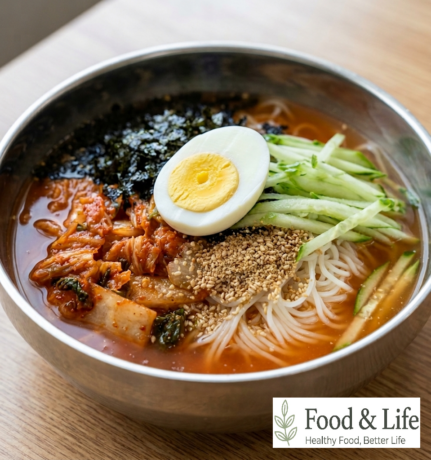
When the weather is hot and you want something refreshing without spending much time at the stove, a cold bowl of noodles is hard to beat.
This Kimchi Mari Guksu (Cold Korean Kimchi Noodles) recipe makes a sweet, tangy, and savory broth without preparing a separate stock. Simply combine cold water with kimchi brine, vinegar, sugar, and Korean tuna extract, then top the noodles with well-fermented kimchi, crisp cucumber, and a boiled egg.
Ready in about 15 minutes, this easy Korean noodle dish makes a satisfying meal with a refreshing broth and pleasantly chewy noodles.
Enjoy it extra cold with a lightly slushy broth for an especially refreshing finish.
⏱️ Cooking Time: About 15 minutes
🍳 Difficulty: ★☆☆☆☆
✓ Ingredients
🥣 Main Ingredients
- 100 g (3.5 oz) somyeon (thin Korean wheat noodles)
- 2/3 Korean paper cup baechu kimchi (about 120 ml / 4.1 fl oz)
- 1 boiled egg
- A small amount of cucumber
- A small amount of roasted seaweed flakes
- 1 tbsp sesame seeds
🧂 Broth & Seasonings
- 400 ml (13.5 fl oz) cold water
- 3 tbsp kimchi brine
- 3 tbsp brewed vinegar
- 1 tbsp sugar
- 1 tbsp Korean tuna extract (chamchi-aek)
(Measurement guide: 1 tbsp = 15 ml, 1 tsp = 5 ml, 1 Korean paper cup = 180 ml / 6.1 fl oz)
✓ How to Make Kimchi Mari Guksu
- Make the cold broth: Pour 400 ml (13.5 fl oz) cold water into a bowl. Add the kimchi brine, brewed vinegar, sugar, and Korean tuna extract, then stir until the sugar completely dissolves. Place the broth in the freezer briefly after mixing if you want it lightly slushy and extra cold.
- Prepare the toppings: Slice the well-fermented baechu kimchi and cucumber into easy-to-eat strips. Cut the boiled egg in half lengthwise.
- Cook the somyeon: Add the somyeon to boiling water, spreading the noodles out as they go in. Cook for 3 minutes 30 seconds, adding a little cold water whenever the water begins to boil over. Adding cold water in stages helps the noodles cook evenly while maintaining their chewy texture.
- Rinse the noodles: Immediately transfer the cooked somyeon to cold water and rub the noodles gently between your hands to wash away the surface starch. Drain thoroughly in a colander. Removing the starch well keeps the broth clear and helps the noodles stay pleasantly springy.
- Assemble the noodles: Arrange the well-drained somyeon in a serving bowl and pour over the cold broth. Top with the sliced kimchi, cucumber, boiled egg, roasted seaweed flakes, and sesame seeds.
✓ Key Tips for Success
- Starchy noodles can make the broth cloudy and soften the texture: After cooking, rinse the somyeon thoroughly in ice water or cold water, gently rubbing the noodles with your hands to remove as much surface starch as possible.
- The flavor depends heavily on your kimchi brine: Saltiness and acidity vary depending on the kimchi, so taste the finished broth and make small adjustments to the vinegar or sugar as needed.
✓ Serving Tips
- For a richer savory flavor, replace part of the water with store-bought dongchimi naengmyeon broth at a 1:1 ratio.
- Lightly toss the kimchi with 1 tsp sesame oil and 1/2 tsp sugar before using it as a topping for an extra nutty, savory flavor.
- Add 3 to 4 ice cubes just before serving to keep the noodles and broth cold throughout the meal.
✓ How to Choose Good Baechu Kimchi
- Appearance and color: Look for kimchi with a natural red color from the gochugaru and cabbage leaves that still hold their shape without becoming overly soft.
- Brine and fermentation: Choose kimchi with a clean-looking brine and a properly fermented flavor that tastes refreshing and pleasantly tangy.
- Texture: The thicker cabbage stems should still feel firm and crisp when pressed. Avoid kimchi that has become excessively soft or has an unpleasant fermented odor.
✓ Baechu Kimchi Nutrition per 100 g (3.5 oz)
| Nutrient | Amount per 100 g (3.5 oz) |
|---|---|
| Calories | 38.00 kcal |
| Carbohydrates | 6.49 g |
| Protein | 1.98 g |
| Fat | 0.43 g |
| Sodium | 551.00 mg |
Based on 100 g (3.5 oz) of baechu kimchi. Actual nutritional values may vary depending on the variety, part of the ingredient, product, and preparation method.
Source: Ministry of Food and Drug Safety Food Nutrition Database – Raw Ingredient Foods
✓ Frequently Asked Questions (FAQ)
Q1. Why do you add cold water while cooking somyeon?
Adding small amounts of cold water helps prevent the pot from boiling over while briefly lowering the water temperature. This helps the noodles cook more evenly from the surface to the center and keeps them pleasantly chewy.
Q2. Why does the broth become diluted and the noodles turn soft while eating Kimchi Mari Guksu?
This can happen when the noodles are not drained thoroughly or when too much ice melts into the broth. Drain the rinsed noodles very well and, if possible, chill the broth in the freezer until it becomes lightly slushy instead of relying on a large amount of ice.
Q3. What can I use instead of Korean tuna extract?
You can substitute an equal amount of anchovy fish sauce or sand lance fish sauce. For a cleaner, milder flavor, the same amount of tsuyu or brewed soy sauce can also be used.
If you have well-fermented kimchi on hand, this easy Kimchi Mari Guksu recipe is a simple way to make a refreshing meal without preparing a separate broth. The sweet and tangy kimchi broth pairs with chewy somyeon and crisp kimchi for a cool, satisfying bowl of Korean noodles.
Save or bookmark this recipe for the next time you want a quick and refreshing meal, and share it with someone who enjoys Korean food.
More easy-to-follow Korean recipes and practical cooking tips will be added regularly. 😊
If there is a Korean dish you would like to see next, feel free to leave a comment with your request. 😊