
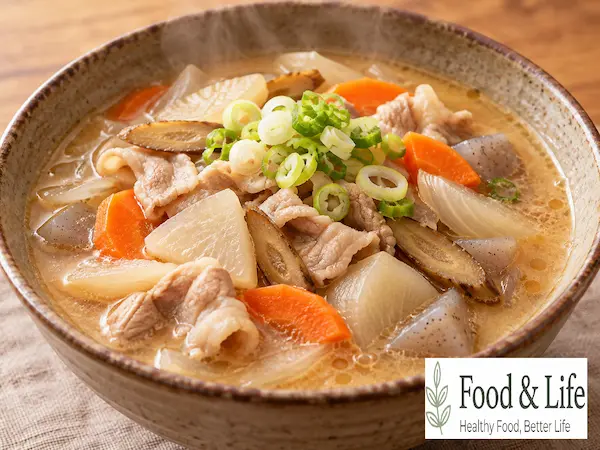
When making Japanese pork miso soup at home, it is better to sauté the pork and vegetables first rather than adding everything directly to the broth. This extra step brings out more flavor from each ingredient and gives the soup a deeper, more savory taste.
Tonjiru (Japanese Pork Miso Soup) is made by sautéing thinly sliced pork belly with burdock root, daikon, carrot, and konjac, then simmering everything with water and Hondashi before adding miso. The burdock root is browned first to bring out its earthy aroma. Of the 3 tablespoons of miso, 2 tablespoons are simmered for 7 minutes, while the final tablespoon is added near the end to preserve more of the miso aroma. The richness of the pork, gentle sweetness of the root vegetables, and deep savory flavor of miso come together in a hearty soup packed with tender ingredients.
⏱️ Cooking Time: About 25 minutes
🍳 Difficulty: ★★☆☆☆
✓ Ingredients (Serves 2)
🥣 Main Ingredients
- 100 g (3.5 oz) thinly sliced pork belly
- 1/2 onion
- 1/4 green onion
- 1/4 burdock root, about 70 g (2.5 oz)
- 1/4 carrot, about 50 g (1.8 oz)
- 3 cm (1.2-inch) piece daikon radish, about 100 g (3.5 oz)
- 50 g (1.8 oz) konjac, optional
🧂 Sauce & Seasonings
- Cooking oil
- 500 ml (16.9 fl oz) water
- 1 tsp Hondashi
- 1 tbsp Cheongha
- 1 tbsp mirin
- 3 tbsp miso
(Measurement guide: 1 tbsp = 15 ml (0.5 fl oz), 1 tsp = 5 ml, 1 Korean paper cup = 180 ml (6.1 fl oz))
✓ How to Make Tonjiru
- Prep the ingredients: Cut 100 g (3.5 oz) thinly sliced pork belly into bite-size pieces and slice 1/2 onion. Thinly slice 1/4 green onion and set it aside. Lightly scrape the skin from 1/4 burdock root with the back of a knife, then slice it thinly on a diagonal. Cut 1/4 carrot in half lengthwise and slice into thin half-moons. Quarter the 3 cm (1.2-inch) piece of daikon lengthwise, then cut it into 4–5 mm (about 1/4-inch) fan-shaped slices. Tear 50 g (1.8 oz) konjac into bite-size pieces with a spoon to create a rough surface.
- Brown the burdock root: Add a small amount of cooking oil to a pot. Cook the prepared burdock root over medium heat until lightly browned, then remove it from the pot and set aside.
- Cook the pork belly: With the burner turned off, add 100 g (3.5 oz) thinly sliced pork belly to the still-hot pot. Stir until the pink color disappears. If the pot cools down too much, turn the heat back on to medium.
- Sauté the vegetables and konjac: Add the onion, daikon, carrot, and konjac and sauté them together. Once the daikon has absorbed some of the pork fat and starts to turn translucent, return the browned burdock root to the pot.
- Add the broth ingredients: Pour in 500 ml (16.9 fl oz) water, then add 1 tsp Hondashi, 1 tbsp Cheongha, and 1 tbsp mirin. Bring to a boil.
- Add the first portion of miso: Once the soup begins to boil, place 2 tbsp miso in a fine-mesh strainer and gradually dissolve it into the broth by ladling hot soup over it. Simmer for 7 minutes so the miso flavor can season the pork and vegetables.
- Finish with the remaining miso and green onion: Dissolve the remaining 1 tbsp miso into the broth, add the sliced green onion, and simmer for 1 more minute before serving.
✓ Key Tips for Success
- Sauté the vegetables thoroughly for a deeper broth: After adding the onion, daikon, carrot, and konjac to the pork belly, do not add the water right away. Sauté everything until the daikon absorbs some of the fat and begins to turn translucent. This helps build a deeper flavor in the finished soup.
- Do not add all 3 tablespoons of miso at the beginning: Dissolve 2 tablespoons of miso into the soup first and simmer for 7 minutes. Add the final tablespoon near the end so the characteristic aroma of the miso remains more noticeable instead of fading during prolonged cooking.
✓ Serving Tips
- Tonjiru is especially flavorful when served immediately after adding the final portion of miso and green onion and simmering for 1 minute. This keeps the aromas of both ingredients more distinct.
- With plenty of pork and root vegetables, this soup pairs well with a bowl of warm rice for a filling meal.
✓ How to Choose Good Pork Belly
- Meat and fat color: Choose pork belly with bright light pink to reddish-pink lean meat and clean, milky-white fat.
- Firmness and surface condition: The meat should spring back quickly when gently pressed and should not have excessive liquid or stickiness on the surface.
- Balance of fat and lean meat: Look for pork belly with evenly alternating layers of meat and fat and a grain that does not appear excessively coarse.
✓ Pork Belly Nutrition per 100 g (3.5 oz)
| Nutrient | Amount per 100 g (3.5 oz) |
|---|---|
| Calories | 372.00 kcal |
| Carbohydrates | 0.00 g |
| Protein | 13.90 g |
| Fat | 33.31 g |
| Sodium | 56.00 mg |
Based on 100 g of raw pork belly listed in the Ministry of Food and Drug Safety raw ingredient database. Actual nutrition values may vary depending on breed, cut, product, and cooking method.
Source: Ministry of Food and Drug Safety Food Nutrition Database – Raw Ingredients
✓ Frequently Asked Questions (FAQ)
Q1. When should I add the miso when making tonjiru?
Add 2 of the 3 tablespoons of miso once the broth starts boiling and simmer for 7 minutes. Stir in the remaining 1 tablespoon near the end so the soup keeps more of its rich miso aroma.
Q2. Why does my tonjiru taste bland or lack depth?
If you add the water before thoroughly sautéing the pork and vegetables, less flavor develops in the pot. Sauté the ingredients until the daikon starts to turn translucent after absorbing some of the pork fat, then add the water.
Q3. Do I have to add konjac to tonjiru?
No. Konjac is optional, but it adds a pleasant chewy texture. If you use it, tear it into bite-size pieces with a spoon instead of cutting it neatly with a knife. The rough surface creates more area for the broth to cling to.
The finished soup has a deep, comforting miso flavor enriched by the savory fat from the thinly sliced pork belly. Daikon and carrot become tender and add a mild natural sweetness, while the chewy konjac provides a pleasant contrast to the soft vegetables.
Browning the burdock root first brings out its distinctive earthy, roasted aroma, which pairs particularly well with the pork. Adding the final portion of miso near the end also gives the broth a more noticeable fermented soybean aroma. Finished with fresh green onion, the soup becomes a hearty bowl filled with plenty of vegetables and pork.
What makes this dish especially satisfying is that every spoonful contains more than just broth. The thin pork belly stays tender, while burdock root, daikon, and carrot each contribute their own flavor and texture. Although there are several ingredients to prepare, the actual cooking process is straightforward because everything is sautéed and simmered in the same pot.
If you are looking for a warm, hearty soup packed with pork and vegetables, try this easy Tonjiru recipe. The deep miso flavor and variety of textures make it a comforting choice for a family meal, especially when served with warm rice.
Save or bookmark this recipe so you can easily find it again later, and share it if you found it helpful.
I’ll continue sharing approachable recipes and practical cooking tips that are easy to follow at home. 😊
If there is a dish you would like to see next, feel free to leave a comment. 😊