
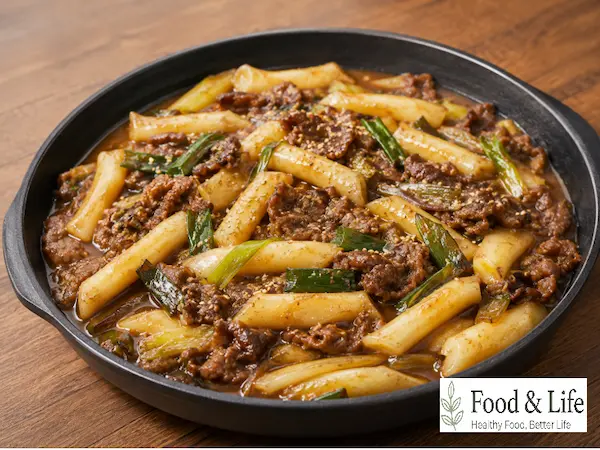
If you want tteokbokki without the heat, Ryu Soo-young’s Gungjung Tteokbokki is a sweet and savory soy sauce version made with thinly sliced beef and Korean rice cakes.
The recipe starts by charring green onions over high heat for 2 minutes without oil, then stir-frying the beef with soy sauce, oyster sauce, and sugar. A 238 ml (8.0 fl oz) can of pear beverage adds gentle sweetness without requiring a separate marinade. Everything comes together in one skillet in about 20 minutes.
The chewy rice cakes and tender beef soak up the rich soy-based sauce, making this a great option when you want a milder, non-spicy style of tteokbokki.
⏱️ Cooking Time: About 20 minutes
🍳 Difficulty: ★★☆☆☆
✓ Ingredients
🥣 Main Ingredients
- 200 g (7 oz) thinly sliced beef for bulgogi
- 500 g (17.6 oz / 1.1 lb) Korean rice cakes for tteokbokki
- 2 green onions
- 2 pinches salt
- 1 swirl cooking oil
- 100 ml (3.4 fl oz) water
- 1 tbsp sesame oil
- Sesame seeds, as needed
🧂 Sauce & Seasonings
- 1 tbsp minced garlic
- 6 tbsp soy sauce
- 2 tbsp oyster sauce
- 2 tbsp sugar
- 1 can pear beverage (238 ml / 8.0 fl oz)
Measurement guide: 1 tbsp = 15 ml, 1 tsp = 5 ml, 1 Korean paper cup = 180 ml (6.1 fl oz)
✓ How to Make Gungjung Tteokbokki
- Prep the ingredients: Separate the beef slices one by one and cut them into bite-size pieces. Split the 2 green onions lengthwise and cut them into 5 cm (2-inch) pieces. Rinse the 500 g (17.6 oz / 1.1 lb) rice cakes briefly under cold water and drain.
- Char the green onions: Place the prepared green onions in a preheated dry skillet. Without turning them, cook over high heat for 2 minutes until the surface develops dark charred spots. Charring the green onions without oil first helps mellow their sharpness and brings out a roasted aroma.
- Cook the beef: Add 1 swirl of cooking oil, then add the 200 g (7 oz) thinly sliced beef and 2 pinches of salt. Stir-fry evenly.
- Add the garlic: Once the red color of the beef has disappeared, reduce the heat to medium. Add 1 tbsp minced garlic and stir-fry so the garlic aroma coats the beef.
- Build the soy sauce base: Pour 6 tbsp soy sauce directly onto the bottom of the skillet and let it bubble briefly. Add 2 tbsp oyster sauce and 2 tbsp sugar, then stir-fry lightly. Heating the soy sauce directly in the skillet helps develop a deeper cooked-soy aroma.
- Add the rice cakes and liquid: Add the rinsed rice cakes, 1 can pear beverage (238 ml / 8.0 fl oz), and 100 ml (3.4 fl oz) water. Increase the heat to high and bring everything to a boil.
- Reduce the sauce: Once the sauce comes to a boil, reduce to medium heat and cook for 3 minutes. Then lower the heat and simmer gently until the sauce thickens. It is ready when you drag a spatula across the bottom of the skillet and a clear trail briefly remains.
- Finish: Turn off the heat. Add 1 tbsp sesame oil and a little sesame seed, then toss everything together until evenly coated.
✓ Key Tips for Success
- Char the green onions properly: If you add oil from the beginning or keep turning the green onions, they may not develop enough color. Leave one side in contact with a dry skillet over high heat for 2 minutes to create dark charred spots and a roasted aroma.
- Reduce the sauce enough: If you stop cooking while there is still too much liquid, the soy sauce seasoning will not cling well to the rice cakes. Finish over low heat until a clear trail remains when you scrape the bottom of the skillet with a spatula.
✓ Serving Tips
- Add shiitake mushrooms or onion: If you want to use shiitake mushrooms or thinly sliced onion, add them while stir-frying the beef.
- Make it spicy: If you prefer a little heat, add sliced Cheongyang chili peppers near the end of cooking or finish with extra black pepper.
- Use the leftover sauce: If there is rich beef sauce left after eating the rice cakes, stir-fry it with warm rice and crushed roasted seaweed to make fried rice.
✓ How to Choose Good Beef
- Color and sheen: Look for beef with bright, vivid red lean meat rather than meat that appears excessively dark. The surface should also have a natural sheen.
- Fat color and distribution: Choose beef with light, milky-white fat rather than fat that looks overly yellow, and look for fat that is evenly distributed through the lean meat.
- Firmness and grain: The beef should feel resilient when lightly pressed and return toward its original shape. The grain should not appear excessively coarse.
✓ Beef Nutrition per 100 g (3.5 oz)
| Nutrient | Amount per 100 g (3.5 oz) |
|---|---|
| Calories | 162.00 kcal |
| Carbohydrates | 0.00 g |
| Protein | 23.00 g |
| Fat | 6.92 g |
| Sodium | 50.00 mg |
Based on 100 g of raw Korean Hanwoo beef, Grade 1, round cut. Actual nutrition may vary depending on breed, cut, product, and cooking method.
Source: Ministry of Food and Drug Safety Food Nutrition Database – Raw Food Ingredients
✓ Frequently Asked Questions (FAQ)
Q1. How should I adjust the heat and cooking time when making Gungjung Tteokbokki?
Once the sauce comes to a boil, cook over medium heat for 3 minutes, then reduce to low heat and simmer until the sauce thickens. It is ready when a clear trail remains briefly after scraping the bottom of the skillet with a spatula.
Q2. Why does the beef turn tough or clump together?
Thinly sliced bulgogi beef can become tough if it is added in one clump or cooked for too long. Separate the slices before cooking, cut them into bite-size pieces, and stir-fry only until the red color disappears.
Q3. Can I use fresh pear instead of pear beverage?
You can grate or juice fresh pear, but the sweetness and consistency may differ from the original pear beverage. To keep the original seasoning ratio, use 1 can of pear beverage, 238 ml (8.0 fl oz), as written in the recipe.
Ryu Soo-young’s Gungjung Tteokbokki combines chewy Korean rice cakes and tender beef with a rich, sweet-savory soy sauce. Charring the green onions first adds another layer of roasted flavor, while the pear beverage helps build sweetness without requiring a separate marinating step.
Because the beef does not need to be marinated in advance, this Gungjung Tteokbokki recipe comes together in one skillet in about 20 minutes. It works well as a simple meal or snack when you want a milder alternative to spicy tteokbokki.
For the best finish, let the sauce reduce gently over low heat until it clings well to the rice cakes.
Save or bookmark this recipe for later, and share it with someone who enjoys Korean food.
More easy-to-follow recipes and practical cooking tips are coming soon. 😊
If there is a dish you would like to see featured, feel free to leave a comment. 😊