
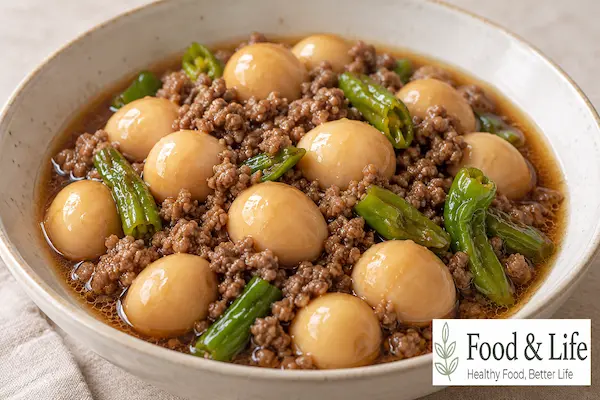
Beef and quail egg jangjorim is a Korean soy-braised side dish that usually takes time when made with large cuts of beef. Jung Ho-young’s version skips the long boiling and shredding process by using ground beef, making it possible to prepare this easy jangjorim in about 15 minutes.
The key is to add 200 g (7 oz) of ground beef to the water with minced garlic before it comes to a boil, then break the meat apart thoroughly. This keeps the beef from clumping and gives it a fine, tender texture throughout the sauce. The quail eggs are simmered in a savory mixture of soy sauce, cooking wine, sugar, corn syrup, and tuna extract sauce, while kkwari-gochu (Korean wrinkled peppers) are added at the end for extra aroma.
The salty, soy-braised quail eggs pair well with the small pieces of seasoned beef, making this a convenient Korean side dish to serve with warm rice.
⏱️ Cooking Time: About 15 minutes
🍳 Difficulty: ★☆☆☆☆
✓ Ingredients
🥣 Main Ingredients
- 200 g (7 oz) ground beef
- 200 g (7 oz) quail eggs
- 10 kkwari-gochu (Korean wrinkled peppers), optional
🧂 Sauce & Seasonings
- 500 ml (16.9 fl oz) water
- 1 tbsp minced garlic
- 100 ml (3.4 fl oz) cooking wine
- 2 tbsp sugar
- 2 tbsp corn syrup
- 100 ml (3.4 fl oz) soy sauce
- 1 tbsp tuna extract sauce
(Measurement guide: 1 tbsp = 15 ml, 1 tsp = 5 ml, 1 Korean paper cup = 180 ml / 6.1 fl oz)
✓ How to Make Beef and Quail Egg Jangjorim
- Break up the ground beef: Add 500 ml (16.9 fl oz) water, 1 tbsp minced garlic, and 200 g (7 oz) ground beef to a pot or deep skillet. Before turning on the heat, stir and separate the beef thoroughly with chopsticks so it does not form large clumps.
- Skim off the foam: Turn the heat to high and bring the mixture to a boil. As foam from the beef rises to the surface, carefully skim it off with a ladle.
- Add the seasonings: After removing the foam, add 100 ml (3.4 fl oz) cooking wine, 2 tbsp sugar, 2 tbsp corn syrup, 100 ml (3.4 fl oz) soy sauce, and 1 tbsp tuna extract sauce in that order. Stir well to combine.
- Simmer the quail eggs: Add 200 g (7 oz) quail eggs to the seasoned broth and continue cooking. Skim off any additional foam that rises to the surface, then simmer until the quail eggs are evenly stained with the soy sauce mixture.
- Prepare the peppers: Remove the stems from 10 kkwari-gochu, rinse them well, and cut them into 2–3 cm (about 1-inch) pieces.
- Finish with the peppers: Once the quail eggs have taken on an appetizing soy-braised color, add the chopped peppers. Cook briefly, just until the peppers soften slightly and release their aroma into the sauce.
✓ Key Tips for Success
- Break up the ground beef before the water boils: If ground beef is added after the water is already boiling, the proteins can quickly firm up and stick together in large clumps. Break the beef apart thoroughly with chopsticks while the water is still cold or before it reaches a boil for a finer, softer texture.
- Skim the foam early: If the foam that rises from the beef is not removed as the mixture begins to boil, it can settle back into the broth and make the jangjorim sauce cloudy with a heavier taste. Skim it off carefully with a ladle as soon as it appears.
✓ Serving Tips
- Spoon the ground beef, quail eggs, and some of the sauce generously over warm rice, then add a small pat of butter and mix everything together for an easy jangjorim butter rice bowl.
- Let the finished jangjorim cool slightly before transferring it to an airtight container. Store it in the refrigerator for about one week to maintain its flavor and texture.
- If serving this dish to young children, you can omit the kkwari-gochu or replace them with green onion or bell pepper for a milder version.
✓ How to Choose Good Quail Eggs
- Shell condition: When buying fresh quail eggs in the shell, look for eggs with clearly defined natural spots and firm, intact shells without cracks or visible debris.
- Packaged peeled quail eggs: If buying pre-peeled quail eggs, choose a package with clear packing liquid rather than cloudy liquid. The eggs should have smooth surfaces without splits or damage.
- Smell and firmness: After opening the package, the eggs should not have a sour smell. They should feel firm and springy rather than overly soft.
✓ Quail Egg Nutrition per 100 g (3.5 oz)
| Nutrient | Amount per 100 g (3.5 oz) |
|---|---|
| Calories | 146.00 kcal |
| Carbohydrates | 1.66 g |
| Protein | 12.80 g |
| Fat | 9.02 g |
| Sodium | 137.00 mg |
Based on 100 g of raw quail eggs. Actual nutritional values may vary depending on variety, product, and cooking method.
Source: Korea Ministry of Food and Drug Safety Food Nutrition Database
✓ Frequently Asked Questions (FAQ)
Q1. Why should I add the ground beef before the water boils?
Adding ground beef directly to boiling water can cause the proteins on the surface to firm up quickly, making the meat stick together in larger clumps. Breaking it apart with chopsticks while the water is still cold helps the beef disperse into fine, tender pieces.
Q2. Why does my jangjorim sauce turn cloudy?
The sauce can become cloudy if the foam that rises from the beef is not skimmed off early in the cooking process. Remove the foam carefully as the liquid comes to a boil to keep the sauce cleaner and clearer.
Q3. Do I have to use kkwari-gochu?
No. The peppers add a light aroma and help balance the richness of the soy-braised sauce, but they can be omitted if you prefer a milder dish. You can also substitute green onion or non-spicy bell pepper.
Using ground beef makes this beef and quail egg jangjorim recipe much easier because there is no need to boil a large piece of beef and shred it afterward. The finely separated beef adds savory flavor throughout the soy-braised sauce, while the seasoned quail eggs and aromatic peppers make it a satisfying side dish for rice.
If traditional jangjorim feels too time-consuming, try breaking up the ground beef in cold water before cooking. With a cooking time of about 15 minutes, this version is especially useful when you want to prepare a quick Korean side dish for a busy day.
Save or bookmark this recipe so you can easily find it again, and share it with someone who enjoys Korean home cooking.
More easy-to-follow recipes and practical cooking tips will continue to be added. If there is a dish you would like to see featured next, feel free to leave a comment. 😊
This recipe was prepared after referring to a recipe introduced on chef Jung Ho-young’s YouTube channel, “Jung Ho-young’s Today’s Cooking,” and this post was written based on the cooking process and results.