
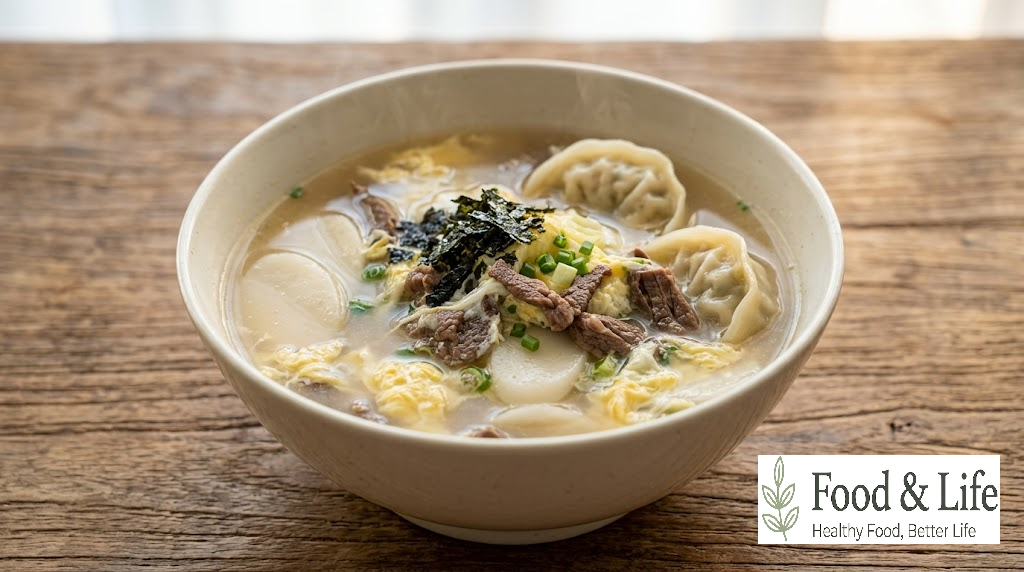
When plain tteokguk doesn’t feel quite filling enough, homemade tteok mandu guk is a comforting way to turn it into a hearty one-bowl meal. This version starts with a clean, savory broth made from dried dipori and kelp, then builds extra depth with sautéed beef and handmade dumplings packed with pork, tofu, and vegetables. Chewy rice cakes and plump dumplings come together in a clear, deeply flavored broth that is satisfying even without many side dishes.
Enjoy the comforting combination of handmade mandu, chewy rice cakes, and a rich yet clean-tasting broth in one warm bowl.
⏱️ Cooking Time: About 40 minutes
🍳 Difficulty: ★★★☆☆
✓ Ingredients
🥣 Main Ingredients
- 200 g (7 oz) sliced tteokguk rice cakes
- 200 g (7 oz) beef for soup or stew, cut into bite-size pieces
- 1 package dumpling wrappers
- 100 g (3.5 oz) ground pork belly
- 1/2 block tofu
- 100 g (3.5 oz) mung bean sprouts
- 100 g (3.5 oz) garlic chives
- 1 onion
- 2 large green onions
- 1 handful glass noodles
- 3 eggs (1 for the dumpling filling, 2 for the soup)
- 16 dried dipori (dried big-eyed herring for broth)
- 1 large sheet kelp
- 1 tbsp cooking oil
- 1.5 L (50.7 fl oz) water
🧂 Seasonings
- 3 tbsp tuna extract sauce (1 tbsp for the dumpling filling, 2 tbsp for the broth)
- 1.5 tbsp regular soy sauce
- 1 tbsp Korean soup soy sauce (guk-ganjang)
- 3.5 tbsp cooking wine (1.5 tbsp for the dumpling filling, 2 tbsp for the broth)
- 1.5 tbsp sugar
- 1/2 tbsp minced garlic
- 1/3 tbsp salt
- Black pepper, to taste
(Measurement guide: 1 tbsp = 15 ml, 1 tsp = 5 ml, 1 Korean paper cup = 180 ml / 6.1 fl oz)
✓ How to Make Homemade Tteok Mandu Guk
- Make the broth: Bring 1.5 L (50.7 fl oz) of water to a boil in a pot. Add the dried dipori and kelp, reduce to medium-low heat, and gently simmer to extract the flavor. Remove the solids afterward. Keeping the heat low helps create a clear, deeply savory seafood broth without excessive bitterness or a thick, slimy texture from the kelp.
- Prepare the vegetables for the dumpling filling: Blanch the glass noodles and mung bean sprouts in boiling water, rinse them under cold water, and chop finely. Finely chop the onion, green onions, and garlic chives as well.
- Mix the dumpling filling: In a large bowl, combine the ground pork belly, tofu crushed with the back of a knife, prepared vegetables, 1 egg, 1/2 tbsp minced garlic, 1 tbsp tuna extract sauce, 1.5 tbsp regular soy sauce, 1.5 tbsp cooking wine, and 1.5 tbsp sugar. Knead and mix until the filling becomes cohesive and slightly sticky.
- Shape the dumplings: Lightly wet the edges of each dumpling wrapper with water and place an appropriate amount of filling in the center. Fold into a half-moon or round shape and press the edges firmly to seal. Make sure there are no gaps so the wrappers do not open while cooking in the soup.
- Sauté the beef and add the broth: Heat 1 tbsp cooking oil in a separate pot and sauté the beef until the outside is cooked. Pour in 1 L (33.8 fl oz) of the prepared dipori broth.
- Add the rice cakes: Add 200 g (7 oz) of tteokguk rice cakes that have been soaked in cold water. Cook together until the broth comes back to a boil.
- Season the broth: Once boiling, add 2 tbsp tuna extract sauce, 1 tbsp Korean soup soy sauce, 2 tbsp cooking wine, 1/3 tbsp salt, and a little black pepper. Stir gently to season the broth.
- Cook the dumplings: When the rice cakes begin to float to the surface, add the handmade dumplings. Simmer for about 3–4 minutes, until the dumpling wrappers become translucent.
- Finish with the eggs: Beat the remaining 2 eggs and slowly pour them in a circular motion over the surface of the soup. Turn off the heat immediately, cover the pot, and let the residual heat gently set the eggs until soft and fluffy.
✓ Key Tips for Success
- Handle the dumplings gently: Stirring too vigorously after adding the dumplings can tear the wrappers and make the broth cloudy. Instead, gently move a spatula along the bottom of the pot if needed. After pouring in the beaten eggs, turn off the heat immediately so they set into soft, tender ribbons rather than becoming tough.
✓ Serving Tips
- Add simple garnishes: Top the finished soup with roasted seaweed flakes and finely sliced green onion for extra savory flavor and aroma.
- Use store-bought dumplings for convenience: If making homemade mandu feels too time-consuming, you can use large frozen Korean dumplings instead to significantly shorten the preparation time.
- For a spicier finish: If you prefer a little heat, add 1/2 finely sliced Cheongyang chili pepper to the broth or finish with a generous amount of black pepper.
✓ How to Choose Tteokguk Rice Cakes
- Appearance and color: Look for rice cakes with a smooth surface and an even milky-white color. Avoid pieces with cracks or chalky white patches caused by moisture loss.
- Density and firmness: Choose rice cakes that feel firm and dense when lightly pressed and do not crumble easily. Firmer rice cakes are less likely to become overly soft during cooking.
- Package condition: Check that the sealed package is free of mold or foreign matter. Avoid products with an excessively strong alcohol-like sanitizing smell or a sharp sour fermented odor.
✓ Tteokguk Rice Cake Nutrition per 100 g (3.5 oz)
| Nutrient | Amount per 100 g (3.5 oz) |
|---|---|
| Calories | 213.00 kcal |
| Carbohydrates | 48.80 g |
| Protein | 3.71 g |
| Fat | 0.37 g |
| Sodium | 261.00 mg |
Based on 100 g (3.5 oz) of garaetteok made from non-glutinous rice. Actual nutrition may vary depending on the product and cooking method.
Source: Ministry of Food and Drug Safety Food Nutrition Database – Raw Food Ingredients
✓ Frequently Asked Questions (FAQ)
Q1. In what order should I add the rice cakes and dumplings, and how long should they cook?
The rice cakes take longer to cook through, so add the soaked rice cakes first. Once they begin floating to the surface, add the dumplings and simmer for another 3–4 minutes, until the dumpling wrappers turn translucent.
Q2. Why do my dumplings break open and make the broth cloudy while cooking?
This usually happens when the edges of the wrappers are not sealed firmly enough or when the dumplings are stirred too aggressively after being added to the soup. Wet and press the edges thoroughly when shaping them, then avoid stirring once they are in the broth and only gently move along the bottom of the pot if necessary.
Q3. Can I substitute dried anchovies or store-bought beef bone broth if I don’t have dipori?
Yes. You can use gutted dried anchovies to make a clean seafood broth. If using store-bought beef bone broth, you can skip sautéing the beef and bring the broth directly to a boil for a richer, more savory soup.
A clean broth made with dried dipori and kelp, combined with sautéed beef and handmade dumplings, creates a homemade tteok mandu guk with both depth and a light, savory finish. With chewy rice cakes and generously filled dumplings in every bowl, it works well as a hearty family meal without needing many additional side dishes.
Save or bookmark this recipe for the next time you want a comforting Korean soup, and share it with someone who enjoys Korean food.
More approachable Korean recipes and practical cooking tips will continue to be shared here. 😊
If there is a Korean dish you have been curious about or a recipe you would like to see next, feel free to leave a comment. 😊