
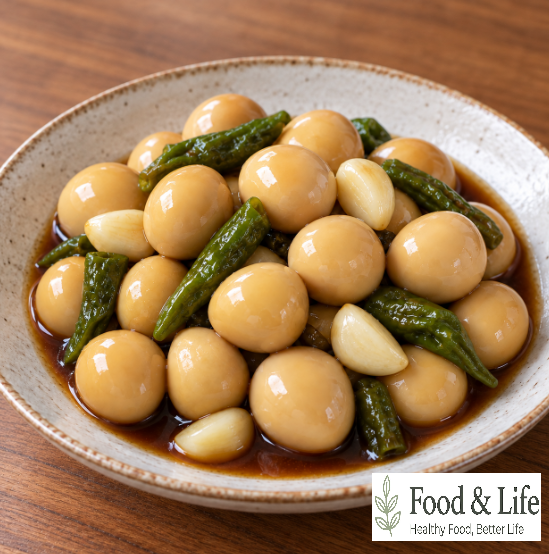
Soy-braised quail eggs (jangjorim) are a classic Korean side dish made by simmering 1 kg (2.2 lb) of peeled quail eggs with 800 ml (27.1 fl oz) of water, soy sauce, brown sugar, whole garlic cloves, and Korean shishito peppers. Adding the garlic and peppers at different stages keeps the seasoning balanced while giving the eggs a rich brown color and glossy finish without making them overly salty.
Once the braising liquid comes to a boil, the whole garlic cloves are simmered for about 5 minutes. The peppers are added only during the final 5 minutes, which helps preserve their fresh aroma and color while keeping the quail eggs pleasantly springy.
Using ready-to-eat peeled quail eggs also eliminates the need to boil and peel them yourself, so this easy soy-braised quail eggs recipe takes only about 20 minutes. The sweet-savory sauce soaks evenly into the eggs, while tender garlic and aromatic peppers make this a flavorful side dish to serve with steamed rice.
⏱️ Cooking Time: About 20 minutes
🍳 Difficulty: ★★☆☆☆
✓ Ingredients
🥣 Main Ingredients
- 1 kg (2.2 lb) peeled quail eggs
- 20 whole garlic cloves
- 10 Korean shishito peppers (kkwari-gochu)
🧂 Sauce & Seasonings
- 800 ml (27.1 fl oz / about 3 1/3 US cups) water
- 120 ml (4.1 fl oz / 1/2 US cup) brewed soy sauce
- 90 ml (about 3/8 US cup by volume) brown sugar
- 90 ml (3 fl oz / about 3/8 US cup) cooking wine
- 30 ml (2 tbsp) tuna extract seasoning sauce
(Original measurement guide: 1 tbsp = 15 ml, 1 tsp = 5 ml, 1 Korean paper cup = 180 ml)
✓ How to Make Soy-Braised Quail Eggs
- Rinse the quail eggs: Drain 1 kg (2.2 lb) of peeled quail eggs in a colander. Rinse them thoroughly under running water about twice, then drain well.
- Add the eggs and seasonings to the pot: Place the rinsed quail eggs in a pot. Add 800 ml (27.1 fl oz) water, 120 ml brewed soy sauce, 90 ml brown sugar, 90 ml cooking wine, and 30 ml (2 tbsp) tuna extract seasoning sauce. Bring to a boil over high heat.
- Add the garlic: Once the braising liquid begins to boil, add 20 whole garlic cloves and cook for about 5 minutes.
- Add the peppers and reduce the sauce: Add 10 Korean shishito peppers cut into bite-size pieces. Continue cooking for about 5 more minutes, until the braising liquid has reduced to a shallow level, then remove from the heat.
✓ Key Tips for Success
- Add the peppers at the right time: If the Korean shishito peppers are added from the beginning, they can turn yellowish and become too soft. Add them only after the quail eggs have taken on enough soy sauce color, then cook them briefly to preserve their aroma and green color.
✓ Serving Tips
- Spoon the braised quail eggs over warm rice with 2–3 spoonfuls of the braising liquid. Add a small amount of butter and mix everything together for a simple rice bowl.
- For more heat, replace the Korean shishito peppers with 2–3 sliced Cheongyang chili peppers and add them during the final stage of cooking.
- Unlike regular egg jangjorim, quail eggs are small enough to eat in one bite. Try one quail egg together with a whole garlic clove and a piece of pepper for a balanced combination of flavors.
✓ How to Choose Good Quail Eggs
- Shell condition: When buying fresh quail eggs in their shells, look for eggs with distinct speckled patterns and firm, intact shells without cracks or visible debris.
- Packaging of peeled quail eggs: For packaged peeled quail eggs, choose products with clear packing liquid rather than cloudy liquid. The eggs should have smooth surfaces without visible splitting or breakage.
- Smell and texture: After opening the package, the eggs should not have a sour smell. They should feel firm rather than mushy and retain a springy texture.
✓ Quail Egg Nutrition per 100 g (3.5 oz)
| Nutrient | Amount per 100 g (3.5 oz) |
|---|---|
| Calories | 146.00 kcal |
| Carbohydrates | 1.66 g |
| Protein | 12.80 g |
| Fat | 9.02 g |
| Sodium | 137.00 mg |
Based on 100 g of raw quail eggs. Actual nutrition values may vary depending on the variety, product, and cooking method.
Source: Ministry of Food and Drug Safety Food Nutrition Database
✓ Frequently Asked Questions (FAQ)
Q1. Why do my braised quail eggs become tough and wrinkled?
They have likely been simmered too long, causing too much moisture to cook out. Stop cooking once the braising liquid has reduced to a shallow level rather than continuing to simmer the eggs for too long.
Q2. Can I use light brown sugar or white sugar instead of dark brown sugar?
Yes. Light brown sugar or white sugar can provide the sweetness, but dark brown sugar gives the eggs the deeper brown color and distinctive savory-sweet flavor used in this recipe.
Q3. What can I use instead of Korean shishito peppers?
For a spicier version, use 2–3 sliced Cheongyang chili peppers instead. Add them during the final stage of cooking, just as you would the Korean shishito peppers.
Following the seasoning ratio and cooking order in this recipe gives the quail eggs a balanced combination of savory soy sauce and mild sweetness from the brown sugar. Because the braising liquid is not reduced for too long, the eggs keep their springy texture, while the whole garlic becomes tender and the peppers added at the end retain their aroma.
If you’re looking for an easy soy-braised quail eggs recipe that isn’t too salty, simply simmer the peeled quail eggs with the seasonings, cook the garlic for 5 minutes, then add the peppers for the final 5 minutes. With no boiling or peeling required, this Korean side dish is ready in about 20 minutes and is easy to serve with everyday meals.
Save or bookmark this recipe so you can quickly find it again, and share it with someone who enjoys Korean food.
I’ll continue sharing practical, easy-to-follow recipes and useful cooking tips. If there’s a dish you’d like to see next, feel free to leave a comment. 😊