
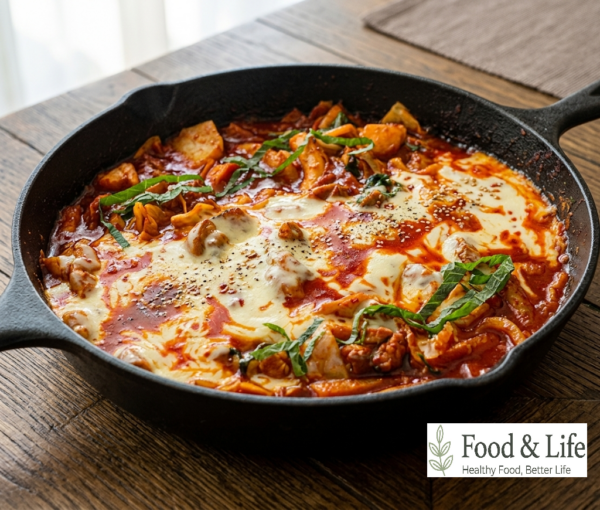
Yano Shiho’s Cheese Dakgalbi is a rich, spicy-sweet Korean chicken dish made with 500 g (17.6 oz) boneless chicken thighs, gochujang, store-bought bulgogi sauce, and a touch of curry powder. The combination gives the chicken a bold, savory sauce with plenty of depth.
The chicken and sweet potato are first cooked over medium heat for 3–4 minutes. Onion, cabbage, green onion, and tteokbokki rice cakes are then added, and everything is covered and cooked over medium-low heat for another 5 minutes. This helps prevent the sauce from burning while keeping the chicken moist. At the end, 150 g (5.3 oz) mozzarella is added to the center of the pan and melted with the residual heat.
Tender chicken thighs, sweet potato, chewy rice cakes, vegetables, and melted cheese come together in one generous skillet, making this Cheese Dakgalbi recipe a satisfying meal to share.
⏱️ Cooking Time: About 25 minutes
🍳 Difficulty: ★★☆☆☆
✓ Ingredients
🥣 Main Ingredients
- 500 g (17.6 oz) boneless chicken thighs
- 1 sweet potato
- 1/2 onion
- 1/6 head cabbage
- 1/2 stalk green onion
- 100 g (3.5 oz) tteokbokki rice cakes
- 10 perilla leaves
- 150 g (5.3 oz) mozzarella cheese
🧂 Seasonings & Sauce
- 6 turns black pepper from a pepper grinder, for seasoning the chicken
- A little salt, for seasoning the chicken
- 3 tbsp gochujang (Korean chili paste)
- 1 tbsp minced garlic
- 1/2 tsp minced ginger
- 3 tbsp Mirim
- 1 tbsp sugar
- 3 tbsp store-bought bulgogi sauce
- 2 tbsp gochugaru (Korean chili flakes)
- 1/2 tbsp curry powder
- Cooking oil, as needed
(Measurement guide: 1 tbsp = 15 ml (0.5 fl oz), 1 tsp = 5 ml, 1 Korean paper cup = 180 ml (6.1 fl oz))
✓ How to Make Cheese Dakgalbi
- Prepare the ingredients and season the chicken: Cut 500 g (17.6 oz) boneless chicken thighs into bite-size pieces and lightly pierce the meat several times with the tip of a knife. Place in a bowl and season with 6 turns of black pepper and a little salt. Slice 1/2 onion, cut 1 sweet potato into thick matchsticks, slice 1/2 green onion diagonally, cut 1/6 head cabbage into bite-size pieces, and thinly slice 10 perilla leaves.
- Make the Dakgalbi sauce: Add 3 tbsp gochujang, 1 tbsp minced garlic, 1/2 tsp minced ginger, 3 tbsp Mirim, 1 tbsp sugar, 3 tbsp store-bought bulgogi sauce, 2 tbsp gochugaru, and 1/2 tbsp curry powder to a bowl. Mix until evenly combined.
- Season the chicken with the sauce: Add half of the prepared sauce to the seasoned chicken. Mix thoroughly so the sauce evenly coats the meat.
- Cook the chicken and sweet potato first: Add enough cooking oil to a frying pan and heat over medium heat. Place the seasoned chicken on one side of the pan and the sweet potato on the other. Cook for 3–4 minutes, turning frequently so the sauce does not burn.
- Add the vegetables and rice cakes: Once the chicken is partially cooked, mix it with the sweet potato. Add the onion, cabbage, green onion, and tteokbokki rice cakes. Cover and cook over medium-low heat for 5 minutes, mixing everything evenly 1–2 times during cooking.
- Add the remaining sauce: Remove the lid and add the remaining half of the sauce. Stir-fry over medium-low heat until the vegetables soften and the sauce is evenly distributed.
- Melt the cheese and finish: Once the vegetables are cooked, add the sliced perilla leaves and stir-fry briefly. Clear a space in the center of the pan and add 150 g (5.3 oz) mozzarella cheese. Turn off the heat, cover the pan, and let it sit for 5 minutes so the cheese melts with the residual heat.
✓ Key Tips for Success
- Control the heat and turn the chicken often: Chicken coated in a gochujang-based sauce can burn easily over high heat. Keep the heat at medium while cooking it with the sweet potato and turn the pieces frequently.
- Use the lid to cook with the vegetables’ moisture: Once the vegetables and rice cakes are added, covering the pan and cooking over medium-low heat allows moisture from the vegetables to release naturally. This helps prevent sticking and keeps the chicken moist.
✓ Serving Tips
- Wrap with ssam-mu or roasted seaweed: Place some cheese-covered Dakgalbi on tangy ssam-mu (Korean pickled radish slices) or mild roasted seaweed. The fresh, clean flavors balance the rich cheese and spicy sauce.
- Make fried rice with the leftovers: Leave a little chicken and vegetables in the pan and cut them into smaller pieces with kitchen scissors. Add cooked rice, crushed roasted seaweed, and sesame oil, then stir-fry everything together for a savory finish to the meal.
✓ How to Choose Good Chicken Thighs
- Color and sheen: Choose chicken thighs with pale pink meat and cream-colored skin with a natural sheen.
- Firmness and texture: Fresh chicken should feel springy when lightly pressed and quickly return to its original shape. The grain of the meat should also look intact.
- Surface condition: Avoid chicken with excessive slime or stickiness on the surface or an excessive amount of liquid in the package.
✓ Chicken Thigh Nutrition per 100 g (3.5 oz)
| Nutrient | Amount per 100 g (3.5 oz) |
|---|---|
| Calories | 144.00 kcal |
| Carbohydrates | 0.00 g |
| Protein | 19.41 g |
| Fat | 7.67 g |
| Sodium | 84.00 mg |
Based on raw chicken thigh meat per 100 g. Actual nutrition values may vary depending on breed, cut, product, and preparation.
Source: Food Safety Korea Nutrition Information – Chicken Thigh, Raw
✓ Frequently Asked Questions (FAQ)
Q1. How can I make sure the chicken and sweet potato finish cooking at the same time?
Do not cut the sweet potato too thick. Cook it together with the chicken first, then cover the pan after adding the vegetables and cook over medium-low heat so the sweet potato cooks evenly all the way through.
Q2. Why does Dakgalbi stick to the bottom of the pan or burn easily?
The sauce contains gochujang and sugar, which can burn quickly over high heat. Start cooking over medium heat, then reduce the heat and use the moisture released from the vegetables to keep the sauce from sticking.
Q3. Do I have to use store-bought bulgogi sauce in the Dakgalbi seasoning?
The store-bought bulgogi sauce is an important part of this recipe because it conveniently adds a balance of soy-based sweetness and savory flavor. It is best to use it as written, but if unavailable, it can be replaced with a mixture of dark soy sauce and a sweet seasoning, although the final flavor will differ.
Yano Shiho’s Cheese Dakgalbi has a bold spicy-sweet sauce that coats the tender chicken thighs evenly. Curry powder and bulgogi sauce add extra depth, while cooking over medium-low heat with the moisture from the vegetables helps keep the chicken juicy. The melted mozzarella at the end softens the heat and adds a creamy, savory finish.
If you are looking for a hearty Cheese Dakgalbi recipe to make at home or a spicy one-pan meal with plenty of cheese, this version is easy to enjoy. With chicken, sweet potato, rice cakes, and vegetables all cooked together, it works especially well for a weekend dinner or a family meal.
Save or bookmark this recipe so you can easily find it again later, and share it with someone who enjoys Korean food or cheesy skillet dishes.
I’ll continue sharing easy-to-follow recipes and practical cooking tips. 😊
If there is a dish or recipe you would like to see next, feel free to leave a comment. 😊