
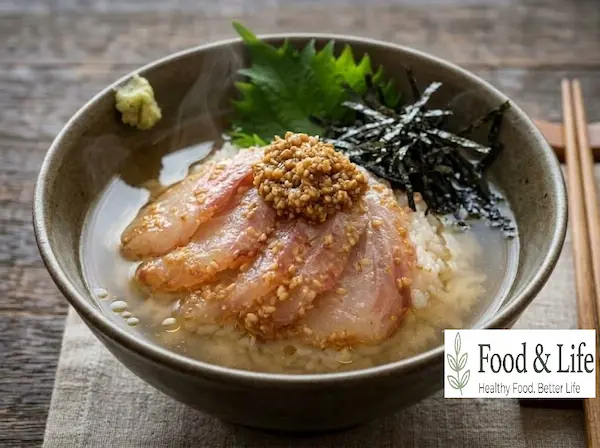
If you want a different way to enjoy delicate sashimi and warm rice, this Japanese rice bowl combines savory sesame seasoning with a clear katsuobushi broth.
This Tai Chazuke recipe starts with thinly sliced sea bream marinated for 5 minutes in goma dare made with mirin, soy sauce, sugar, and crushed sesame seeds. The seasoned fish is arranged over warm rice, then finished with a light broth made by steeping katsuobushi for 3 minutes. The key is to heat the mirin first to cook off the alcohol and to steep the katsuobushi only after turning off the heat.
The firm, delicate sea bream pairs naturally with the nutty sesame sauce and clean bonito broth, giving you several flavors and textures in a single comforting bowl.
⏱️ Cooking Time: About 20 minutes
🍳 Difficulty: ★★☆☆☆
✓ Ingredients for 2 Servings
🥣 Main Ingredients
- 200 g (7 oz) sea bream sashimi
- Warm cooked rice
- Nori, to taste
- Shiso leaves, to taste
- Wasabi, to taste
🧂 Sauce & Broth
- 2 tbsp mirin
- 1.5 tbsp soy sauce
- 1/2 tbsp sugar
- 3 tbsp crushed sesame seeds
- 400 ml (13.5 fl oz) water
- 10 g (0.35 oz) katsuobushi (dried bonito flakes)
(Measurement guide: 1 tbsp = 15 ml, 1 tsp = 5 ml, 1 Korean paper cup = 180 ml)
✓ How to Make Tai Chazuke
- Heat the mirin: Place 2 tbsp mirin in a microwave-safe container and microwave at 700W for 1 minute to cook off the alcohol.
- Make the goma dare: Add 1.5 tbsp soy sauce, 1/2 tbsp sugar, and 3 tbsp crushed sesame seeds to the heated mirin. Mix thoroughly to make the sesame sauce.
- Remove the sea bream skin if needed: If your sea bream fillet still has the skin attached, make a cut near the tail end. Hold the skin firmly with one hand while sliding the knife lengthwise between the skin and flesh to separate them.
- Slice the sea bream: Cut 200 g (7 oz) skinless sea bream into sashimi-style slices that are easy to eat.
- Marinate the sea bream: Add the sliced sea bream to the prepared goma dare and toss gently until evenly coated. Let it marinate for 5 minutes.
- Boil the water: While the sea bream is marinating, add 400 ml (13.5 fl oz) water to a saucepan and bring it to a boil.
- Steep the katsuobushi: Once the water boils, turn off the heat. Add 10 g (0.35 oz) katsuobushi and let it steep for 3 minutes.
- Strain the broth: After 3 minutes, strain the broth through a fine-mesh strainer lined with a paper towel, leaving only the clear katsuobushi broth.
- Assemble the rice bowl: Add warm rice to a serving bowl. Arrange the sea bream that has marinated for 5 minutes on top, then spoon over the remaining goma dare.
- Add garnishes and broth: Garnish with nori, shiso, and wasabi to taste. Pour in as much warm katsuobushi broth as you like and serve.
✓ Key Tips for Success
- Marinate the sea bream for only 5 minutes: Leaving the fish in the goma dare for too long can make the soy-based seasoning overpower the delicate flavor of the sea bream. Toss it evenly in the sauce and keep the marinating time to 5 minutes.
- Steep the katsuobushi after turning off the heat: Do not continue boiling the bonito flakes with the water. Once the water reaches a boil, turn off the heat, add 10 g (0.35 oz) katsuobushi, and steep for 3 minutes. Straining it through a fine-mesh strainer and paper towel helps produce a clean, clear broth.
✓ Serving Tips
- Try the marinated sea bream over warm rice first, almost like a sea bream rice bowl. Then pour in the katsuobushi broth so you can enjoy two different styles from the same bowl.
- Wasabi adds a sharp, aromatic note that balances the nutty goma dare and mild sea bream. Add as much as you prefer.
- If you do not have pre-crushed sesame seeds, lightly crush toasted sesame seeds and use 3 tbsp. This preserves both the sesame texture and nutty flavor.
✓ How to Choose Good Red Sea Bream
- Firm flesh: Choose red sea bream with flesh that feels firm rather than soft when gently pressed.
- Clear eyes: If buying a whole fish, check that the eyes look clear rather than cloudy.
- Smell: Choose fresh fish without a strong or unpleasant fishy odor.
Source: Korean Seafood Safety Information Service – Red Sea Bream, Queen of the Sea
✓ Red Sea Bream Nutrition per 100 g (3.5 oz)
| Nutrient | Amount per 100 g (3.5 oz) |
|---|---|
| Calories | 82.00 kcal |
| Carbohydrates | 0.80 g |
| Protein | 18.40 g |
| Fat | 0.10 g |
| Sodium | – |
Based on 100 g of raw red sea bream. Actual nutrition may vary depending on the variety, cut, product, and preparation method.
Source: Ministry of Food and Drug Safety K-FIND Food Nutrition Database
✓ Frequently Asked Questions (FAQ)
Q1. How long should I marinate sea bream for Tai Chazuke?
Marinate the sea bream in the goma dare for 5 minutes. Toss the slices gently so the sauce coats the surface evenly, then arrange them over the rice.
Q2. Why isn’t my katsuobushi broth clear?
Instead of continuing to boil the katsuobushi, turn off the heat as soon as the water boils and steep 10 g (0.35 oz) for 3 minutes. Then strain it through a fine-mesh strainer lined with a paper towel and use only the clear broth.
Q3. Can I use regular sesame seeds instead of crushed sesame seeds?
Yes. Since crushed sesame seeds are simply sesame seeds that have been broken up, lightly crush regular sesame seeds and use the same amount, 3 tbsp.
The sea bream coated in goma dare keeps its firm, delicate texture while the surface becomes evenly covered with rich sesame seasoning. The savory soy sauce and gentle sweetness of mirin blend with the pronounced nuttiness of crushed sesame without overwhelming the mild flavor of the fish.
Once the clear katsuobushi broth is poured over the bowl, the concentrated sesame sauce gradually loosens into the broth, adding savory depth throughout. Green shiso, dark nori, and pale pink sea bream also create a clean, appetizing contrast in the bowl. A small amount of wasabi finishes everything with a sharp aroma that balances the rich sesame sauce and delicate fish.
I especially enjoyed the firm texture and clean flavor of the sea bream after its short marinade in the goma dare. At first, I ate the seasoned fish with warm rice without adding the broth, which made the nutty sesame flavor much more noticeable.
After that, I poured in the warm katsuobushi broth. Even though the ingredients were the same, the dish changed into a much softer and more comforting bowl, making it enjoyable in a completely different way. Heating the mirin in the microwave and steeping the katsuobushi briefly were also simple steps, so the recipe was easier to prepare than I expected.
My family also enjoyed the combination of firm sea bream, savory sesame seasoning, and warm bonito broth. Being able to enjoy it first as a rice bowl and then as warm chazuke made this a dish I would happily prepare again.
If you are looking for a different way to serve delicate sea bream sashimi or want a light, warm Japanese rice dish, try this Tai Chazuke recipe. Enjoy the sea bream and goma dare over rice first, then pour in the katsuobushi broth to experience how the flavor changes.
Save or bookmark this recipe so you can easily find it again, and share it with anyone who enjoys Japanese home cooking.
I’ll continue sharing approachable recipes and practical cooking tips that are easy to follow at home. 😊
If there is a dish you are curious about or a recipe you would like to see next, feel free to leave a comment. 😊
※ This recipe was prepared with reference to a recipe introduced by the YouTube channel ‘일식예보’, then written based on my own cooking process and results.