
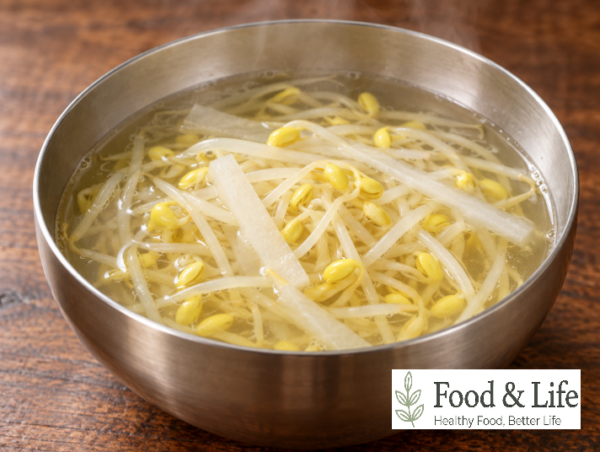
When you want a light soup for breakfast or a clean, comforting broth, Korean soybean sprout soup (Kongnamul Guk) is an easy choice.
This recipe starts by simmering 0.7 cm (about 1/4 inch) thick strips of Korean radish for 3 minutes in anchovy and dried kelp stock to bring out their mild sweetness and savory depth. Then, 400 g (14.1 oz) of soybean sprouts and tuna extract seasoning are added for a simple, clean flavor. The key is to cook the soybean sprouts with the pot uncovered from start to finish, which helps reduce their distinctive raw aroma while keeping them crisp.
The clear broth combines the refreshing flavor of Korean radish with the fresh crunch of soybean sprouts, making this a light everyday Korean soup that is easy to enjoy.
⏱️ Cooking Time: About 25 minutes
🍳 Difficulty: ★★☆☆☆
✓ Ingredients
🥣 Main Ingredients
- 400 g (14.1 oz) soybean sprouts
- 1/3 Korean radish, white section
- 10 dried anchovies or dried round herring (dipori), for stock
- 5 pieces dried kelp (dashima), for stock
- 3 L (101.4 fl oz) water
🧂 Seasonings
- 45 ml (3 tbsp) tuna extract seasoning
- Sea salt, as needed
(Measurement guide: 1 tbsp = 15 ml, 1 tsp = 5 ml, 1 Korean paper cup = 180 ml / 6.1 fl oz)
✓ How to Make Korean Soybean Sprout Soup
- Wash the soybean sprouts: Place 400 g (14.1 oz) soybean sprouts in a large bowl and gently swish them in cold water 2–3 times. Drain well in a colander.
- Prepare the Korean radish: Cut 1/3 of a Korean radish, using the white section, into thick strips about 0.7 cm (1/4 inch) wide with a knife rather than a mandoline.
- Make the stock: Add 3 L (101.4 fl oz) water, 10 dried anchovies or dipori, and 5 pieces of dried kelp to a pot. Simmer for about 10 minutes, then remove the anchovies and kelp completely.
- Cook the radish first: Add about one-third of the prepared stock and the sliced radish to a pot. Simmer for 3 minutes so the radish can release its mild sweetness into the broth.
- Add the soybean sprouts and seasoning: Pour in the remaining stock, then add 45 ml (3 tbsp) tuna extract seasoning and 400 g (14.1 oz) soybean sprouts. Bring to a boil and cook with the lid uncovered.
- Season to taste: Once the soybean sprouts are cooked to the desired texture, taste the broth and add sea salt as needed.
✓ Key Tips for Success
- Cut the radish thick and cook it first: If the radish is sliced too thinly with a mandoline, it can break down and make the broth cloudy. Cut it into approximately 0.7 cm (1/4 inch) thick strips with a knife and simmer it for 3 minutes in part of the stock first. This helps keep the broth clear while drawing out the radish’s mild sweetness.
- Keep the pot uncovered: Once the soybean sprouts are added, cook the soup with the lid open from start to finish. This helps the sprouts’ distinctive raw aroma escape and keeps the broth tasting clean.
✓ Serving Tips
- Serve with freshly steamed white rice and well-fermented napa cabbage kimchi or kkakdugi for a simple, refreshing Korean meal.
- If you prefer a little heat, add sliced Cheongyang chili pepper or green onion just before the soup is finished.
- You can also make extra broth, chill the soup completely, and enjoy it cold for a clear and refreshing variation.
✓ How to Choose Good Soybean Sprouts
- Stems: Choose soybean sprouts with plump, firm, white stems and no soft or damaged areas.
- Bean heads: The yellow bean heads should look firm, compact, and brightly colored.
- Roots: Look for sprouts with roots that are not excessively long and have no brown discoloration.
✓ Soybean Sprout Nutrition per 100 g (3.5 oz)
| Nutrient | Amount per 100 g (3.5 oz) |
|---|---|
| Calories | 43.00 kcal |
| Carbohydrates | 3.44 g |
| Protein | 4.66 g |
| Fat | 1.19 g |
| Sodium | 3.00 mg |
Based on raw soybean sprouts per 100 g (3.5 oz). Actual nutrition values may vary depending on variety, part used, product, and cooking method.
Source: Ministry of Food and Drug Safety Food Nutrition Database – Raw Ingredients
✓ Frequently Asked Questions (FAQ)
Q1. Should I cover the pot when making soybean sprout soup?
It is best to cook Kongnamul Guk with the lid uncovered from beginning to end. This allows the sprouts’ distinctive raw aroma to escape and keeps the broth tasting clean.
Q2. Why does the broth taste cloudy or slightly bitter?
The broth can become cloudy if the radish is sliced too thinly and begins to break apart. Simmering the dried anchovies for too long can also release bitterness into the stock.
Q3. Can I use fish sauce or Korean soup soy sauce instead of tuna extract seasoning?
Anchovy fish sauce or sand lance fish sauce can be used as substitutes. However, for the clean umami flavor intended in this recipe, tuna extract seasoning works best.
Following this method, I simmered the thick-cut Korean radish in the anchovy and kelp stock first, then added the soybean sprouts. The broth stayed clear while developing a refreshing, savory flavor. Finishing the seasoning with tuna extract and sea salt allowed the mild sweetness of the radish and the clean flavor of the soybean sprouts to come through naturally.
I usually prefer light, clean soups over rich or heavily seasoned broths, and this Kongnamul Guk was especially enjoyable because the soybean sprouts stayed pleasantly crisp. My family also liked the clear, refreshing broth and enjoyed it with rice.
If you want to make clear and refreshing Korean soybean sprout soup, simmer the radish for 3 minutes first, then add the soybean sprouts and keep the pot uncovered while they cook. Give this method a try when you need a simple breakfast soup or a light Korean broth for an everyday meal.
Save or bookmark this recipe for later, and share it with someone who enjoys Korean home cooking.
I’ll continue sharing approachable recipes and practical cooking tips that are easy to follow at home. 😊
If there is a dish you have been curious about or a recipe you would like to see next, feel free to leave a comment. 😊