
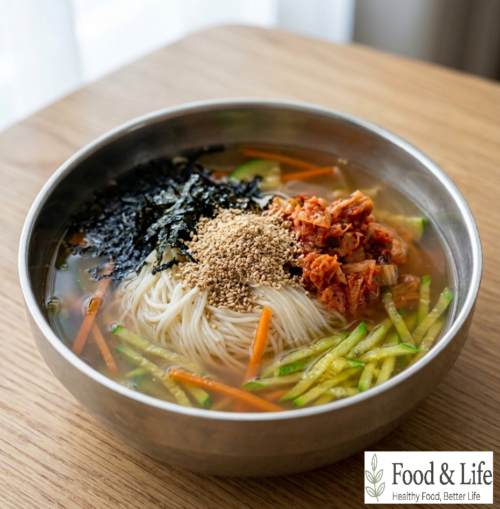
When you’re craving something warm and comforting, a simple bowl of noodles in a clear, savory broth makes a satisfying meal.
This Janchi Guksu (Korean Anchovy Noodle Soup) starts by lightly toasting dried anchovies, then simmering them with Korean radish and dried kelp to reduce any fishy aroma while building a clean, deeply savory broth. Korean zucchini, carrot, and onion add a gentle natural sweetness, so the soup develops plenty of flavor without a complicated seasoning mixture.
Serve the hot anchovy broth over chewy somyeon noodles and finish with tangy sour kimchi for a warm and refreshing Korean noodle bowl.
⏱️ Cooking Time: About 35 minutes
🍳 Difficulty: ★★☆☆☆
✓ Ingredients
🥣 Main Ingredients
- 100 g (3.5 oz) somyeon (thin Korean wheat noodles)
- 1.8 L (60.9 fl oz) water
- 1 handful dried anchovies for stock, about 50 g (1.8 oz)
- 1 sheet dried kelp (dashima), about 10 g (0.35 oz)
- 120 g (4.2 oz) Korean radish
- 1 Cheongyang chili, about 10 g (0.35 oz)
- 1/2 Korean zucchini (aehobak), about 140 g (4.9 oz)
- 1/3 carrot, about 100 g (3.5 oz)
- 1/4 onion, about 60 g (2.1 oz)
🧂 Seasonings & Toppings
- 3 tbsp Korean soup soy sauce
- 3 tbsp Korean tuna extract
- 2 tbsp sour kimchi
- A small amount of roasted seaweed flakes
- A small amount of sesame seeds
(Measurement guide: 1 tbsp = 15 ml, 1 tsp = 5 ml, 1 Korean paper cup = 180 ml / 6.1 fl oz)
✓ How to Make Janchi Guksu
- Toast the anchovies: Place the dried anchovies in a pot and lightly toast them over low heat for 1–2 minutes to reduce the fishy aroma.
- Make the anchovy broth: Add 1.8 L (60.9 fl oz) water, the toasted anchovies, dried kelp, Korean radish, and Cheongyang chili to the pot. Once it comes to a boil, reduce the heat to low and simmer for about 30 minutes.
- Strain and season the broth: Once the broth is well infused, remove the anchovies, dried kelp, and chili. Add 3 tbsp Korean soup soy sauce and 3 tbsp Korean tuna extract, then stir to season.
- Cook the vegetables: Add the julienned Korean zucchini, carrot, and onion to the broth. Bring it briefly back to a boil and cook until the vegetables soften. Their natural sweetness will gently flavor the broth.
- Cook the somyeon: Add the somyeon to boiling water. When the water rises toward a boil-over, add a little cold water and continue cooking until the noodles are chewy. Rinse the cooked noodles thoroughly under cold water, rubbing them gently with your hands to remove the surface starch, then drain well. Removing the starch helps keep the noodles springy and prevents them from becoming overly soft.
- Assemble the noodle soup: Place the drained noodles in a serving bowl and pour over the hot broth and vegetables. Top with finely chopped sour kimchi, roasted seaweed flakes, and sesame seeds.
✓ Key Tips for Success
- Remove the anchovy innards and toast the anchovies first: For large dried anchovies, removing the innards and lightly toasting them in a dry pot helps prevent bitterness and an overly fishy flavor. Skim off any foam that rises while the broth simmers to help keep the broth clear.
✓ Serving Tips
- If you prefer a spicier broth, make a small slit in the Cheongyang chili before simmering it, or thinly slice the chili and serve it as a topping.
- Mix the sour kimchi with 1/2 tsp sesame oil and a pinch of sugar before adding it as a topping. This adds a richer savory flavor that pairs well with the anchovy broth.
✓ How to Choose Good Dried Anchovies for Stock
- Appearance and color: Choose dried anchovies with intact scales and a clear silvery-blue or silvery-white sheen.
- Dryness and shape: Look for anchovies with intact bellies and slightly curved backs. They should feel properly dried without leaving an oily residue on your fingers and should not crumble too easily.
- Aroma: Choose anchovies with a mild, savory ocean aroma. Avoid those with a stale, musty, or rancid smell.
✓ Dried Anchovy Nutrition per 100 g (3.5 oz)
| Nutrient | Amount per 100 g (3.5 oz) |
|---|---|
| Calories | 302.00 kcal |
| Carbohydrates | 0.00 g |
| Protein | 59.31 g |
| Fat | 5.45 g |
| Sodium | 2,180.00 mg |
Based on 100 g (3.5 oz) of large anchovies that have been boiled and dried. Actual nutritional values may vary depending on the variety, part of the ingredient, product, and preparation method.
Source: Ministry of Food and Drug Safety Food Nutrition Database – Raw Ingredient Foods
✓ Frequently Asked Questions (FAQ)
Q1. How long should I simmer anchovy broth for Janchi Guksu?
For 1.8 L (60.9 fl oz) of water, bring the broth to a boil over high heat, then reduce to low heat and simmer for about 30 minutes. This is enough to develop a deep yet clean-tasting broth.
Q2. Why does my anchovy broth taste bitter or fishy?
This can happen if the innards are left inside large dried anchovies or if you skip toasting them before simmering. Removing the innards and lightly dry-toasting the anchovies helps reduce excess moisture, bitterness, and fishy aromas.
Q3. What can I use instead of Korean tuna extract?
You can slightly increase the amount of Korean soup soy sauce, or substitute an equal amount of anchovy fish sauce or sand lance fish sauce for a similarly deep and savory flavor.
Once you have a broth slowly infused with dried anchovies, Korean radish, and dried kelp, this Janchi Guksu recipe is easy to prepare at home. The hot, clean-tasting broth pairs with chewy somyeon noodles and crisp, tangy sour kimchi for a warm and satisfying meal.
Save or bookmark this recipe for later, and share it with someone who enjoys Korean food.
More easy-to-follow Korean recipes and practical cooking tips will be added regularly. 😊
If there is a Korean dish you would like to learn how to make or a recipe you would like to see next, feel free to leave a comment. 😊