
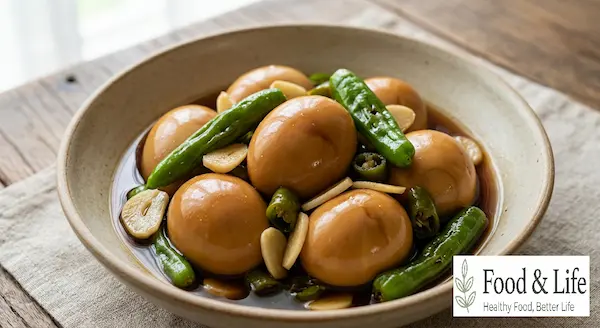
The key to making Gyeran Jangjorim (Korean soy-braised eggs) flavorful without being overly salty is to use a 5:1 ratio of water to soy sauce and add the boiled eggs before the braising liquid comes to a boil.
Simmer 20 eggs in 1.5 L (50.7 fl oz) water, 300 ml (10.1 fl oz) soy sauce, 270 ml of sugar (1.5 Korean paper cups), and 90 ml (3 fl oz) brown oligosaccharide syrup over medium heat for about 30 minutes. This gradually gives the eggs an even, deep brown color while keeping the seasoning balanced. When the liquid has reduced by about half, add the Kkwari-gochu, Cheongyang chili peppers, and sliced garlic, then simmer for just 2 more minutes to preserve their texture and aroma.
The eggs stay moist while absorbing the sweet and savory soy sauce, making this a satisfying Korean side dish that pairs especially well with warm rice.
⏱️ Cooking Time: About 45 minutes
🍳 Difficulty: ★★☆☆☆
✓ Ingredients
🥣 Main Ingredients
- 20 eggs
- 20 Kkwari-gochu (Korean wrinkled green peppers)
- 4 Cheongyang chili peppers
- 25 garlic cloves
🧂 Sauce & Seasonings
- 50 ml (1.7 fl oz) vinegar, for boiling the eggs
- 2 tbsp sea salt, for boiling the eggs
- 1.5 L (50.7 fl oz) water
- 300 ml (10.1 fl oz) soy sauce
- 270 ml sugar (1.5 Korean paper cups)
- 90 ml (3 fl oz) brown oligosaccharide syrup
(0.5 Korean paper cup) (Measurement guide: 1 tbsp = 15 ml, 1 tsp = 5 ml, 1 Korean paper cup = 180 ml / 6.1 fl oz)
✓ How to Make Gyeran Jangjorim
- Boil the eggs: Place 20 eggs in a pot and add enough water to fully cover them. Add 50 ml (1.7 fl oz) vinegar and 2 tbsp sea salt, then bring to a boil over high heat. Once the water begins boiling, cook for 10 minutes. Rinse the eggs under cold water and peel them cleanly.
- Prepare the peppers and garlic: Remove the stems from 20 Kkwari-gochu and 4 Cheongyang chili peppers and wash them well. Pierce each pepper several times with a fork so the soy sauce can penetrate and the spicy aroma can infuse the braising liquid. Slice the 25 garlic cloves into fairly thick pieces.
- Mix the braising liquid: Add 1.5 L (50.7 fl oz) water, 300 ml (10.1 fl oz) soy sauce, 270 ml sugar, and 90 ml (3 fl oz) brown oligosaccharide syrup to a pot. Before turning on the heat, stir thoroughly so the sugar and syrup dissolve and do not settle and burn on the bottom.
- Braise the eggs: Add the 20 peeled eggs to the braising liquid before turning on the heat. Bring it to a boil, then reduce to medium heat and simmer for about 30 minutes, or until the liquid has reduced by roughly half.
- Finish with the peppers and garlic: Once the liquid has reduced by half and the eggs have developed an even, deep brown color, add the prepared Kkwari-gochu, Cheongyang chili peppers, and sliced garlic. Spoon the braising liquid over the ingredients as they cook, simmer for another 2 minutes, then turn off the heat.
✓ Key Tips for Success
- Add the eggs before the braising liquid boils: Adding boiled eggs directly to vigorously boiling liquid can cause the surface to tighten quickly, resulting in uneven coloring and seasoning that stays mostly on the outside. Start the eggs in the cold braising liquid and heat everything together so they gradually absorb the sauce and develop an even brown color during the 30-minute simmer.
- Add the peppers and garlic at the end: If the peppers cook from the beginning, they can become overly soft and lose their color. The garlic can also break down and make the braising liquid cloudy. Add both only after the liquid has reduced by about half, then simmer for just 2 minutes to preserve the peppers’ texture and fresh, spicy aroma.
✓ Serving Tips
- Place a hard-boiled egg over warm white rice and roughly break it apart with a spoon. Add 3–4 tbsp of the braising liquid along with some braised Kkwari-gochu and sliced garlic, then mix in a small piece of butter for extra richness and savory flavor.
- After all the eggs have been eaten, strain the remaining braising liquid instead of discarding it. Store it in the refrigerator and reuse it as a seasoned soy sauce base for stir-fried fish cakes, braised tofu, or braised potatoes.
- For a milder flavor, reduce the Cheongyang chili peppers to about 2, depending on your preference. This keeps a gentle, pleasant heat without making the dish too spicy.
✓ How to Choose Good Eggs
- [Shell texture]: Choose eggs with clean, firm shells and an even surface rather than focusing on shells that look unusually smooth or glossy.
- [Movement inside the egg]: When gently shaken by hand, a fresher egg should have very little noticeable movement or sloshing inside.
- [Check the shell markings]: Check the four-digit laying date and the housing-system code printed on the shell, and choose eggs with a more recent laying date when possible.
✓ Egg Nutrition per 100 g (3.5 oz)
| Nutrient | Amount per 100 g (3.5 oz) |
|---|---|
| Calories | 140.00 kcal |
| Carbohydrates | 1.07 g |
| Protein | 12.86 g |
| Fat | 8.51 g |
| Sodium | 137.00 mg |
Based on raw egg per 100 g. Actual nutritional values may vary depending on the variety, product, and cooking method.
Source: Korea Ministry of Food and Drug Safety Food Nutrition Database
✓ Frequently Asked Questions (FAQ)
Q1. Why should I add the eggs before the braising liquid comes to a boil?
Starting the boiled eggs in the cold braising liquid helps them develop a more even color. As everything gradually heats and simmers for about 30 minutes, the sweet and savory seasoning also has time to absorb into the eggs.
Q2. Why does the braising liquid sometimes turn cloudy?
If the egg white tears during peeling and exposes the yolk, particles from the egg can escape into the liquid and make it cloudy. For a cleaner sauce, use smoothly peeled eggs without major cracks or exposed yolks.
Q3. Can I replace brown oligosaccharide syrup with regular corn syrup or white sugar?
Regular syrup or rice syrup can be substituted in the same amount to add sweetness and gloss. However, brown sugar or brown oligosaccharide syrup helps create a deeper brown color.
Using a 5:1 ratio of water to soy sauce and simmering the eggs in the seasoning from the very beginning gives the eggs a deep, glossy brown color all over.
The Kkwari-gochu and Cheongyang chili peppers added at the end bring a fresh, pleasant heat, while the sliced garlic adds a pungent aroma that pairs well with the sweet and savory soy sauce. The eggs are especially good broken up over rice and mixed with a spoonful of the braising liquid.
If you want to make Gyeran Jangjorim with a rich color without making it overly salty, use the 5:1 water-to-soy sauce ratio and simmer the eggs for about 30 minutes. This recipe makes a generous batch of 20 eggs, making it convenient as a rice side dish for several meals.
Save or bookmark this recipe so you can easily find it again, and share it with someone who enjoys Korean food.
More easy-to-follow recipes and practical cooking tips will be shared here regularly. 😊
If there is a dish you have been curious about or would like to see featured, feel free to leave a comment. 😊
※ This recipe was prepared with reference to a recipe introduced on the YouTube channel ‘요리왕비룡 셰프TV’. It was cooked firsthand, and this post was written based on the preparation process and results.