
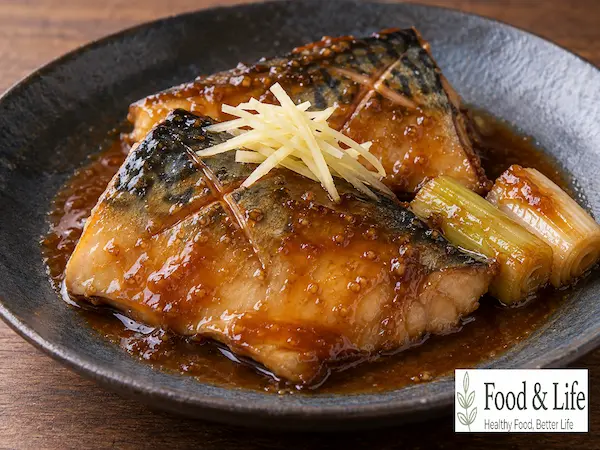
When making Japanese-style miso-braised mackerel, the key is to reduce the fishy aroma while simmering the mackerel gently enough to keep the flesh from falling apart.
This Saba Misoni recipe starts by blanching the mackerel in boiling water for just 3 seconds, then gently rinsing it in cold water. The fish is simmered for 8 minutes over medium heat in a sauce made with Cheongha, mirin, sugar, and Korean doenjang. During cooking, an otoshibuta (Japanese drop lid) made from parchment paper helps the sauce circulate evenly around the fish. Once the sauce has reduced to about one-third of its original amount, 1 teaspoon of vinegar is added for a final boil, creating a sweet and savory doenjang sauce that pairs well with tender mackerel.
⏱️ Cooking Time: 25 minutes
🍳 Difficulty: ★★☆☆☆
✓ Ingredients (Serves 1)
🥣 Main Ingredients
- 1/2 mackerel
- 10 g (0.35 oz) ginger
- 1/4 green onion
🧂 Sauce & Seasonings
- 100 ml (3.4 fl oz) Cheongha
- 100 ml (3.4 fl oz) mirin
- 1 tbsp sugar
- 80 g (2.8 oz) Korean doenjang (fermented soybean paste)
- 1 tsp vinegar
(Measurement guide: 1 tbsp = 15 ml (0.5 fl oz), 1 tsp = 5 ml, 1 Korean paper cup = 180 ml (6.1 fl oz))
✓ How to Make Saba Misoni
- Prep the ginger and green onion: Divide the 10 g (0.35 oz) ginger in half. Thinly slice one half for simmering and cut the remaining half into fine julienne strips for garnish. Cut the 1/4 green onion into roughly 3 cm (1.2-inch) pieces.
- Score the mackerel: Cut the 1/2 mackerel into 2 pieces, then make an X-shaped score on the skin side of each piece.
- Blanch and clean the mackerel: Place the prepared mackerel in boiling water for 3 seconds, then immediately transfer it to cold water. Gently rinse away any residue without breaking the softened flesh, then pat the fish dry with paper towels.
- Make the doenjang braising sauce: Add 100 ml (3.4 fl oz) Cheongha, 100 ml (3.4 fl oz) mirin, 1 tbsp sugar, and 80 g (2.8 oz) doenjang to a skillet or shallow pan. Mix until the doenjang is evenly dissolved.
- Add the ginger and bring to a boil: Add the sliced ginger to the sauce and bring it to a boil over medium heat.
- Add the mackerel and green onion: Once the sauce begins to boil, place the mackerel pieces in the pan skin-side up without overlapping them. Add the prepared green onion.
- Simmer with an otoshibuta: Cover the mackerel directly with a piece of parchment paper to create an otoshibuta, or drop lid. Simmer slowly over medium heat for 8 minutes. When steam rises around the edges of the parchment paper, the lid is sitting properly over the simmering sauce.
- Baste and reduce the sauce: Continue spooning the braising sauce over the mackerel as it reduces. Cook until roughly one-third of the original amount of sauce remains.
- Finish with vinegar: Add 1 tsp vinegar. Once the sauce comes back to a boil, turn off the heat.
- Serve: Transfer the mackerel and green onion to a plate. Spoon plenty of the thickened braising sauce over the fish and finish with the julienned ginger.
✓ Key Tips for Success
- If the mackerel breaks apart easily: After the 3-second blanch, the flesh becomes delicate. Scrubbing or handling it roughly in cold water can cause it to fall apart. Rinse it gently just enough to remove surface residue, then carefully pat it dry with paper towels.
- If the seasoning does not coat the fish evenly: Score the skin in an X shape and place the mackerel skin-side up without overlapping the pieces. As the sauce reduces, repeatedly spoon it over the fish so the seasoning coats the surface evenly.
✓ Serving Tips
- Serve the tender mackerel over warm white rice with a little of the thickened doenjang sauce for a satisfying combination of savory and slightly sweet flavors.
- The julienned ginger added at the end brings a fresh ginger aroma that balances the rich flavor of the doenjang sauce.
✓ How to Choose Good Mackerel
- Skin color and pattern: Look for mackerel with clear blue-green wavy markings along the back and a natural sheen on the skin. The belly should have a distinct silvery-white color.
- Firmness: Choose mackerel with firm flesh that does not feel soft or mushy. It should spring back slightly when gently pressed.
✓ Mackerel Nutrition per 100 g (3.5 oz)
| Nutrient | Amount per 100 g (3.5 oz) |
|---|---|
| Calories | 183.00 kcal |
| Carbohydrates | 0.00 g |
| Protein | 20.20 g |
| Fat | 10.40 g |
| Sodium | 75.00 mg |
Based on 100 g of raw mackerel. Actual nutrition values may vary depending on variety, cut, product, and cooking method.
Source: Ministry of Food and Drug Safety Food Nutrition Database – Raw Ingredients
✓ Frequently Asked Questions (FAQ)
Q1. Why do you blanch the mackerel for 3 seconds before making Saba Misoni?
The mackerel is briefly blanched for 3 seconds and then gently rinsed in cold water to remove surface impurities. This step helps clean away oil, blood, and slippery residue that can contribute to a stronger fishy aroma.
Q2. Why does the mackerel fall apart while cooking?
The flesh becomes delicate after blanching, so washing it too roughly in cold water can cause it to break apart. Rinse it gently, pat it dry, then arrange the pieces without overlapping and baste the sauce over the top instead of moving the fish repeatedly.
Q3. Can I use salted mackerel for Saba Misoni?
For this recipe, use unsalted mackerel rather than pre-salted or cured mackerel. Prepare 1/2 plain mackerel so the seasoning in the braising sauce stays balanced.
The finished Saba Misoni has the deep savory flavor of doenjang layered with the sweet and salty notes of Cheongha, mirin, and sugar. Briefly blanching the mackerel before slowly simmering it helps keep the flesh tender while maintaining a neat shape. As the sauce reduces to about one-third of its original amount, it becomes glossy and coats the surface of the fish.
Fresh ginger adds a clean aromatic contrast to the rich doenjang sauce. The final teaspoon of vinegar adds a light tang that balances the sweetness of the sugar and the savory depth of the fermented soybean paste.
I especially enjoyed serving the tender mackerel and thickened sauce over warm white rice. The savory sauce blends naturally with the rice, while the julienned ginger adds a fresh accent between bites.
If you want to make Japanese Saba Misoni at home, focus on briefly blanching the mackerel, handling it gently, and simmering it under an otoshibuta over medium heat. The result is a rich Japanese-style mackerel dish with tender fish and a thick, flavorful doenjang sauce.
Save or bookmark this recipe for later, and share it if you found it helpful.
I’ll continue sharing approachable recipes and practical cooking tips that are easy to follow at home. 😊
If there is a dish you would like to see next, feel free to leave a comment. 😊