
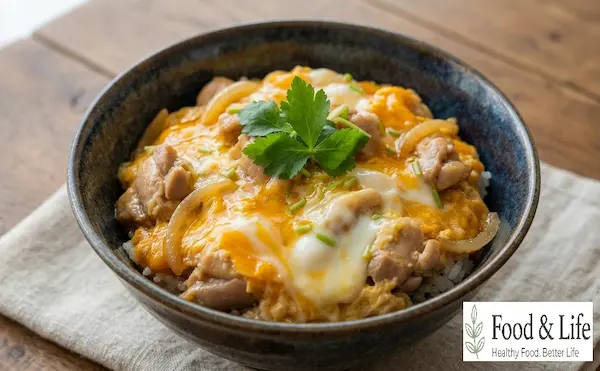
When you want a simple one-bowl meal with tender chicken and soft, custardy eggs over warm rice, oyakodon is an easy Japanese comfort food to make at home.
The key to this oyakodon recipe is simmering chicken thigh and onion in a savory soy-based broth, then adding 3 eggs in two separate batches—2 eggs first and the final egg last. Chamnamul stems are mixed into the first batch, while optional mentsuyu is added to the last egg. By cooking the eggs only briefly, they stay soft and moist instead of becoming fully firm.
The lightly sweet and savory broth soaks into the rice, while tender chicken and softly set eggs come together in every bite.
⏱️ Cooking Time: About 10 minutes
🍳 Difficulty: ★★☆☆☆
✓ Ingredients (2 Servings)
🥣 Main Ingredients
- 200 g (7 oz) chicken thigh
- 1/4 onion
- Chamnamul, as needed (scallions or green onion can be substituted)
- 3 eggs
- Cooked rice, as needed
🧂 Seasonings & Sauce
- 100 ml (3.4 fl oz) water
- 1 tbsp sugar
- 2 tbsp brewed soy sauce
- 2 tbsp mirin
- 1/2 tsp Hondashi (anchovy Dashida can be substituted)
- 1/2 tsp mentsuyu, optional
(Measurement guide: 1 tbsp = 15 ml, 1 tsp = 5 ml, 1 Korean paper cup = 180 ml / 6.1 fl oz)
✓ How to Make Oyakodon
- Cut the chicken: Cut 200 g (7 oz) chicken thigh into pieces slightly smaller than bite-size so they are easy to scoop up with rice using a spoon.
- Slice the onion: Slice 1/4 onion about 5 mm thick.
- Prepare the chamnamul: Separate the chamnamul stems from the leaves. The stems will be mixed into the eggs, while the leaves will be used as a garnish.
- Make the seasoned broth: Add 100 ml (3.4 fl oz) water, 1 tbsp sugar, 2 tbsp brewed soy sauce, 2 tbsp mirin, and 1/2 tsp Hondashi to a skillet. Mix well.
- Cook the chicken and onion: Add the prepared chicken thigh and onion to the broth and simmer over medium heat for 5 minutes.
- Divide and lightly beat the eggs: Crack 2 of the 3 eggs into one bowl and the remaining egg into a separate bowl. Lightly beat each batch without fully blending the whites and yolks, leaving some visible streaks.
- Add the extra ingredients to the eggs: Add the prepared chamnamul stems to the bowl with 2 eggs. Add 1/2 tsp optional mentsuyu to the bowl with the remaining egg and mix lightly.
- Turn the chicken: After the chicken and onion have cooked for 5 minutes, turn the ingredients once so they absorb the seasoning evenly.
- Add the first batch of eggs: While the broth is simmering, pour the 2 beaten eggs with chamnamul stems around the outer edge of the skillet in a circular motion. Cover and cook for 30 seconds.
- Add the second egg: Remove the lid and evenly pour in the remaining beaten egg mixed with 1/2 tsp mentsuyu. Cover again and cook for just 10 seconds.
- Serve over rice: Divide warm rice between bowls. Spoon the chicken, eggs, and broth over the rice, then garnish with the chamnamul leaves.
✓ Key Tips for Success
- Do not add all 3 eggs at once: If all the eggs are cooked together, they can become firm throughout. Add 2 eggs first and cook for 30 seconds, then add the final egg and cook for only 10 seconds to keep the texture soft and gently set.
- Do not overbeat the eggs: Beating until the whites and yolks are completely blended can reduce the irregular, silky texture that is characteristic of oyakodon. Mix them lightly with chopsticks so some separation between the whites and yolks remains.
✓ Serving Tips
- Serve the finished oyakodon over rice while the eggs are still soft and moist so you can enjoy the broth and silky eggs together.
- Use the chamnamul stems in the eggs and reserve the leaves for garnish to keep both their aroma and fresh color.
- If chamnamul is unavailable, you can substitute scallions or green onion as noted in the recipe.
✓ How to Choose Good Chicken Thigh
- Color and appearance: Choose chicken with a clear pink color that is neither unusually pale nor overly dark, with a natural sheen on the surface.
- Firm texture: Look for chicken that feels firm rather than soft and springs back toward its original shape when lightly pressed.
- Packaging and surface condition: Choose packages without excessive liquid collected inside, and avoid chicken with discoloration or an unusual odor.
Source: Rural Development Administration, Nongsaro – How to Choose and Store Livestock Products
✓ Chicken Thigh Nutrition per 100 g (3.5 oz)
| Nutrient | Amount per 100 g (3.5 oz) |
|---|---|
| Calories | 144.00 kcal |
| Carbohydrates | 0.00 g |
| Protein | 19.41 g |
| Fat | 7.67 g |
| Sodium | 84.00 mg |
Based on 100 g of raw chicken thigh listed by Food Safety Korea. Actual nutrition values may vary depending on the breed, product, and cooking method.
Source: Food Safety Korea Food Nutrition Information – Chicken, Thigh, Raw
✓ Frequently Asked Questions (FAQ)
Q1. Why are the eggs added in two batches for oyakodon?
Adding the eggs in two stages lets the first batch coat the chicken and absorb the seasoning, while the final egg stays softer and less cooked. In this recipe, 2 eggs are cooked for 30 seconds, followed by the last egg for only 10 seconds.
Q2. Why do the eggs in my oyakodon turn firm and dry?
The eggs may have been cooked too long or beaten too thoroughly before cooking. Lightly beat them and add them in two batches for short cooking times to preserve a soft, gently set texture.
Q3. Do I have to use mentsuyu and Hondashi?
The 1/2 tsp mentsuyu is optional and can be omitted. The 1/2 tsp Hondashi can be replaced with anchovy Dashida according to this recipe.
The lightly sweet and savory broth made with soy sauce and mirin pairs beautifully with tender chicken thigh and soft eggs over warm rice. When I made the recipe this way, adding the eggs in two separate batches kept them from setting completely and created a moist texture with visible ribbons of white and yolk.
The soy-based broth also soaked nicely into the chicken, while the final layer of egg remained soft and delicate. The aroma of chamnamul added another fresh element that balanced the warm, comforting flavors of this Japanese rice bowl.
If you want an easy chicken and egg rice bowl, try this oyakodon recipe using the two-stage egg method. If you especially enjoy soft eggs, the final 10-second cooking step is the key detail to watch.
Save or bookmark this recipe so you can easily find it later, and share it if you found it helpful.
I’ll continue sharing approachable recipes and practical cooking tips that are easy to make at home. 😊
If there is a dish you are curious about or a recipe you would like to see next, feel free to leave a comment. 😊
※ This recipe was prepared and written after referring to a recipe introduced on the YouTube channel ‘일식예보’, then cooking it and documenting the process and results.