
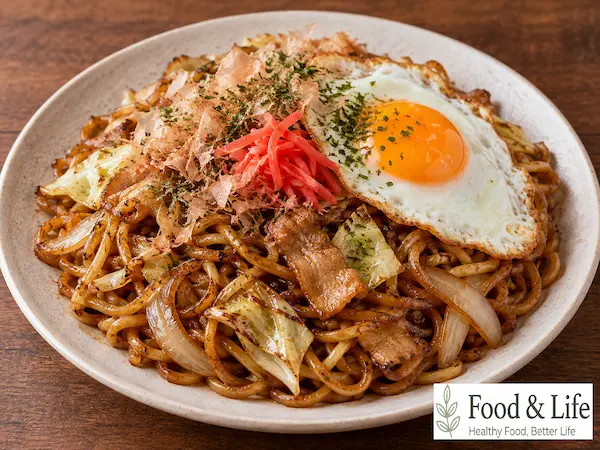
When making yakisoba at home, the key is not to separate and stir-fry the noodles right away. Instead, sear the noodles on both sides until lightly browned before adding the sauce. This gives them more toasted flavor and helps the sauce cling evenly to each strand.
This yakisoba recipe uses 300 g (10.6 oz) yakisoba noodles with 100 g (3.5 oz) thinly shaved pork belly, 100 g (3.5 oz) cabbage, and 1/4 onion. The sauce combines 2 tbsp Worcestershire sauce, 1 tbsp soy sauce, 1 tbsp Cheongha, and 1 tbsp oyster sauce. The pork and vegetables are cooked separately first, while the noodles are seared and tossed with the sauce until the excess moisture evaporates. Bringing everything back together at the end keeps the noodles pleasantly chewy while coating them in the rich, savory sauce.
Finish the Japanese stir-fried noodles with katsuobushi, aonori, beni shoga, and a fried egg to taste for the classic flavors and textures of yakisoba.
⏱️ Cooking Time: About 15 minutes
🍳 Difficulty: ★★☆☆☆
✓ Ingredients (2 Servings)
🥣 Main Ingredients
- 300 g (10.6 oz) yakisoba noodles (chuka noodles)
- 100 g (3.5 oz) thinly shaved pork belly, or bacon
- 100 g (3.5 oz) cabbage
- 1/4 onion
- Katsuobushi (bonito flakes), to taste, optional
- Aonori (green seaweed flakes), to taste, optional
- Beni shoga (red pickled ginger), to taste, optional
- Fried egg, to taste, optional
🧂 Seasonings & Sauce
- 2 tbsp Worcestershire sauce
- 1 tbsp soy sauce
- 1 tbsp Cheongha
- 1 tbsp oyster sauce
- Cooking oil
- 1 pinch salt
- 1 pinch black pepper
(Measurement guide: 1 tbsp = 15 ml, 1 tsp = 5 ml, 1 Korean paper cup = 180 ml / 6.1 fl oz)
✓ How to Make Yakisoba
- Prepare the onion, cabbage, and pork: Slice 1/4 onion about 5 mm thick. Cut 100 g (3.5 oz) cabbage into roughly 2 cm pieces so it keeps some texture after cooking. Cut 100 g (3.5 oz) thinly shaved pork belly into bite-size pieces.
- Make the yakisoba sauce: Combine 2 tbsp Worcestershire sauce, 1 tbsp soy sauce, 1 tbsp Cheongha, and 1 tbsp oyster sauce in a small bowl. Mix well and set aside.
- Warm the yakisoba noodles: Microwave the 300 g (10.6 oz) yakisoba noodles one package at a time, about 150 g (5.3 oz) per package, for 1 minute each. Warming them first softens the compacted noodles and makes them easier to handle in the pan.
- Cook the pork and vegetables: Heat 2 tbsp cooking oil in a pan over medium heat. Add the shaved pork belly and cook until the surface begins to change color. Add the cabbage and onion and continue stir-frying. When the vegetables begin to brown, season with 1 pinch salt and 1 pinch black pepper. Stir-fry briefly so the pork and vegetables are lightly seasoned, then transfer everything to a clean bowl and set aside.
- Sear the yakisoba noodles: Add more cooking oil to the same pan. Place the warmed yakisoba noodles in the pan without immediately separating them. Leave them in compact portions and cook until both sides develop a lightly browned, toasted surface.
- Separate the noodles and add the sauce: Once the noodles are browned on both sides, gently loosen them with chopsticks without breaking the strands. Pour in the prepared sauce and stir-fry until the excess moisture in the pan evaporates and the sauce is well absorbed by the noodles.
- Return the pork and vegetables: Once the noodles are evenly coated with the sauce, return the cooked pork belly, cabbage, and onion to the pan. Toss everything together just until the sauce evenly coats the noodles, meat, and vegetables.
- Add the toppings: Transfer the finished yakisoba to a plate. Sprinkle with katsuobushi and aonori to taste. Add beni shoga and a fried egg if desired.
✓ Key Tips for Success
- Do not separate the yakisoba noodles as soon as they hit the pan: If you immediately pull the noodles apart with chopsticks, they will not develop as much toasted flavor. Sear both sides while the noodles are still together, then gently loosen them so the strands do not break.
- Let the excess moisture evaporate after adding the sauce: Instead of immediately returning the pork and vegetables to the pan, stir-fry the noodles with the sauce first. Allowing the moisture to cook off helps the Worcestershire sauce, soy sauce, Cheongha, and oyster sauce cling to and flavor the noodles evenly.
✓ Serving Tips
- Finish the yakisoba with katsuobushi and aonori for the familiar aroma of Japanese-style yakisoba.
- Serve with beni shoga to add a bright, tangy contrast to the rich, savory noodles.
- A fried egg with a soft yolk also pairs well with the noodles. Break the yolk and mix it into the yakisoba for a smoother, richer finish.
✓ How to Choose Good Cabbage
- Appearance and color: Look for cabbage with green outer leaves and a natural sheen. Avoid heads with prominent insect damage, wilted areas, or noticeable brown discoloration.
- Weight and firmness: Choose a cabbage that feels heavy for its size and does not easily give when pressed. The leaves should be tightly packed toward the center.
- Stem condition: Check that the cut stem is not excessively dry or brown and that the center is not hollow.
Source: Rural Development Administration, Nongsaro – How to Choose Cabbage
✓ Cabbage Nutrition per 100 g (3.5 oz)
| Nutrient | Amount per 100 g (3.5 oz) |
|---|---|
| Calories | 29.00 kcal |
| Carbohydrates | 6.98 g |
| Protein | 1.36 g |
| Fat | 0.12 g |
| Sodium | 9.00 mg |
Based on 100 g of raw cabbage. Actual nutrition values may vary depending on the variety, product, and cooking method.
Source: Ministry of Food and Drug Safety Food Nutrition Database – Raw Food Ingredients
✓ Frequently Asked Questions (FAQ)
Q1. Why should I sear yakisoba noodles before separating them?
Searing the noodles first gives them a lightly browned surface and more toasted flavor. Warm the noodles, cook both sides while they are still together, and then gently loosen the strands before adding the sauce.
Q2. Why does my yakisoba sauce stay on the surface instead of coating the noodles?
There may be too much moisture left in the pan. After adding the sauce, stir-fry the noodles first and let the excess moisture evaporate so the mixture of 2 tbsp Worcestershire sauce, 1 tbsp soy sauce, 1 tbsp Cheongha, and 1 tbsp oyster sauce can coat and absorb into the noodles.
The key to flavorful homemade yakisoba is to sear the noodles while they are still together, then cook them with the sauce until the excess moisture has evaporated. Worcestershire sauce and oyster sauce provide a rich savory base, while soy sauce and Cheongha round out the seasoning. Thinly shaved pork belly adds richness, and the cabbage keeps some crisp texture, making this Japanese stir-fried noodle dish satisfying enough for a complete meal.
I especially like serving it with plenty of katsuobushi and aonori, plus a fried egg with a soft yolk that can be mixed into the noodles. If you have been looking for an easy yakisoba recipe, focus on searing the noodles before separating them and use the sauce ratio of 2 tbsp Worcestershire sauce, 1 tbsp soy sauce, 1 tbsp Cheongha, and 1 tbsp oyster sauce.
Save or bookmark this recipe so you can easily find it later, and share it if you found it helpful.
I’ll continue sharing approachable recipes and practical cooking tips that are easy to make at home. 😊
If there is a dish you are curious about or a recipe you would like to see next, feel free to leave a comment. 😊
※ This recipe was prepared and written after referring to a recipe introduced on the YouTube channel ‘일식예보’, then cooking it and documenting the process and results.