
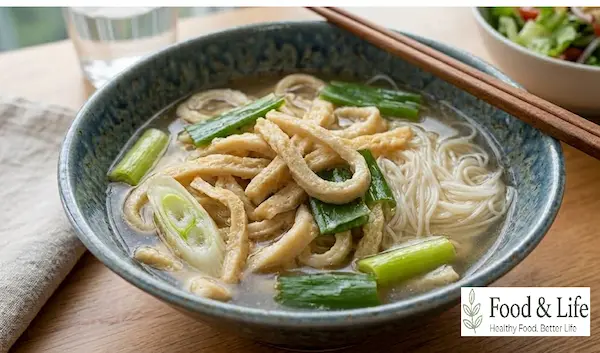
This Eomuk Guksu recipe comes from actor Ryu Soo-young and turns 4 sheets of rectangular eomuk (Korean fish cake) into thin, noodle-like strips for a warm and comforting bowl of noodles in about 15 minutes. The broth is made simply with green onion and tuna extract sauce, so there is no need to prepare a separate anchovy stock.
Start by simmering large pieces of green onion in 1 L (33.8 fl oz) of water, then add 3 tbsp tuna extract sauce and the thinly sliced eomuk. Even with just a few ingredients, the fish cake and seasoning create a clear broth with plenty of savory umami flavor.
The somyeon noodles are cooked for 2 minutes 30 seconds, then rubbed thoroughly under cold water to remove excess starch. Before serving, the chilled noodles are warmed using toryeom, a Korean technique of pouring hot broth over the noodles and draining it off again. The chewy eomuk, tender somyeon, and clear, savory broth make this an easy warm noodle dish for busy days.
⏱️ Cooking Time: About 15 minutes
🍳 Difficulty: ★☆☆☆☆
✓ Ingredients (2 Servings)
🥣 Main Ingredients
- 4 rectangular eomuk sheets (Korean fish cake), 200 g (7 oz)
- Somyeon (thin Korean wheat noodles), 2 servings, 200 g (7 oz)
- 1 green onion
- 1 L (33.8 fl oz) water
🧂 Seasonings
- 3 tbsp tuna extract sauce
- 10 turns freshly ground black pepper
(Measurement guide: 1 tbsp = 15 ml, 1 tsp = 5 ml, 1 Korean paper cup = 180 ml / 6.1 fl oz)
✓ How to Make Eomuk Guksu
- Prep the green onion: Cut the green onion in half lengthwise, then cut it into large 4 cm (1.6-inch) pieces.
- Slice the eomuk: Roll up the 4 rectangular eomuk sheets (200 g / 7 oz), then slice them thinly and lengthwise into noodle-like strips.
- Make the green onion broth: Add 1 L (33.8 fl oz) water and the prepared green onion to a pot. Bring to a boil over high heat.
- Add the tuna extract sauce: Once the green onion begins to soften, add 3 tbsp tuna extract sauce.
- Cook the eomuk: When the broth returns to a boil, add the thinly sliced eomuk and continue cooking.
- Season with black pepper: Once the eomuk has absorbed some broth and becomes plump, add 10 turns of black pepper and turn off the heat.
- Cook the somyeon: Bring water to a boil in a separate pot or deep skillet. Add 200 g (7 oz) somyeon and cook for exactly 2 minutes 30 seconds.
- Rinse the noodles thoroughly: Transfer the cooked somyeon to cold water and rub the noodles firmly between your hands, almost as if washing laundry, to remove the surface starch. Drain thoroughly in a colander.
- Warm the noodles with toryeom and serve: Place the cooked somyeon in serving bowls. Pour some of the hot broth over the noodles, then drain it back out to warm them. Finally, pour in the hot broth and top with the eomuk strips and green onion.
✓ Key Tips for Success
- Wash off the somyeon starch thoroughly: If the cooked noodles are not rubbed and rinsed well in cold water, the remaining starch can make the broth cloudy and thick while causing the noodles to soften more quickly. Rinse several times until the slippery coating is gone, then drain the noodles thoroughly to help them stay pleasantly chewy.
- Do not overcook the eomuk: Thinly sliced eomuk can lose its springy texture and absorb too much broth if simmered for too long. Turn off the heat as soon as the fish cake becomes plump after soaking up the broth.
✓ Serving Tips
- If you like a little heat, sprinkle 1/2 tsp gochugaru (Korean red pepper flakes) over the finished noodles and stir it into the broth.
- Serve with well-fermented baechu kimchi or freshly seasoned geotjeori kimchi for a crisp contrast to the savory fish cake broth.
- To fully enjoy the clean, deep flavor of the broth, try the first few spoonfuls without adding any extra toppings or seasoning.
✓ How to Choose Good Eomuk
- Check the fish or surimi content: Look at the ingredient list on the package and choose a product with a higher percentage of fish meat or surimi. This helps the eomuk keep its chewy texture instead of becoming overly soft after cooking.
- Appearance and elasticity: Choose eomuk that does not look excessively oily or watery on the surface. It should feel springy when gently pressed and have the product’s natural light color.
- Packaging and refrigeration: Choose a properly sealed package with no visible damage or signs that air has entered. The product should also have been consistently stored under refrigeration.
✓ Eomuk Nutrition per 100 g (3.5 oz)
| Nutrient | Amount per 100 g (3.5 oz) |
|---|---|
| Calories | 169.00 kcal |
| Carbohydrates | 20.69 g |
| Protein | 11.44 g |
| Fat | 4.49 g |
| Sodium | 699.00 mg |
Values are based on 100 g (3.5 oz) of eomuk. Actual nutrition may vary depending on the product, ingredients, and cooking method.
Source: Ministry of Food and Drug Safety Food Nutrition Database
✓ Frequently Asked Questions (FAQ)
Q1. Why do I need to warm the cold-rinsed somyeon with hot broth before serving?
The noodles become cold after being rinsed thoroughly in cold water. If the final broth is poured directly over them, the temperature of the entire bowl can drop quickly. Toryeom warms the noodles first by pouring hot broth over them and draining it away before the final serving.
Q2. Why does my broth turn cloudy or feel too thick?
This usually happens when the starch on the cooked somyeon has not been washed off thoroughly. Rub the noodles firmly under cold water until the slippery starch coating is gone, then drain them completely before adding them to the soup.
Q3. Can I replace the tuna extract sauce with the same amount of regular soy sauce or Korean soup soy sauce?
The savory, concentrated flavor of the tuna extract sauce is an important part of this simple broth. Replacing it entirely with soy sauce will noticeably change the depth and character of the soup, so it is best to use the original 3 tbsp tuna extract sauce when possible.
Slicing the rectangular eomuk into thin, noodle-like strips helps it blend naturally with the somyeon while making the bowl feel more substantial. Even without a separate anchovy or kelp stock, the combination of 3 tbsp tuna extract sauce and the savory flavor released from the eomuk creates a clean yet deeply satisfying broth.
Cooking the somyeon for 2 minutes 30 seconds, rubbing it thoroughly under cold water, and then warming it with hot broth using the toryeom method keeps the broth from becoming cloudy while helping the noodles maintain their texture.
For Ryu Soo-young’s Eomuk Guksu, the two key steps are slicing the fish cake thinly like noodles and thoroughly rinsing the starch from the somyeon before warming it with hot broth. Follow those steps and you can make a warm, clean-tasting Korean noodle soup in about 15 minutes without preparing a complicated stock.
Save or bookmark this recipe so you can easily find it later, and share it with someone who enjoys Korean food.
More easy-to-follow recipes and practical cooking tips will be shared regularly. If there is another Korean dish or recipe you would like to see, feel free to leave a comment.