
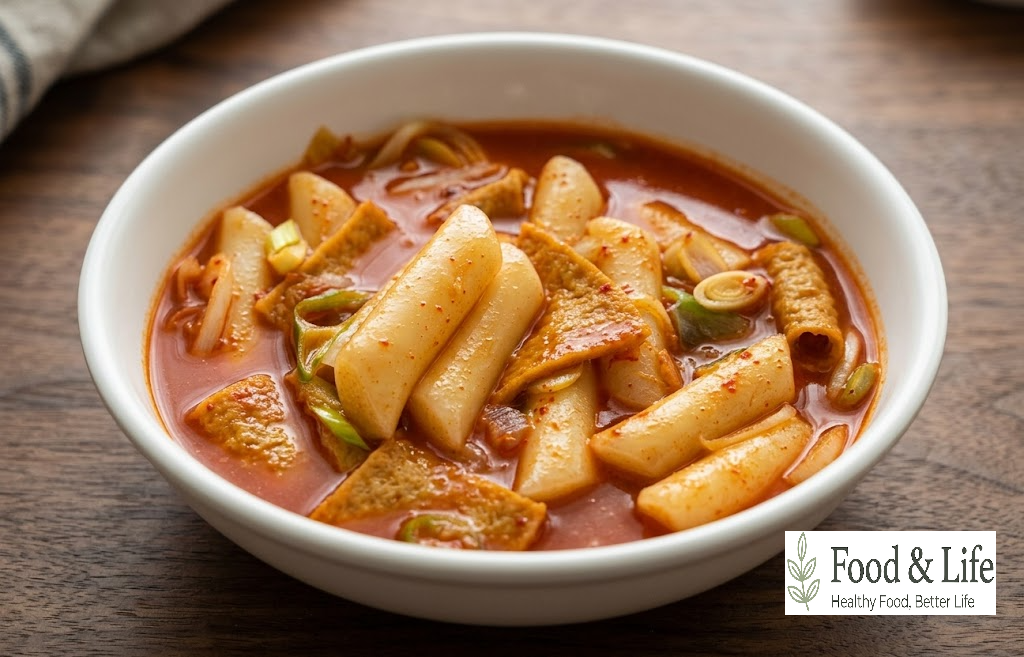
Sometimes you crave the sweet, spicy flavor of the old-school tteokbokki served at Korean snack shops rather than the extra-bold versions that are popular today. This easy Tteokbokki recipe, inspired by Korean chef Jung Ho-young, skips a separate stock and simmers fish cakes with the rice cakes so their savory flavor seasons the broth naturally. Gochujang and gochugaru create the familiar Korean street-food sauce, while a little potato starch thickens the broth so it clings beautifully to every piece of tteok and fish cake. Enjoy a nostalgic bowl of chewy rice cakes, tender fish cakes, and a thick, sweet-and-spicy sauce.
⏱️ Cooking Time: About 15 minutes
🍳 Difficulty: ★☆☆☆☆ Easy
✓ Ingredients
🥣 Main Ingredients
- 400 g (14.1 oz) tteokbokki rice cakes
- 4–7 square Korean fish cake sheets
- 1 large green onion
- 1 L (33.8 fl oz) water
- 1 tbsp potato starch
🧂 Sauce & Seasonings
- 2 tbsp gochugaru (Korean red pepper flakes)
- 4 tbsp sugar
- 1 tbsp regular soy sauce
- 2 tbsp gochujang (Korean red chili paste)
- 1/2 tbsp Miwon (MSG seasoning)
- 1/2 tbsp beef Dashida seasoning
(Measurement guide: 1 tbsp = 15 ml, 1 tsp = 5 ml, 1 Korean paper cup = 180 ml / 6.1 fl oz)
✓ How to Make Classic Korean Tteokbokki
- Prepare the ingredients: Rinse the rice cakes briefly under running water and drain. Cut each square fish cake sheet into 4 large pieces, and slice the green onion diagonally into thick pieces.
- Add the rice cakes and fish cakes to the pot: Pour 1 L (33.8 fl oz) water into a pot and add the rice cakes and fish cakes from the beginning. Starting the fish cakes in the water allows their savory flavor to infuse the broth as it cooks.
- Add the seasonings and boil: Add 2 tbsp gochugaru, 4 tbsp sugar, 1 tbsp soy sauce, 2 tbsp gochujang, 1/2 tbsp Miwon, and 1/2 tbsp beef Dashida. Bring everything to a vigorous boil over high heat.
- Prepare the starch mixture: Place 1 tbsp potato starch in a bowl. Ladle in some of the hot tteokbokki broth and stir quickly until the starch is completely smooth with no lumps.
- Thicken the sauce: When the tteokbokki is bubbling strongly, slowly pour the starch mixture evenly into the pot while stirring with a spatula. Continue stirring until the broth becomes thick and glossy. The starch helps the spicy-sweet sauce cling closely to the rice cakes and fish cakes.
- Add the green onion: Add the thickly sliced green onion and simmer for another 1–2 minutes, just until it begins to soften. Serve hot.
✓ Key Tip for Thick, Glossy Tteokbokki Sauce
- Add the starch mixture only when the broth is actively bubbling, then stir quickly and continuously. This helps the starch disperse evenly and creates the thick, glossy sauce associated with classic Korean snack-shop tteokbokki.
✓ Serving Tips
- Serve with hard-boiled eggs and mash the yolk into the tteokbokki sauce for an extra-rich bite.
- Korean fried snacks such as gimmari (fried seaweed rolls), fried dumplings, or fried squid are especially good dipped into the thick sauce.
- You can use chewy wheat tteok instead of rice tteok. If using wheat tteok, reduce the water by about 100 ml (3.4 fl oz) to keep the seasoning balanced.
✓ How to Choose Good Tteokbokki Rice Cakes
- Check the appearance and color: Choose rice cakes with an even, clean white color and no dark spots or visible foreign material. Avoid pieces that look dried out, cracked, or split.
- Check the surface and texture: The surface should feel smooth rather than sticky or slimy, with a slightly springy and chewy texture.
- Check the aroma and packaging: After opening the package, the rice cakes should not have a sour, stale, or moldy smell. Check that the package is not swollen and that there is no excessive condensation inside.
✓ Garaetteok Nutrition per 100 g (3.5 oz)
| Nutrient | Amount per 100 g (3.5 oz) |
|---|---|
| Calories | 213.00 kcal |
| Carbohydrates | 48.80 g |
| Protein | 3.71 g |
| Fat | 0.37 g |
| Sodium | 261.00 mg |
Values are based on 100 g (3.5 oz) of garaetteok made from non-glutinous rice. Actual nutrition may vary depending on variety, product, and cooking method.
Source: Ministry of Food and Drug Safety (Korea) – Food Nutrition Database, Raw Ingredients
✓ Frequently Asked Questions (FAQ)
Q1. Can I mix the potato starch with hot tteokbokki broth instead of cold water?
Yes. Add a small amount of the hot broth to the bowl of potato starch little by little while stirring quickly until completely smooth. Once there are no lumps, pour the mixture into the bubbling pot while stirring.
Q2. Why does my tteokbokki sauce become too salty or the rice cakes get too soft?
If you boil the tteokbokki uncovered over high heat for too long, the water evaporates quickly and the sauce becomes concentrated. Once the rice cakes are soft, add the starch mixture, reduce the heat to medium-low, and add about 1/2 cup water if needed to adjust the consistency and seasoning.
Q3. Can I make this without Miwon and Dashida?
Yes. You can use a strongly flavored anchovy-kelp broth instead of the seasonings. However, a small amount of Miwon and Dashida gives this recipe the distinctive savory flavor associated with old-school Korean snack-shop tteokbokki.
You do not need to make a separate stock to enjoy a thick and flavorful bowl of classic Korean Tteokbokki. With rice cakes, fish cakes, and a few familiar Korean seasonings, you can recreate the sweet, spicy, and savory flavor of an old-school Korean snack shop in about 15 minutes.
Serve it with hard-boiled eggs and crispy fried snacks for dipping into the thick sauce whenever you are craving nostalgic Korean street food.
If you found this recipe helpful, please bookmark it and share it with anyone who enjoys easy Korean recipes.
I’ll continue sharing approachable Korean recipes and practical cooking tips that make Korean food easier to recreate at home. 😊
If there’s a Korean dish or recipe you’d like to see next, feel free to leave a comment! 😊