
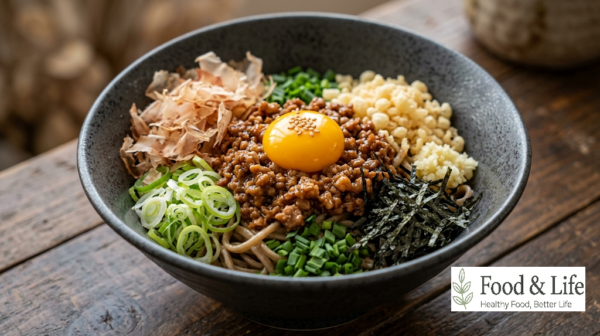
Mazesoba is a Japanese-style mixed noodle dish tossed with savory ground pork seasoned with doubanjiang and chewy wheat noodles. Unlike ramen, it is served without broth, allowing the rich meat topping, egg yolk, aromatic oils, and fresh garnishes to coat every strand of noodle.
This mazesoba recipe uses 150 g (5.3 oz) ground pork per serving, cooked with sugar, sake, cooking wine, soy sauce, and doubanjiang until most of the moisture has evaporated and the seasoning becomes concentrated. The noodles are topped with garlic chives, scallions, green onion, shredded nori, bonito flakes, and an egg yolk, then finished with sesame oil and chili oil for a rich, savory, and mildly spicy flavor.
With chewy noodles, deeply seasoned pork, and crisp fresh garnishes in every bite, this makes a satisfying one-bowl noodle meal.
⏱️ Cooking Time: About 20 minutes
🍳 Difficulty: ★★☆☆☆
✓ Ingredients (1 Serving)
🥣 Main Ingredients
- 1 serving Chinese-style wheat noodles
- 150 g (5.3 oz) ground pork
- 3–4 scallions
- 1/2 large green onion
- 1/2 handful garlic chives
- 1 egg yolk
- Tempura crumbs, to taste
- Shredded nori, to taste
- Bonito flakes, to taste
- A small amount of sesame seeds
🧂 Sauce & Seasonings
- A small amount of cooking oil
- 1/2 tbsp sugar
- 1 tbsp sake
- 1 tbsp cooking wine
- 2/3 tbsp soy sauce
- 1/2 tbsp doubanjiang
- 1/2 tbsp sesame oil
- 1/2 tbsp chili oil
(Measurement guide: 1 tbsp = 15 ml, 1 tsp = 5 ml, 1 paper cup = 180 ml / 6.1 fl oz)
✓ How to Make Mazesoba
- Cook the ground pork: Add a small amount of cooking oil to a skillet and add 150 g (5.3 oz) ground pork. Cook over medium heat, breaking it apart as you stir, until no pink remains.
- Add the seasonings and reduce: Once the pork is cooked through, add 1/2 tbsp sugar, 1 tbsp sake, 1 tbsp cooking wine, and 2/3 tbsp soy sauce. Stir-fry briefly, then add 1/2 tbsp doubanjiang. Continue cooking over medium-low heat until the pork is evenly seasoned and most of the liquid has evaporated.
- Cook the noodles: Add 1 serving of Chinese-style wheat noodles to boiling water and cook according to the package directions. Drain in a colander, rinse briefly under cold water, and drain thoroughly.
- Prepare the fresh toppings: Wash 1/2 handful garlic chives, 3–4 scallions, and 1/2 large green onion. Finely chop them into even pieces.
- Assemble the noodles and toppings: Place the well-drained noodles in a bowl. Arrange the seasoned pork, garlic chives, scallions, green onion, tempura crumbs, shredded nori, and bonito flakes neatly over the noodles.
- Finish with egg yolk and oils: Place 1 egg yolk in the center, sprinkle with a small amount of sesame seeds, then drizzle evenly with 1/2 tbsp sesame oil and 1/2 tbsp chili oil.
✓ Key Tips for Success
- Cook off the moisture from the pork: If too much liquid remains after adding the doubanjiang and other seasonings, the sauce may not cling well to the noodles. Cook the pork over medium-low heat until most of the moisture has evaporated and the rendered oil becomes more visible for a richer, more concentrated flavor.
- Drain the noodles thoroughly: Excess water left on the cooked noodles can dilute the seasoning and prevent the sesame oil and chili oil from coating them properly. Shake the colander well and remove as much moisture as possible before assembling the bowl.
✓ Serving Tips
- After finishing the noodles, add a spoonful of warm rice to any remaining pork seasoning in the bowl and mix well for a satisfying finish.
- If you do not have tempura crumbs, lightly crush a crunchy savory snack such as Goraebab and sprinkle it on top to add a crisp texture.
- After eating about half of the noodles, you can add 1/2 tbsp vinegar or kombu vinegar to taste. Mix well to give the rich, oily flavors a brighter finish.
✓ How to Choose Fresh Pork
- Color: Look for pork with a clear pinkish-red color and a moist sheen without a sticky surface.
- Fat: Choose pork with firm, milky-white fat that is evenly distributed through the lean meat.
- Firmness and moisture: Fresh pork should spring back when gently pressed. Avoid packages with a large amount of blood or meat juices collected at the bottom.
✓ Pork Leg Nutrition per 100 g (3.5 oz)
| Nutrient | Amount per 100 g (3.5 oz) |
|---|---|
| Calories | 135.00 kcal |
| Carbohydrates | 0.00 g |
| Protein | 20.88 g |
| Fat | 4.97 g |
| Sodium | 48.00 mg |
Based on 100 g of raw pork leg. Actual nutrition values may vary depending on the breed, cut, product, and cooking method.
Source: Ministry of Food and Drug Safety Food Nutrition Database – Raw Food Ingredients
✓ Frequently Asked Questions (FAQ)
Q1. Can I use udon or other noodles instead of Chinese-style wheat noodles?
Yes. Udon or ramen noodles also work well with the seasoning. Since the ground pork and finely chopped toppings need to cling to the noodles, thicker, springier noodles work better than very thin somyeon.
Q2. What can I use instead of doubanjiang?
If you do not have doubanjiang, you can stir-fry the pork with 1/2 tbsp gochujang instead. Gochujang will give the pork a different but similarly spicy, thick seasoning that coats the meat well.
Q3. What should I do if my mazesoba feels too dry when mixing?
Add 1–2 tbsp of noodle cooking water or warm water and mix again. The egg yolk, sesame oil, and chili oil already help coat the noodles, so only a small amount of extra liquid is needed to make the mixture smoother.
Cooking the pork until the liquid had almost completely evaporated gave the doubanjiang and soy sauce seasoning a deep, savory flavor that paired naturally with the chewy noodles. Once the egg yolk was broken and mixed with the sesame oil and chili oil, the pork seasoning coated the noodles smoothly, while the finely chopped garlic chives, scallions, and green onion added fresh aroma and crisp texture. The bonito flakes and shredded nori brought even more layers of flavor and texture to the bowl.
If you want to make a different kind of Japanese mixed noodle dish at home or are craving noodles with a rich meat topping, try this mazesoba recipe with doubanjiang pork. Once the noodles are gone, mixing a little warm rice into the remaining pork topping is also a satisfying way to finish the meal.
Save or bookmark this recipe so you can easily find it again, and share it with someone who enjoys Japanese noodle dishes.
More easy-to-follow recipes and practical cooking tips are coming soon. If there is a dish you would like to see featured next, feel free to leave a comment. 😊