
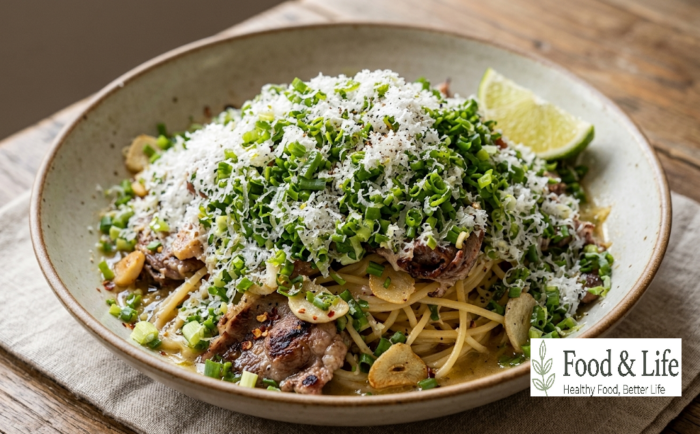
If you’re craving an oil pasta with a richer, more savory twist, chadolbaegi pasta (Korean beef brisket pasta) makes a satisfying and flavorful one-bowl meal.
The key to this Korean beef brisket pasta recipe is searing the thinly sliced beef first, then sautéing garlic in the rendered beef fat. The pasta is finished directly in a broth made with 100 ml (3.4 fl oz) water and 10 ml rice noodle soup base, allowing the noodles to absorb plenty of savory flavor. Peperoncino and butter add depth, while scallions, garlic chives, and a splash of lime juice brighten up the richness of the beef.
The result is a fusion-style oil pasta with springy noodles, savory seasoning, and the rich flavor of seared beef brisket.
⏱️ Cooking Time: About 20 minutes
🍳 Difficulty: ★★☆☆☆
✓ Ingredients
🥣 Main Ingredients
- 110 g (3.9 oz) pasta (No. 11 spaghettini)
- Chadolbaegi (thinly sliced beef brisket), as needed
- 6 whole garlic cloves
- 5 scallions
- A small amount of Korean garlic chives
🧂 Seasonings & Sauce
- Olive oil, as needed
- 100 ml (3.4 fl oz) water
- 10 ml rice noodle soup base
- 3 peperoncino chilies
- 10 g (0.35 oz) butter
- Black pepper, to taste
- A small amount of lime or lemon juice
- Parmesan cheese, as needed
(Measurement guide: 1 tbsp = 15 ml (0.5 fl oz), 1 tsp = 5 ml (0.17 fl oz), 1 Korean paper cup = 180 ml (6.1 fl oz))
✓ How to Make Korean Beef Brisket Pasta
- Prepare the ingredients: Finely slice 5 scallions and a small amount of Korean garlic chives. Slice 6 garlic cloves into fairly thick pieces so they do not burn too quickly while cooking.
- Cook the pasta: Add 110 g (3.9 oz) No. 11 spaghettini to boiling water and cook for 3 minutes 50 seconds. Drain, drizzle with a small amount of olive oil, and toss gently to keep the noodles from sticking together.
- Make the rice noodle broth: Combine 100 ml (3.4 fl oz) water with 10 ml rice noodle soup base and stir well.
- Sear the beef brisket: Heat a skillet over high heat and quickly sear the desired amount of chadolbaegi. Transfer only the beef to a plate, leaving the rendered fat in the skillet.
- Sauté the garlic: Add the sliced garlic to the beef fat and cook over medium heat until lightly golden and aromatic.
- Add the broth and pasta: Once the garlic is golden, add the prepared broth made with 100 ml water and 10 ml rice noodle soup base, the cooked 110 g pasta, and 3 peperoncino chilies. Cook over medium heat until the liquid reduces and is absorbed into the noodles.
- Finish with butter and olive oil: When most of the broth has reduced, add 10 g (0.35 oz) butter and stir until the noodles are evenly coated. Drizzle in a small amount of olive oil and toss lightly for a glossy finish.
- Plate the pasta and beef: Arrange the finished pasta neatly on a plate. Place the seared beef brisket on top, then generously cover the beef with the sliced scallions and garlic chives.
- Add the finishing toppings: Sprinkle with a little black pepper and lime or lemon juice, then grate a generous amount of Parmesan over the top until the pasta is lightly covered like snow.
✓ Key Tips for Success
- Do not fully cook the pasta in the pot: If the pasta is cooked completely before it goes into the skillet, it can become too soft while reducing in the broth. Boil it for only about 3 minutes 50 seconds, then finish cooking it in the rice noodle broth so the noodles stay pleasantly al dente while absorbing the savory flavor.
- Control the heat when adding butter: If too much liquid remains or the skillet is excessively hot, the butter may separate from the sauce. Wait until most of the broth has been absorbed, then lower the heat or use the residual heat and stir in the butter quickly so it emulsifies and coats the noodles.
✓ Serving Tips
- Add nước mắm if you like: Just before eating, drizzle 1–2 tsp nước mắm over the pasta and mix it in for an even deeper savory flavor and a more Southeast Asian-inspired finish.
- Top with fresh cilantro: If you enjoy cilantro, finely chop a generous amount and add it along with the scallions and garlic chives. Its fresh aroma helps balance the richness of the beef.
- Mix everything together before eating: Toss the Parmesan, scallions, garlic chives, beef brisket, noodles, and sauce from the bottom of the plate together so every bite gets a balanced mix of fresh allium flavor, savory beef juices, and sauce.
✓ How to Choose Good Chadolbaegi
- Meat color: Look for beef with a bright reddish color and a natural sheen on the surface.
- Fat color: The fat between the lean meat should be clean, milky white, and slightly glossy.
- Texture and grain: Choose beef that feels firm rather than soft, with a fine and even grain on the cut surface.
✓ Chadolbaegi Nutrition per 100 g (3.5 oz)
| Nutrient | Amount per 100 g (3.5 oz) |
|---|---|
| Calories | 408.00 kcal |
| Carbohydrates | 0.00 g |
| Protein | 16.45 g |
| Fat | 35.94 g |
| Sodium | 66.00 mg |
Based on 100 g of raw Grade 1 Hanwoo beef brisket (chadolbaegi). Actual nutrition values may vary depending on the breed, cut, product, and cooking method.
Source: Ministry of Food and Drug Safety Food Nutrition Database
✓ Frequently Asked Questions (FAQ)
Q1. Why is the pasta boiled for less time than usual?
The noodles continue cooking in the skillet with the rice noodle broth. Boiling them for only 3 minutes 50 seconds at first helps them finish with a pleasantly chewy, al dente texture instead of becoming too soft.
Q2. Doesn’t the rendered beef fat make the pasta too greasy?
The beef is seared and removed first, then the rendered fat is used to sauté the garlic and peperoncino. Lime or lemon juice, scallions, and garlic chives are added at the end to balance the richness with a fresher flavor.
Q3. Can I substitute another thinly sliced meat for chadolbaegi?
Yes. Thinly sliced beef belly or thinly sliced pork belly can be used instead, while still providing the rich rendered fat that works well with the savory rice noodle broth.
Following this recipe, the rich juices from the chadolbaegi and the salty, savory flavor of the rice noodle soup base soak evenly into the pasta, giving the noodles plenty of depth. The butter-coated noodles are balanced by the sharp freshness of scallions and garlic chives and the brightness of lime juice, so even a generous amount of beef does not feel overly heavy.
If you’re looking for something a little different from a classic oil pasta, this Korean beef brisket pasta is an easy fusion noodle dish worth trying. It works especially well for a weekend lunch or whenever you want a more unusual one-bowl meal.
Save or bookmark this recipe so you can easily find it again, and share it with someone who enjoys Korean-inspired cooking.
More easy-to-follow recipes and practical cooking tips will be added regularly. 😊
If there is a dish you are curious about or would like to see featured, feel free to leave a comment. 😊