
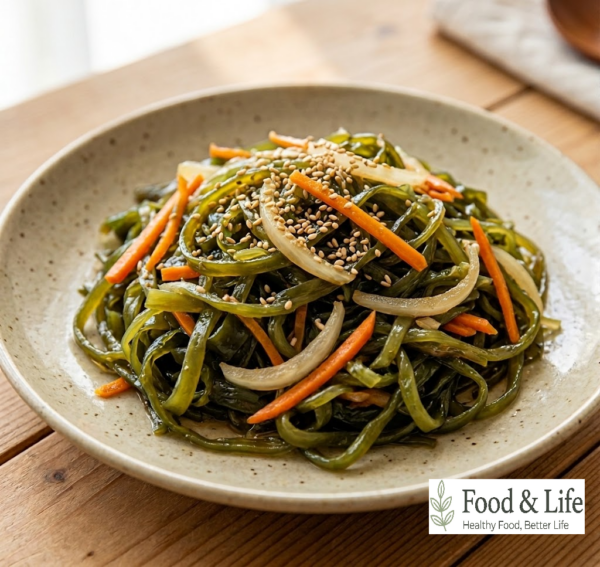
Salted seaweed stems need to be prepared properly to remove excess saltiness and their strong ocean aroma while keeping their pleasantly chewy texture.
For this Miyeok Julgi Bokkeum (Korean Seaweed Stem Stir-Fry), the salted seaweed stems are soaked in cold water for 30 minutes to draw out excess salt, tossed with soju, and then blanched in boiling water for only 10 seconds. This quick blanch helps reduce the strong seaweed aroma while preserving the firm, chewy texture. After squeezing out as much moisture as possible, the seaweed stems are stir-fried with vegetables in fragrant green onion and garlic oil so the seasonings coat everything evenly.
Savory soy sauce and nutty sesame oil bring the dish together, creating a chewy Korean side dish that pairs especially well with steamed rice.
⏱️ Cooking Time: About 45 minutes
🍳 Difficulty: ★★☆☆☆
✓ Ingredients
🥣 Main Ingredients
- 300 g (10.6 oz) salted seaweed stems
- 1/2 onion
- 1/4 carrot
- 1/3 stalk green onion
- 1 Cheongyang chili pepper
🧂 Sauce & Seasonings
- 1 shot soju
- 45 ml (3 tbsp) neutral cooking oil
- 15 ml (1 tbsp) minced garlic
- 15 ml (1 tbsp) cooking wine
- 45 ml (3 tbsp) regular soy sauce
- 7.5 ml (1/2 tbsp) sugar
- 15 ml (1 tbsp) sesame oil
- A small amount of sesame seeds
(Measurement guide: 1 tbsp = 15 ml, 1 tsp = 5 ml, 1 Korean paper cup = 180 ml / 6.1 fl oz)
✓ How to Make Korean Seaweed Stem Stir-Fry
- Rinse off the salt: Rinse 300 g (10.6 oz) of salted seaweed stems under cold running water 3–4 times, gently rubbing them with your hands to remove all the coarse salt from the surface.
- Soak to remove excess salt: Place the rinsed seaweed stems in plenty of cold water and soak for about 30 minutes to draw out the salt absorbed inside the stems.
- Toss with soju and blanch: Drain the soaked seaweed stems and shake off some of the excess water. Pour over 1 shot of soju and gently massage it through the stems. Add them to vigorously boiling water, blanch for exactly 10 seconds, and remove immediately.
- Cool, drain, and cut: Rinse the blanched seaweed stems under cold water until completely cooled. Squeeze firmly with your hands to remove as much moisture as possible, then cut into 5–6 cm (2–2.4 inch) lengths.
- Prepare the vegetables: Thinly slice 1/2 onion and 1/4 carrot lengthwise. Thinly slice 1/3 stalk green onion and 1 Cheongyang chili pepper.
- Make the aromatic oil: Heat 45 ml (3 tbsp) neutral cooking oil in a pan. Add the sliced green onion and 15 ml (1 tbsp) minced garlic, then gently stir-fry over medium heat without letting them burn until the oil becomes fragrant.
- Stir-fry the vegetables and seaweed stems: Once fragrant, add the carrot, seaweed stems, and onion. Pour in 15 ml (1 tbsp) cooking wine and stir-fry evenly over medium heat.
- Add the seasonings: When the onion begins to turn translucent, push the ingredients to one side of the pan. Add 45 ml (3 tbsp) regular soy sauce, 7.5 ml (1/2 tbsp) sugar, and the sliced Cheongyang chili pepper to the empty side. Let the seasoning bubble briefly, then mix everything together and continue stir-frying until evenly coated.
- Finish with sesame oil: Once the seaweed stems are evenly seasoned, turn off the heat. Drizzle with 15 ml (1 tbsp) sesame oil, toss using the residual heat, and finish with a small amount of sesame seeds.
✓ Key Tips for Success
- Blanch for only 10 seconds to reduce the strong seaweed aroma: Tossing the seaweed stems with soju before blanching helps reduce their distinctive ocean-like aroma as the alcohol cooks off. Do not blanch for longer than 10 seconds, as overcooking can soften the naturally firm and chewy texture.
- Remove enough salt before cooking: Simply rinsing the coarse salt from the surface is not enough because salted seaweed stems can still be very salty inside. Soak them in cold water for the full 30 minutes before cooking so the final seasoning stays balanced and coats the stems evenly.
✓ Serving Tips
- Adjust the heat: If you prefer more spice, add the Cheongyang chili pepper while stir-frying the vegetables, or use about 1/2 pepper more depending on your preference.
- Use it as a bibimbap topping: The nutty sesame aroma of miyeok julgi bokkeum pairs well with freshly cooked white rice, gochujang, and a fried egg for an easy bibimbap-style meal.
✓ How to Choose Good Seaweed
- Color: Choose seaweed with a vivid, deep dark green color and no yellowed or noticeably discolored areas.
- Texture: The stems should feel firm and springy when touched rather than soft or mushy.
- Aroma: Good seaweed should have a mild, natural ocean aroma without any stale or unpleasant smell.
✓ Seaweed Nutrition per 100 g (3.5 oz)
| Nutrient | Amount per 100 g (3.5 oz) |
|---|---|
| Calories | 12.00 kcal |
| Carbohydrates | 3.70 g |
| Protein | 1.68 g |
| Fat | 0.29 g |
| Sodium | 361.00 mg |
Based on raw seaweed per 100 g (3.5 oz). Actual nutrition values may vary depending on variety, part used, product, and cooking method.
Source: Ministry of Food and Drug Safety Food Nutrition Database
✓ Frequently Asked Questions (FAQ)
Q1. Why are the seaweed stems blanched for only 10 seconds?
Seaweed stems can lose their naturally firm, chewy texture and become soft if they are cooked for too long. Tossing them with soju and blanching them for exactly 10 seconds helps reduce the strong seaweed aroma while preserving their texture.
Q2. Why does a lot of water come out after stir-frying?
This can happen if the blanched seaweed stems are not squeezed thoroughly after rinsing, or if the heat is too low and the vegetables release too much moisture. Squeeze out as much water as possible and stir-fry quickly over medium-high heat for a cleaner, less watery result.
Q3. Can I use rice wine or cooking wine instead of soju?
You can use cheongju, a Korean rice wine, instead of soju to help reduce the strong seaweed aroma. Commercial cooking wines often contain added sweetness, so unsweetened soju or rice wine works best for this blanching step.
After soaking the salted seaweed stems thoroughly, tossing them with soju, and blanching them for exactly 10 seconds, the strong ocean aroma became milder while the stems kept their pleasantly chewy texture. Stir-frying them in fragrant green onion and garlic oil with savory soy sauce and nutty sesame oil created a clean, well-seasoned side dish that paired perfectly with rice.
I have sometimes found seaweed stem stir-fry either too salty or too soft, but this method produced a much more balanced result with a satisfying crunch and chew. My family also enjoyed it because the seaweed aroma was not overpowering and the seasoning coated the stems evenly.
If you want to make chewy Korean seaweed stem stir-fry without an overly strong ocean smell, soak the salted stems in cold water for 30 minutes, toss them with soju, and blanch them for only 10 seconds before stir-frying. It is a practical side dish to prepare when you want a simple Korean banchan to serve with everyday meals.
Save or bookmark this recipe for later, and give it a try the next time you want a chewy, savory Korean side dish. It is especially worth trying if you have found seaweed stems too salty or too soft in the past.
I’ll continue sharing approachable recipes and practical cooking tips that are easy to follow at home. 😊
If there is a dish you have been curious about or a recipe you would like to see next, feel free to leave a comment. 😊