
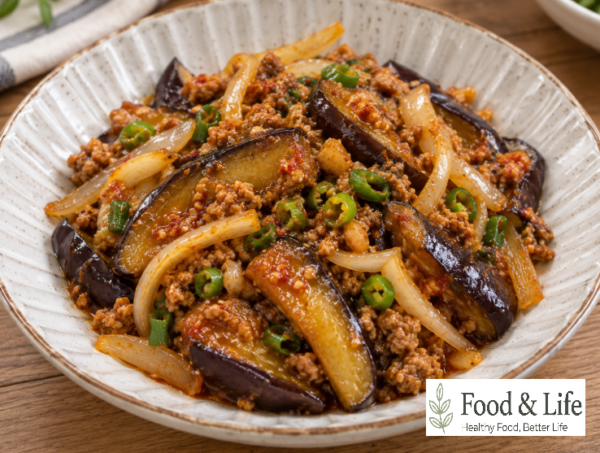
Eggplant can release a lot of moisture as it cooks, which often leaves it overly soft or watery. This Korean stir-fried eggplant recipe solves that problem by letting 2 eggplants sit with 1/2 tbsp salt and 2 tbsp corn syrup for about 20 minutes, then squeezing out as much moisture as possible before stir-frying.
The eggplant is cooked with minced pork in fragrant scallion oil, then coated in a savory, slightly spicy sauce made with soy sauce, gochugaru, oyster sauce, and garlic. The finished eggplant stays tender inside while retaining a pleasant bite, and the rich pork and bold seasoning make it especially good with steamed rice or served as a rice bowl.
⏱️ Cooking Time: About 30 minutes
🍳 Difficulty: ★★☆☆☆
✓ Ingredients
🥣 Main Ingredients
- 2 eggplants
- 50 g (1.8 oz) minced pork belly
- White part of 1 green onion
- 1/4 onion
- 1 Cheongyang chili pepper
🧂 Sauce & Seasonings
- 1/2 tbsp salt, for drawing moisture from the eggplant
- 2 tbsp corn syrup (mulyeot), for drawing moisture from the eggplant
- 1 tbsp soy sauce
- 2 tbsp gochugaru (Korean red pepper flakes)
- 1 tbsp cooking wine
- 1 tbsp oyster sauce
- 1/2 tbsp minced garlic
- Cooking oil, as needed
- 1 tbsp sesame oil
(Measurement guide: 1 tbsp = 15 ml, 1 tsp = 5 ml, 1 Korean paper cup = 180 ml / 6.1 fl oz)
✓ How to Make Korean Stir-Fried Eggplant
- Let the eggplant sit with salt and corn syrup: Cut the 2 eggplants diagonally into thick slices. Place them in a bowl, add 1/2 tbsp salt and 2 tbsp corn syrup, toss well, and let sit for about 20 minutes.
- Make the sauce: In a bowl, combine 1 tbsp soy sauce, 2 tbsp gochugaru, 1 tbsp cooking wine, 1 tbsp oyster sauce, and 1/2 tbsp minced garlic. Mix well and set aside.
- Prep the vegetables: Thinly slice the white part of 1 green onion. Slice 1/4 onion lengthwise into thin strips, and thinly slice 1 Cheongyang chili pepper.
- Squeeze out the eggplant: After 20 minutes, firmly squeeze the eggplant by hand to remove as much liquid as possible. Do not discard the liquid collected in the bowl; set it aside for later.
- Make the scallion oil: Add cooking oil to a skillet, then add the sliced green onion. Cook over medium-low heat until fragrant.
- Cook the pork: Once the scallion becomes aromatic, add 50 g (1.8 oz) minced pork belly. Break up any clumps and stir-fry over medium heat until the pork turns opaque and is cooked through.
- Add the onion and eggplant: Add the sliced onion and stir-fry briefly. Once the onion begins to turn translucent, add the squeezed eggplant.
- Add the sauce and stir-fry: Pour in all of the prepared sauce. Stir-fry quickly over medium heat, stirring constantly so the sauce coats the ingredients evenly without burning.
- Adjust the moisture and consistency: Taste the mixture. If it needs a little more sweetness or feels too dry, add 2 tbsp of the reserved eggplant liquid and stir-fry until evenly incorporated.
- Finish the dish: Add the sliced Cheongyang chili pepper and 1 tbsp sesame oil. Toss briefly, turn off the heat, and transfer to a serving dish.
✓ Key Tips for Success
- Remove as much moisture as possible: After letting the eggplant sit with salt and corn syrup, squeeze it very firmly by hand. Removing excess liquid helps prevent water from collecting in the skillet and keeps the eggplant from becoming overly soft.
- Use medium heat and cook quickly: Once the sauce is added, cooking too slowly over low heat can draw more moisture out of the vegetables. Stir-fry briefly over medium heat so the sauce coats the eggplant evenly without making the dish watery.
✓ Serving Tips
- Spoon the stir-fried eggplant generously over hot rice and top it with a fried egg with a runny yolk for an easy eggplant rice bowl.
- You can also spoon the stir-fried eggplant over cooked somyeon (thin Korean wheat noodles) or pasta and toss everything together for a different way to enjoy it.
- For extra heat, adjust the amount of Cheongyang chili pepper to your preference.
✓ How to Choose Fresh Eggplant
- Surface and firmness: Look for eggplants with an even, well-formed shape and smooth skin without visible damage. They should feel firm and springy rather than soft when gently pressed.
- Color and shine: Choose eggplants with a vivid, deep purple-black color and a naturally glossy surface.
- Stem and calyx: The stem should look fresh and green rather than dry. Sharp, well-defined points around the calyx are also a sign of freshness.
Source: Rural Development Administration Nongsaro – How to Choose Good Eggplant
✓ Eggplant Nutrition per 100 g (3.5 oz)
| Nutrient | Amount per 100 g (3.5 oz) |
|---|---|
| Calories | 19.00 kcal |
| Carbohydrates | 4.36 g |
| Protein | 1.13 g |
| Fat | 0.03 g |
| Sodium | 0.00 mg |
Values are based on 100 g (3.5 oz) of raw eggplant. Actual nutritional values may vary depending on variety, portion, product, and cooking method.
Source: Ministry of Food and Drug Safety Food Nutrition Database
✓ Frequently Asked Questions (FAQ)
Q1. Why do you let the eggplant sit with both salt and corn syrup?
Salt and corn syrup help draw excess moisture out of the eggplant through osmosis, which helps prevent it from becoming overly soft when stir-fried. This step also lightly seasons the eggplant and adds a subtle sweetness before cooking.
Q2. Why does so much water collect in the skillet when I stir-fry eggplant?
This usually happens when the eggplant has not been squeezed thoroughly enough or when it is cooked too long over low heat. Squeeze out as much liquid as possible after the 20-minute resting time, then stir-fry quickly over medium heat.
Q3. Can I use something other than minced pork belly?
Yes. You can substitute ground beef, ground chicken breast, or finely chopped mushrooms. However, the rendered fat from pork belly pairs especially well with the scallion oil and gives the original recipe its rich, savory flavor.
Letting the eggplant sit with salt and corn syrup for 20 minutes and thoroughly squeezing out the moisture gives this dish a noticeably different texture from softer versions of stir-fried eggplant. The eggplant remains tender while keeping a pleasant bite, and the savory pork, fragrant scallion oil, and spicy-sweet sauce make it an easy side dish to serve with hot rice.
If your stir-fried eggplant usually turns watery or too soft, try this Korean stir-fried eggplant recipe with the moisture-removal step. It works well as a simple side dish or as a complete eggplant rice bowl topped with a fried egg.
Save or bookmark this recipe so you can easily find it later, and share it with someone who enjoys Korean home cooking.
More approachable recipes and practical cooking tips are coming, so feel free to leave a comment with any dishes you would like to see next.